
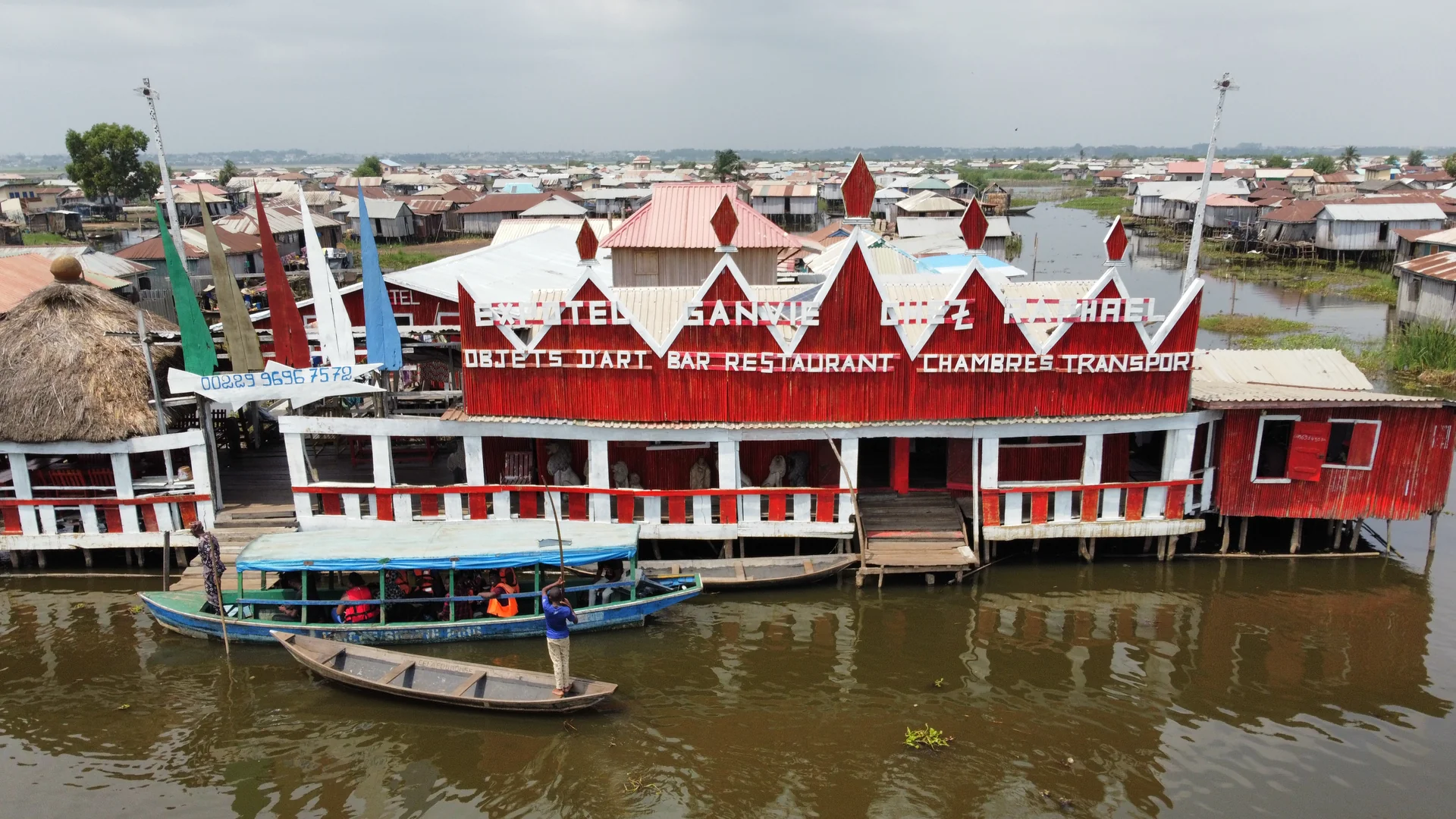
Sleeping on the water in Ganvié transforms a day trip into cultural immersion. Stilt guesthouses cost 15,000 to 50,000 FCFA per night with solar lighting, mosquito nets and bucket showers. The dawn market and sunset over the lake are exclusive to overnight guests.
For most visitors to Benin, Ganvié is a half-day stop. Arrive under the sun of mid-morning, cross by motorized pirogue, photograph the floating market, and return to Cotonou before the heat becomes overwhelming. But staying only during the day means missing what makes the stilt city genuinely singular.
When the tourist boats leave at around 5 pm, the lake transforms. The engine noise fades. The water surface settles. Children play on wooden terraces. Fishermen prepare their nets by lantern light. The only sounds left are water lapping against the stilts and voices crossing the lake from one pirogue to another in the evening calm.
Choosing a hotel in Ganvié — a stilt guesthouse run by a Tofinu family — is how you access this version of the city. It is also the choice that keeps your money in the community rather than with a Cotonou tour operator.
Family guesthouses cost 15,000 to 25,000 FCFA per night including dinner and breakfast. Eco-lodges: 25,000 to 40,000 FCFA. Premium stilt rooms: 40,000 to 50,000 FCFA. Solar lighting, mosquito nets and bucket showers are standard. The wholesale fish market begins at 4 am — accessible only to overnight guests.
Why staying overnight changes the Ganvié experience
 A day trip from Cotonou shows you Ganvié between 7 and noon, in morning light, alongside other visitors. That is a real visit — the floating market exists, the Acadja structures are there, the stilt houses are authentic. But it is a slice of Ganvié, not the whole.
What an overnight stay gives you that a day trip cannot:
The dawn wholesale market. At 4 am, the fishermen who have worked all night on their Acadja arrive at the wholesale market. Dozens of pirogues converge in the dark, their kerosene lamps reflected in the black water. Fish are sorted, weighed, and sold to the women vendors who will distribute them at the retail market. This wholesale phase ends before sunrise. No day trip will ever take you there.
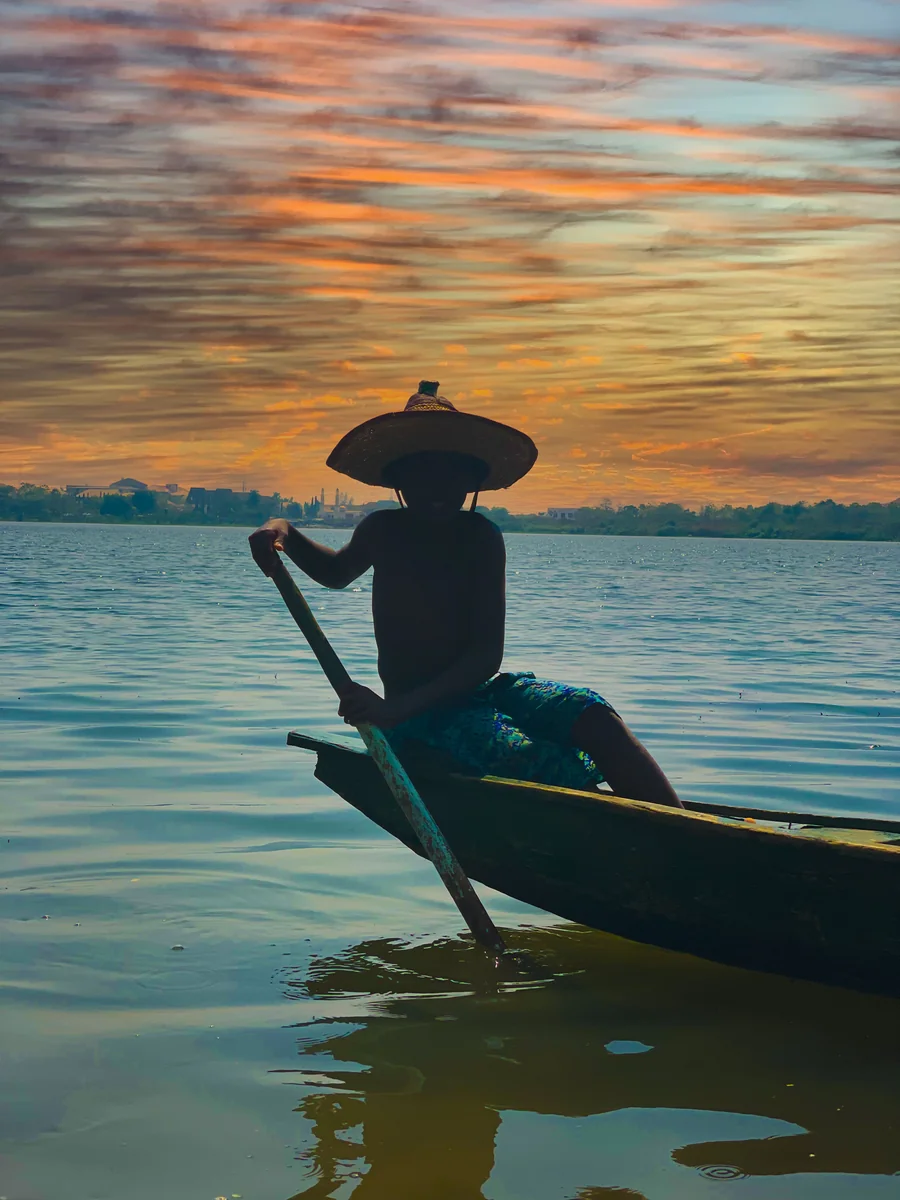
The sunset on the lake. The late-afternoon light on Lake Nokoué is in a different category from the morning light. Copper tones on the corrugated iron roofs, silhouettes of returning fishing pirogues, the lake surface shifting from gold to violet in twenty minutes. Day-trip boats are already headed back to the embarcadère.
Ganvié without tourists. After 5 pm, the lake city becomes what it is: a community of 30,000 people who live, cook, repair, talk, and sleep on the water. Conversations between terraces happen without the self-consciousness of cameras. Children dive from wooden staircases. Evening is a different reality.
Understanding a water economy. Sleeping in a family guesthouse, eating what the family fished that morning, being part of the departure for the market before dawn — these are accesses to Ganvié's economic logic that a three-hour circuit cannot simulate.
Three types of accommodation on the lake
Ganvié has no chain hotels and no resorts. All accommodation is built on stilts above the lake, connected to neighbours by wooden walkways. Three categories coexist.
Family-run guesthouses (local comfort)
These are family homes converted with one to four guest rooms. The family lives on site — you share their living space, their meals, and sometimes their pirogue for the morning market.
Price: 15,000 to 25,000 FCFA per night, dinner and breakfast included.
What you get: a room with a firm mattress and mosquito net, solar lighting sufficient for reading until 10 pm and charging a phone, a shared bucket shower and an outdoor latrine or a terrace toilet. Meals are prepared by the family with fish caught that same day — no menu, no choice between dishes, but genuine cooking made with what's available.
The distinctive advantage: access to Tofinu family life. The host will show you how she smokes fish, invite you to accompany her to market at 5 am, answer your questions about the neighbourhood's history. There is no reception desk, no fixed check-in time, and often no lock on the door — because trust, in a community where everyone knows each other, is the default.
The compromise: less physical comfort. Bucket showers are the norm. Solar electricity is sufficient but not abundant. The nocturnal noise of the lake — wood creaking, water lapping, neighbours' conversations — can disturb light sleepers.
Eco-lodges (intermediate comfort)
Two or three establishments on the lake have invested in better infrastructure without losing their stilt-house character. Solar panels with storage batteries (more reliable electricity until midnight), dedicated shower cabins with gravity-fed running water, a restaurant terrace separate from the sleeping area.
Price: 25,000 to 40,000 FCFA per night.
What you get: rooms built to a higher standard, better quality bedding, the reliability of a semi-private bathroom. The general logic remains the same: you are on stilts, without air conditioning, hot water, or glass windows. But the finish level is noticeably above the family guesthouses.
For whom: travelers who want the Lake Nokoué experience without sacrificing basic physical comfort. Or those coming as a couple who prefer a private bathroom.
Premium stilt rooms
A handful of rooms at the upper end offer private bathrooms with flush toilets (lake water, pumped and filtered), 24-hour solar electricity, and a private terrace with direct lake views.
Price: 40,000 to 50,000 FCFA per night.
What to know: even at this level, the experience is rustic compared to urban hotel standards. No room service, no minibar, no air conditioning. The premium is justified by better construction quality, greater privacy, and a host who speaks French or English fluently. If you're coming to live Ganvié rather than escape discomfort, family guesthouses offer an immersion that premium rooms cannot replicate.
What to expect in detail
The bucket shower
All family guesthouses use lake water, pumped by electric or manual pump and stored in an overhead tank. The water heats in the sun during the day — expect a warm shower in the late afternoon and a cool one in the morning. The standard system is the calabash or plastic scoop: you pour water over yourself.
Soap and shampoo are not provided. Bring biodegradable products — shower water returns to the lake, and what you put in it stays there.
Solar electricity
Solar power is the only energy source throughout most of Ganvié. Standard guesthouse capacity handles LED lighting and phone charging from dusk until around 10 pm, sometimes midnight in eco-lodges. After that, lights dim or go out.
Bring a power bank charged from Cotonou if you use your phone at night or have camera equipment that needs extended charging. Most family guest rooms have no power sockets — charging happens at a shared central point.
Food
Dinner is almost always included in the room price. It consists of fresh fish from the lake — tilapia or capitaine grilled over charcoal, served with rice, fried plantains, or boiled cassava according to the season. Tomato sauce made with market tomatoes and peppers accompanies the fish as standard.
Vegetarian options are available on prior request. The selection is limited to vegetable sauce, rice, and eggs — but it's manageable if you flag your diet at the time of booking.
Breakfast is bread or fried dough fritters with coffee or tea. Lunch is not typically included but can be arranged for 3,000 to 5,000 FCFA extra.
The dawn market: the overnight guest's privilege
The Ganvié floating market operates in two clearly distinct phases. The retail market — what day visitors see — begins around 6:30 am and ends near noon. But before that comes the wholesale phase.
At 4 am, the fishermen who have worked all night on their Acadja arrive with their catch. The vendor women are already on the water, pirogues ready, lamps lit. The transaction is rapid: fish are sorted by species and size, weighed on portable scales, and sold wholesale before heat affects the freshness of the catch.
The scene is extraordinary. Dozens of pirogues converge in the dark, their kerosene lamps and solar lanterns reflected in the black water. Voices negotiate in Fon and Goun. Fish is sorted by flashlight. By 6 am, the wholesale trade is done and the retail market takes over.
This alone is a reason to spend the night. No day trip from Cotonou can deliver this.
Set your alarm for 5:30 am
The sun rises over the eastern shore of Lake Nokoué and the light moves across the stilt houses in sequence — rooftops first, then terraces, then the water below. This lasts about fifteen minutes and is the quietest moment of the day. The wholesale market is nearly over, the retail market hasn't started. The lake surface is perfectly flat.
Nights on the water: sounds and sensations
Spending a night in Ganvié is also an auditory and sensory experience with no urban equivalent.
The lake doesn't really sleep. At any hour of the night you will hear sounds: the regular lapping of water against the stilts, the creak of floorboards under the house's weight as the water rises or falls slightly, a pirogue passing through the neighbouring canal at 2 am (a fisherman leaving early). The lake is alive even when everything seems quiet.
Mosquitoes are active between dusk and dawn. The mosquito net is essential — check its condition before lying down. A skin repellent is recommended for the moments you step out onto the terrace in the evening.
Night temperatures are pleasant in the dry season (November to March). In the rainy season, the humid heat can make sleep more difficult, especially in rooms without ventilation. Some intermediate-level guesthouses have solar-battery fans.
How to choose and book a hotel in Ganvié
The best way to book a stilt guesthouse is through a Ganvié-based local operator rather than international booking platforms.
Why a local operator: they know which guesthouses have available rooms on any given night. They arrange your pirogue transfer from Abomey-Calavi to the guesthouse. They negotiate the best rates because they work directly with the families. They ensure your host speaks your language or can arrange a translator.
Why not Booking.com or Airbnb: the two or three properties listed on these platforms have prices 30 to 50% higher due to commission. A room listed at 60,000 FCFA on Booking.com can cost 35,000 FCFA when booked directly through a local guide. And the commission money leaves Benin, not staying in the community.
Our recommendation: The safest and most comfortable way to experience this is to let us organize your overnight stay. Organizing an overnight stay yourself is a logistical challenge: you'll have to pay for the outbound transfer, negotiate the return transfer the next day, carry your bags on crowded docks, and find where to eat.
The advantage of booking with us
By letting us organize your stay, all logistics are erased. The price is fixed and transparent, we handle your transfer securely, and you don't have to worry about meals or touts. You can simply enjoy the sunset and the lake. Contact us to organize your custom stay.
Practical checklist for your night on the lake
Prepare your bag the evening before. Some non-negotiables:
- Charged power bank — solar electricity is limited after 10 pm
- Headlamp or flashlight — the walkways between houses are unlit at night
- Mosquito repellent — active at dusk and dawn on the lake
- Biodegradable soap and shampoo — shower water goes into the lake
- Toilet paper and hand sanitizer — not provided in family guesthouses
- Cash in small bills — no card payment in Ganvié (500 and 1,000 FCFA)
- Light long-sleeved clothing — sun protection during the day, mosquito protection at night
- Earplugs — if you are a light sleeper, the lake has its natural nocturnal sounds
Questions fréquentes
How much does a hotel in Ganvié cost per night?
Is there electricity in Ganvié guesthouses?
Do Ganvié guesthouses have running water and toilets?
Can I book a Ganvié guesthouse online?
What time does the dawn market start and can I see it?
The Secret Guide to Ganvié: Hidden Gems & Etiquette
Discover the authentic Ganvié far from the tourist crowds. Download our exclusive PDF to prepare a respectful and unforgettable visit.
We respect your inbox. No spam.
The Visit Ganvié Team
Written by native Tofinu guides. We have navigated Lake Nokoué since childhood to share the true history of our city, far from tourist traps.
Related articles
Photographing Ganvié: technical tips and best photo spots
Ganvié, Benin's stilt village on Lake Nokoué, offers unique photographic opportunities. From dawn light to aerial shooting rules, a complete guide to photographing Ganvié with respect.
supportDinner on water at Ganvié: a nighttime food experience on Lake Nokoué
Dinner on the water at Ganvié turns an evening into an unforgettable memory. A floating restaurant under moonlight, grilled fish from the lake and starry skies above the stilt city.