
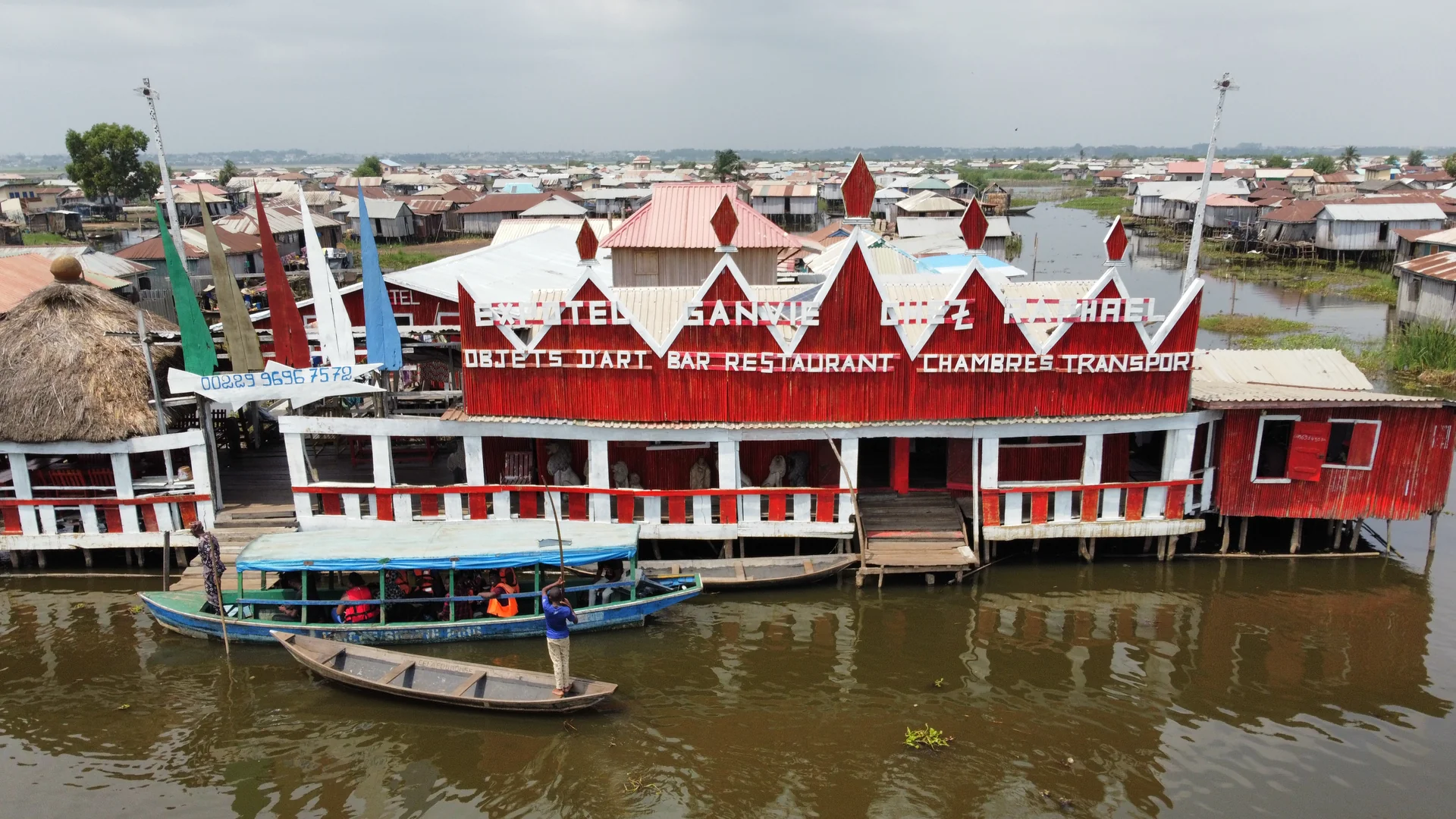
Spending the night on Lake Nokoué transforms your Ganvié experience: dawn market at 4 AM, dinner on a stilt terrace under the stars, and Tofinu ancestral legends told in the dark.
For the day-tripper, Ganvié is a burst of colour under a blazing sun: pirogues crossing in the channels, floating markets in full swing, stilt structures that seem to defy physics. But for those who choose not to return to Cotonou at dusk, the true face of the lake city only reveals itself when shadows lengthen over the waters of Lake Nokoué. Ganvié by night is not a darker version of the day. It is an entirely different city that awakens — calmer, slower, steeped in a spirituality that daytime visitors never perceive.
Around 5 PM, the last motorized pirogues head back to Abomey-Calavi. The engine noise fades across the water. What remains is not silence but a different kind of sound: the lake itself, the creak of platforms, children on wooden terraces, women lighting charcoal fires, fishermen checking their nets before the night's work. The shift from commercial Ganvié to domestic Ganvié happens in twenty minutes, and only overnight guests witness it.
Spending a night on the lake is the most transformative decision a visitor can make. It changes your relationship with the city: you stop being an observer and become a participant. First check our practical guide to getting to Ganvié from Cotonou, then plan to stay.
Ganvié by night means the wholesale fish market at 4 AM when vendor women arrive by pirogue, dinner on a stilt terrace under an unobstructed starry sky, and Tofinu founding legends told by elders in the dark. An immersion that day visitors never access.
Why sleeping on site changes everything

Day visitors see Ganvié in motion. Overnight guests see Ganvié at rest. The difference is not subtle, and it cannot be simulated by arriving earlier or staying later on a day trip.
Four things a night on the lake gives you that no daytime excursion can replicate:
The wholesale dawn market. Between 4 and 5:30 AM, before a single tourist pirogue leaves Abomey-Calavi, the fishermen who worked all night arrive with their catch at the wholesale point. Dozens of boats converge in near-darkness, their kerosene lamps reflected in the black water. Fish is sorted, weighed and sold to the vendor women who will run the retail market a few hours later. This phase is over before sunrise. No day-tripper will ever see it.
Sunset on the lake. The late-afternoon light on Lake Nokoué is in a completely different register from the morning light. Copper tones on corrugated iron rooftops, silhouettes of returning fishing pirogues, the lake surface shifting from gold to violet in twenty minutes. Day-trip boats are already heading back to the embarcadère at this hour.
Ganvié without visitors. After 5 PM, the lake city becomes what it is: a community of 30,000 people who live, cook, repair, converse and sleep on the water. Conversations cross terraces without the self-consciousness of cameras. Children dive from wooden staircases. The evening is a different reality from the one that pays entry fees.
Understanding a water economy. Sleeping in a family guesthouse, eating what the family caught that morning, joining the departure for market before dawn — these are accesses to Ganvié's economic logic that a three-hour circuit cannot simulate.
Dinner on the water: what to expect
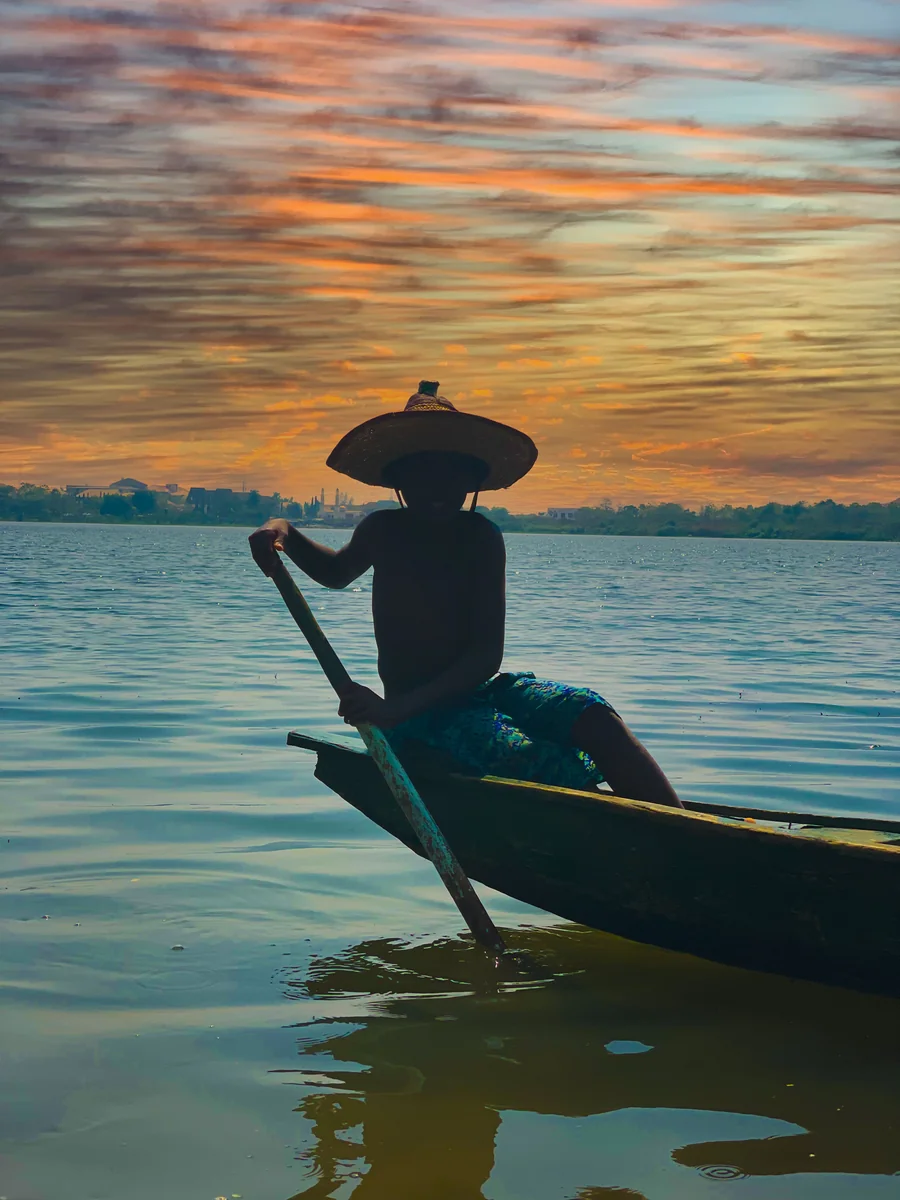 Ganvié's guesthouses prepare dinner using ingredients bought that morning at the floating market. The meal is served on a wooden terrace facing the lake, almost always by kerosene lamp or solar lantern.
What's on the plate
There is no written menu in a family guesthouse. What you eat was decided at the market at dawn, based on what the fishermen brought in. That constraint is also an absolute freshness guarantee. A few dishes appear regularly:
Grilled tilapia is the most common. Caught that morning in the Acadja traps under the lake, marinated with ginger, garlic and fresh ground chili, cooked over charcoal on the guesthouse terrace. Served with attiéké (cassava semolina) or boiled plantains. The firm, smoke-fragrant flesh bears no resemblance to the tilapia you find in Cotonou restaurants.
Dakouin is tilapia simmered in a tomato-onion sauce with local herbs. The sauce reduces slowly and develops a depth of flavour that quick cooking never achieves. Served with white rice or akassa, the fermented corn paste that accompanies most Tofinu meals.
Catfish in peanut sauce is available in some guesthouses depending on the catch. The catfish's fattier flesh holds up to long, slow cooking. In a homemade peanut sauce made with the mortar, it develops a melting texture that makes it the preferred dish for those who have tried both.
Meals cost between 3,000 and 6,000 FCFA per person including a drink. Most guesthouses do not serve alcohol. A few offer sodabi — locally distilled palm wine — on request.
The atmosphere at the table
Dinner is eaten in chosen near-darkness. A kerosene lamp or solar lantern in the middle, the black water of the lake a few planks below your feet, the sounds of distant conversations crossing from neighbouring houses. No generators, no roads, no horns. On clear nights, the sky above Lake Nokoué is completely unobstructed — no light pollution within a wide radius, the Milky Way visible from horizon to horizon. It is one of the few places within 30 kilometres of Cotonou where that is true.
Night pirogue ride through the sleeping canals
After dinner, some guesthouses offer a short pirogue ride through the sleeping channels. Without a motor, poled silently by the guide, the boat glides between stilt houses in near-total darkness. The experience is intimate and disorienting.
The village you walked through by day is unrecognizable. Shapes emerge and disappear. Light filters through doors and windows and reflects in broken lines on the black water. You can make out the silhouettes of houses but the colours, faces and details have all dissolved.
The guide points out things invisible by day: which houses belong to the founding families, where the vodun sites are located (identifiable by subtle markers the untrained eye misses), how Tofinu fishermen navigate at night using stars and current. Some guides share creation narratives linked to constellations visible directly overhead — correspondences between the sky and the clan geography of the city that exist nowhere in writing.
The ride lasts 30 to 60 minutes. It is not automatically offered — ask your host on arrival whether it is available that evening. It is not possible in strong wind or rain.
Tofinu ancestral legends
Oral tradition is central to Tofinu culture, and night is the natural time for stories. The reason is not romantic — it is practical. Days on the lake are for work: fishing, market, construction, maintenance. When charcoal fires go out and children are asleep, elders speak.
What overnight visitors sometimes hear, if their guide is a native with the right network, are the founding narratives that Tofinu have transmitted orally for three centuries. The flight from the Abomey slave raids. The decision to settle on the lake when dry land could no longer guarantee safety. The metamorphosis of King Agbodogbé into a crocodile to lead his people toward the protected waters — a metaphor for radical adaptation that the contemporary Tofinu do not treat as folklore but as a founding account carrying real meaning.
The stories about the sacred crocodile are particularly alive in Ganvié. Crocodiles in Lake Nokoué are not hunted. When a crocodile is spotted near the stilt village, it is approached with caution and respect rather than fear or hostility. The animal that saved the ancestors does not become prey. This cultural attitude has governed the coexistence of the Tofinu and the lake's crocodiles for three hundred years, without notable incidents.
These stories take on a different dimension when told at night, from a stilt house, on the very lake where the history unfolded.
A night on the lake: sounds and sensations
Spending a night in Ganvié is also an auditory and sensory experience with no urban equivalent.
The lake does not really sleep. At any hour of the night you will hear sounds: the regular lapping of water against the stilts, the creak of floorboards as the water level shifts slightly, a pirogue moving through the neighbouring canal at 2 AM (a fisherman leaving early for his trap). The lake is alive even when everything seems quiet.
Temperature varies with the season. In the dry season (November to March), nights on the lake are cool — a gentle breeze comes through the woven bamboo walls and temperatures drop noticeably compared to Cotonou. In the rainy season (June to September), humid heat can make sleep harder in rooms without ventilation.
Mosquitoes are active between dusk and dawn. The mosquito net is non-negotiable — check its condition before lying down. Carry a skin repellent for the moments you step out onto the terrace in the evening.
The smell of the lake is present but not unpleasant. It is an organic smell, aquatic vegetation and slightly brackish silt. Visitors who expect it find it consistent with the setting. A mild camphor-based repellent tends to mask it if it bothers you.
The dawn market: the overnight guest's reward
The strongest reason to spend the night at Ganvié is access to the dawn market. Between 4 and 6 AM, before day-trippers arrive, the market is a working space for the Tofinu themselves — the village's main fresh-food distribution point, not an attraction.
The dawn market runs in two clearly distinct phases. The wholesale phase, from 4 to 5:30 AM, involves fishermen selling their catch to vendor women. The vendors arrive by pirogue from surrounding lake villages, their lanterns already lit. Transactions are fast, conducted in Fon and Goun. Fish is sorted by species and size, weighed on portable scales, and sold before the heat of the day affects freshness.
The retail phase begins around 5:30 AM and builds until 8 AM, when the first tourist pirogues appear on the horizon from Abomey-Calavi. This is what day visitors see — already reorganized, already partly sold through compared to what happened before sunrise.
Vendor women arrive by pirogue from surrounding lake villages. They set their goods in wooden basins or directly in their pirogues turned into floating platforms. Transactions happen standing up, boats held side by side by the weight of bodies.
Photographers should reach the market around 4:30 AM. A guide is essential — both to explain what is happening and to introduce you to vendors who consent to being photographed.
What to bring for a night on the lake
A short list, but none of it is optional:
- Mosquito repellent — mosquitoes arrive at dusk. Bring reliable repellent and reapply before stepping out in the evening.
- Light long-sleeved clothing — protection against mosquitoes and the evening breeze without adding heat.
- A light layer — temperatures drop noticeably after sunset in dry season.
- A headlamp — the walkways between guesthouses are unlit. A headlamp keeps your hands free on the wooden planks.
- A charged power bank — solar electricity runs until about 10 PM. After that, power is limited.
- Cash in small bills — no card payment anywhere on the lake. Bring 500 and 1,000 FCFA notes.
- Toilet paper and hand sanitizer — not provided in family guesthouses.
- Earplugs — if you are a light sleeper, the lake's nocturnal sounds can disrupt sleep in the first hours.
Photography notes for Ganvié by night
Low-light shooting on the lake presents specific challenges and specific opportunities.
Recommended gear: a camera with solid high-ISO performance (5000 to 12800) and a fast lens (f/1.8 or f/2.8). A phone works for kerosene-lamp scenes if you stabilize it against a fixed surface — the wooden railing of your terrace doubles as an improvised tripod.
Blue hour: the two most rewarding light windows are dusk (20 to 40 minutes after sunset) and dawn (30 minutes before sunrise). During these moments, sky and water take on tones that never repeat in exactly the same way.
Long exposures at night: 3 to 10 second exposures capture the ambient light from distant houses reflecting on the water in golden trails. You need a stable surface or a compact tripod.
At the dawn market: no flash, ever. Push ISO to maximum and shoot wide. Flash kills the atmosphere, distracts the vendors and produces flat images. Kerosene-lamp market photographs are technically imperfect and humanly irreplaceable.
Asking permission: ask before photographing anyone, especially early in the morning. The 4:30 AM market is a workspace, not a stage. A guide who makes introductions opens doors that a raised camera closes.
Practical information
Nights at Ganvié are booked through local guesthouses or organized tours. Expect simple but clean accommodation: a room on stilts with a firm mattress, mosquito net, solar lighting and a shared bathroom. Showers are bucket-style — water warmed by the sun during the day, cool in the morning. Most intermediate guesthouses have flush toilets.
Prices range from 15,000 to 50,000 FCFA per night depending on comfort level, with dinner and breakfast included in most cases.
For a full comparison of accommodation options and 2026 prices, see our complete guide to stilt guesthouses in Ganvié.
Book a night at Ganvié
Experience the lake city after sunset with our overnight packages including dinner, evening pirogue ride and the dawn market.
Conclusion
Ganvié by night is not an extension of the daytime visit. It is a distinct experience — slower, quieter, closer to Tofinu life than any daytime excursion can offer. The guests who stay overnight are those who remember not just what Ganvié looks like, but what it feels like underfoot, in the palms of the hand, in the ear at 4 AM when the lake begins to stir before the market pirogues arrive.
The choice to stay is not a choice of comfort. It is a choice of understanding.
Questions fréquentes
Is it safe to sleep in Ganvié?
What time does the dawn market start?
Is there electricity in Ganvié guesthouses at night?
How does showering work in a stilt guesthouse?
How do I get back to Cotonou the next morning?
Can I take a pirogue ride at night?
When is the best season for an overnight stay?
Book your visit
Guided tour with native Tofinu guide, private pirogue, fixed prices.
The Secret Guide to Ganvié: Hidden Gems & Etiquette
Discover the authentic Ganvié far from the tourist crowds. Download our exclusive PDF to prepare a respectful and unforgettable visit.
We respect your inbox. No spam.
The Visit Ganvié Team
Written by native Tofinu guides. We have navigated Lake Nokoué since childhood to share the true history of our city, far from tourist traps.
Related articles
Photographing Ganvié: technical tips and best photo spots
Ganvié, Benin's stilt village on Lake Nokoué, offers unique photographic opportunities. From dawn light to aerial shooting rules, a complete guide to photographing Ganvié with respect.
supportDinner on water at Ganvié: a nighttime food experience on Lake Nokoué
Dinner on the water at Ganvié turns an evening into an unforgettable memory. A floating restaurant under moonlight, grilled fish from the lake and starry skies above the stilt city.