
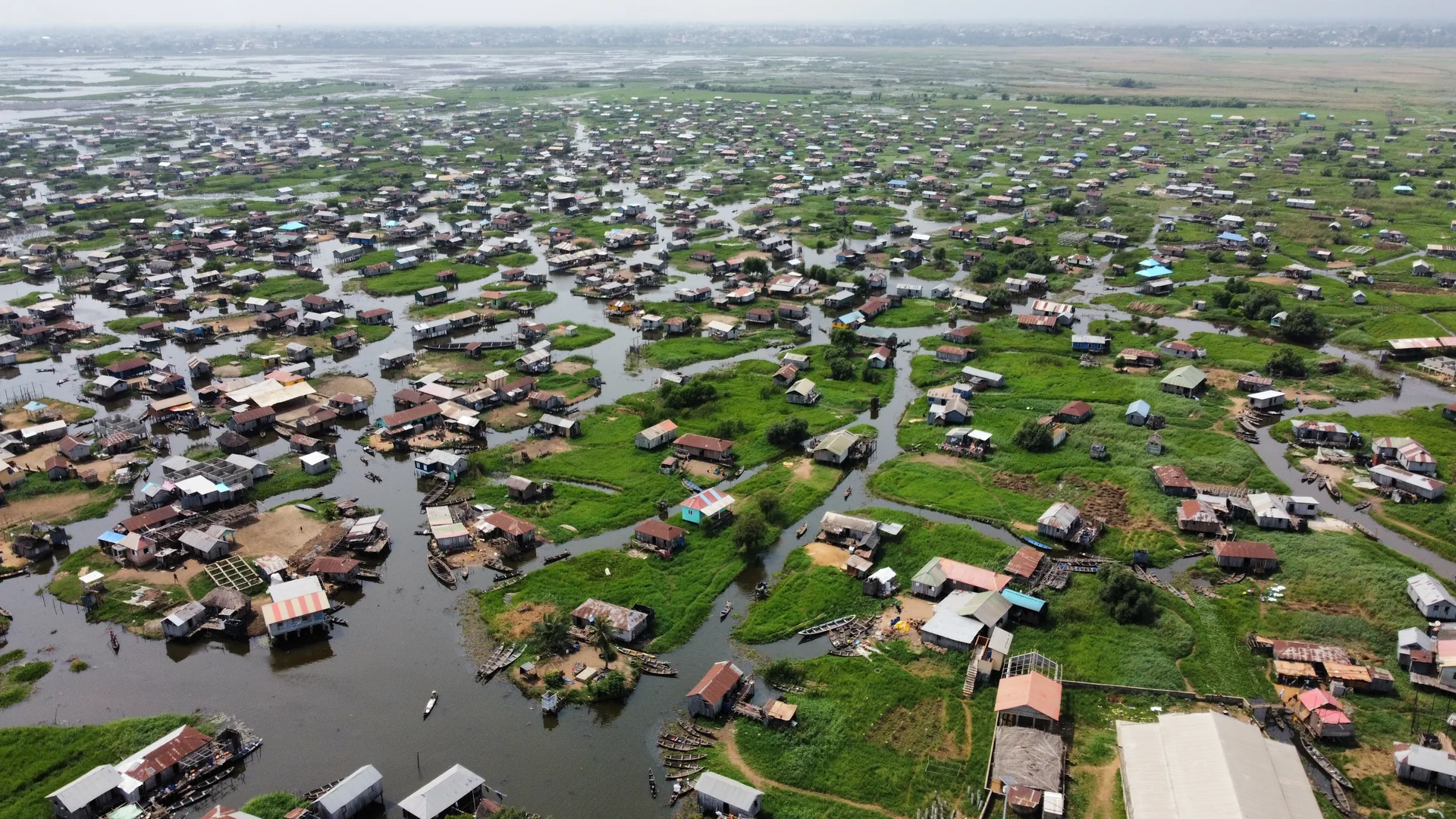
Ganvié, Inle Lake, Nzulezu, Kampong Ayer: four stilt villages from around the world compared. Size, tourism, architecture, access and sustainability.
Ganvié is not the only stilt village in the world. From Myanmar to Ghana and Brunei, other communities have chosen life on the water: sometimes out of necessity like the Tofinu, sometimes by tradition, sometimes by geography. But each stilt city tells a radically different story. How does Ganvié compare to its counterparts in Asia and Africa?
Ganvié (Benin): the largest stilt city in Africa
Ganvié is the largest stilt village in Africa and one of the largest in the world. Over 30,000 people live on Lake Nokoué in houses built on mangrove wood pilings. The city has schools, markets, churches, bars, and hotels, all on water. There are no streets, no cars, and no dry land within its limits. Everything moves by pirogue.
What sets Ganvié apart is that it is a fully functional city, not a tourist attraction that happens to be on water. People live, work, study, trade, and worship here every day. The floating market supplies thousands of families. Children paddle to school. Fishermen maintain centuries-old fishing techniques.
The city was founded in the 16th-17th centuries by the Tofinu people fleeing slave raids from the Kingdom of Abomey. The lake was a natural fortress: the Abomey cavalry could not cross water.
Inle Lake (Myanmar): floating gardens and leg rowing
Inle Lake in Myanmar is famous for its floating gardens, built from mats of vegetation anchored to the lake bed. Farmers grow tomatoes, beans, and flowers on these artificial islands. Fishermen are known for their distinctive leg-rowing technique, standing on one leg at the stern of their boat while wrapping the other around the oar.
Unlike Ganvié, Inle Lake's stilt villages are built along the lake's edge rather than in the middle. The houses are raised on wooden stilts over the water, but the population is smaller and more dispersed. Tourism is well developed, with boat tours, craft villages, and lakeside resorts.
Inle Lake faces serious environmental challenges: deforestation, water pollution from agriculture, and declining water levels. The floating gardens, while ingenious, contribute to nutrient loading in the lake. These pressures have led to debates about sustainable tourism similar to those surrounding Ganvié.
Nzulezu (Ghana): a living village on stilts
Nzulezu, in western Ghana, is a stilt village built on Lake Tadane. It is smaller than Ganvié, with around 4,000 inhabitants, and its history is tied to the Nzema people, who built the village to escape conflict and for protection against wild animals.
The village is constructed entirely from wood and bamboo, with raised walkways connecting the houses. Unlike Ganvié, which has modern materials like corrugated iron roofs, Nzulezu maintains a more traditional appearance. It was added to the UNESCO Tentative List in 2000.
Nzulezu receives significantly fewer visitors than Ganvié. Access requires a long canoe ride through a canal lined with mangroves, followed by a walk through the village. Tourism is managed by the community, and visitors typically spend two to three hours there.
Kampong Ayer (Brunei): the Venice of the East
Kampong Ayer, on the Brunei River, is often called the Venice of the East. It is the largest stilt settlement in the world by population, with approximately 39,000 residents. Unlike Ganvié, it sits within the capital city of Bandar Seri Begawan and has modern infrastructure: electricity, running water, schools, mosques, police stations, and fire brigades on stilts.
The comparison with Venice is more apt here than for Ganvié. Kampong Ayer has boardwalks, streetlights, and a well-organized network of water taxis. Many houses are modern buildings with concrete foundations on stilts, not traditional wooden structures. The village has been inhabited for over 1,000 years.
Tourism at Kampong Ayer is less developed than at Ganvié. Visitors take boat tours through the canals, visit the cultural museum, and stay in a few floating homestays. The community faces challenges of modernization: younger residents often move to the mainland, and maintaining traditional architecture is expensive.
How they compare
| Feature | Ganvié | Inle Lake | Nzulezu | Kampong Ayer | |---------|--------|-----------|---------|--------------| | Population | 30,000 | ~10,000 (lake area) | ~4,000 | 39,000 | | Country | Benin | Myanmar | Ghana | Brunei | | Access | Pirogue from Calavi | Boat from Nyaungshwe | Canoe from Beyin | Water taxi from BSB | | Modern infrastructure | Limited | Moderate | Minimal | Extensive | | Tourism level | High | High | Low | Moderate | | UNESCO status | Tentative list | Not listed | Tentative list | Listed (as part of BSB) | | Founded | 16th-17th c. | Unknown | 17th c. | 7th-8th c. |
What makes Ganvié unique
Ganvié occupies a rare middle ground among the world's stilt cities. It is large enough to function as a real city, unlike Nzulezu which is a village. It is authentic enough to feel like a living community, unlike Kampong Ayer which has become a suburb of Brunei's capital. It is accessible enough to visit easily, unlike Inle Lake which requires significant travel within Myanmar.
Its size sets it apart: 30,000 people living entirely on water, with no land connection, no road access, and no prospect of moving to shore. The Tofinu are not temporary residents. They are a lake civilization that has built an entire society on pilings.
The challenge Ganvié faces is how to develop tourism without losing this authenticity. As more visitors discover the village, the pressure to build more hotels, restaurants, and tourist infrastructure grows. So far, Ganvié has resisted the worst excesses of mass tourism, but the balance is fragile.
Book your visit
Guided tour with native Tofinu guide, private pirogue, fixed prices.
Frequently asked questions about stilt villages
Is Ganvié the largest stilt village in the world? Kampong Ayer in Brunei is larger by population (39,000 vs 30,000), but some sources consider Ganvié the largest, depending on whether Kampong Ayer is classified as a village or a suburb. Ganvié is the largest in Africa and one of the largest globally.
Which stilt village is easiest to visit? Ganvié is among the easiest. It is 30 minutes from Cotonou, Benin's largest city, and a day trip is straightforward. Kampong Ayer is also easy to visit from Bandar Seri Begawan. Inle Lake requires more travel within Myanmar. Nzulezu requires a long canoe ride but is accessible.
Are all stilt villages tourist attractions? No. Some, like Nzulezu, receive few visitors. Even Ganvié, despite its popularity, is first and foremost a living city. Tourism is secondary to daily life.
Which stilt village is most at risk from climate change? Ganvié is particularly vulnerable. Lake Nokoué is affected by rising water levels, erosion, and pollution. Inle Lake faces similar challenges. Nzulezu and Kampong Ayer are also threatened but by different factors.
The Secret Guide to Ganvié: Hidden Gems & Etiquette
Discover the authentic Ganvié far from the tourist crowds. Download our exclusive PDF to prepare a respectful and unforgettable visit.
We respect your inbox. No spam.
The Visit Ganvié Team
Written by native Tofinu guides. We have navigated Lake Nokoué since childhood to share the true history of our city, far from tourist traps.
Related articles
Tofinu glossary: essential lexicon of lake life
Complete lexicon of Tofinu, Goun and Fon words to understand lake life at Ganvie. Housing, fishing, navigation, spirituality, cuisine: essential vocabulary before your visit.
edgeLake Nokoue before Ganvie: geography, origins and ecosystem
Before becoming the cradle of Ganvie, Lake Nokoue was a vast lagoon system teeming with fish. A look at the geographical origins and unique ecosystem of this exceptional lake.