Complete lexicon of Tofinu, Goun and Fon words to understand lake life at Ganvie. Housing, fishing, navigation, spirituality, cuisine: essential vocabulary before your visit.
Visiting Ganvie without knowing a few words of the culture that animates it is like watching a film with no sound. This Tofinu glossary gives you the linguistic keys to understand what you see on the lake: the names of the neighbourhoods, the fishing techniques, the everyday objects, the spiritual landmarks, the dishes you will eat. Each word tells a fragment of life on the water.
Tofinu is a variant of Goun, itself a branch of the Fon-Gbe group. If you wonder why certain words resemble those you hear in Cotonou, it is because the languages of southern Benin share a common substrate inherited from centuries of proximity and exchange. The few basic words below will earn you guaranteed smiles on the lake.
Housing and architecture
Acadja (masculine noun) -- Traditional Tofinu fishing technique. Branches are planted in shallow water to create an artificial shelter where fish come to take refuge and reproduce. Fishermen then close the trap with a net and gradually drain the area. This centuries-old method, recognised by aquaculture researchers as a model of sustainability, is still used on Lake Nokoue. An Acadja can cover several hundred square metres.
Gandjito (masculine noun) -- Traditional Tofinu carpenter. The gandjito is the specialist in stilt construction, a skill passed from father to son in certain lineages. He knows the types of wood that resist water, the depths to which stilts must be driven depending on the lake bed composition, and the rules for building walkways. The rising water levels of Lake Nokoue are challenging some of the gandjito's ancestral knowledge -- new depths, new timbers.
Houedje (proper noun) -- One of the main neighbourhoods of Ganvie. Its canals are among the liveliest in the village, lined with colourful houses, small shops and private landing stages. The term designates both the neighbourhood and the identity of its inhabitants.
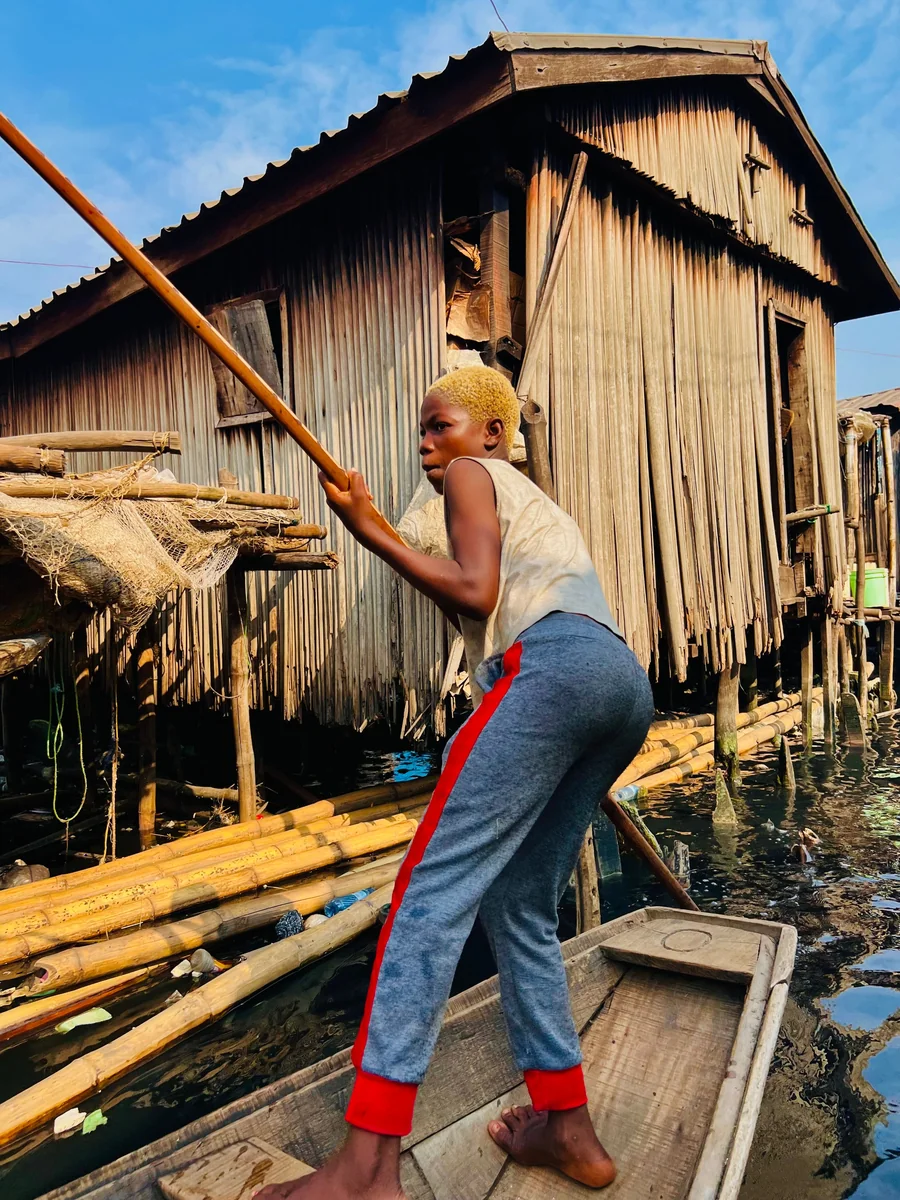
Stilts (plural noun) -- Wooden posts made from borassus palm, palm tree or teak driven into the lake bed to support the houses, schools, churches and businesses of Ganvie. A properly planted stilt can last twenty to thirty years. Its lifespan depends on the wood used, the depth of insertion and the seasonal variation in water level -- the alternating air-water zone being the most vulnerable to biological degradation.
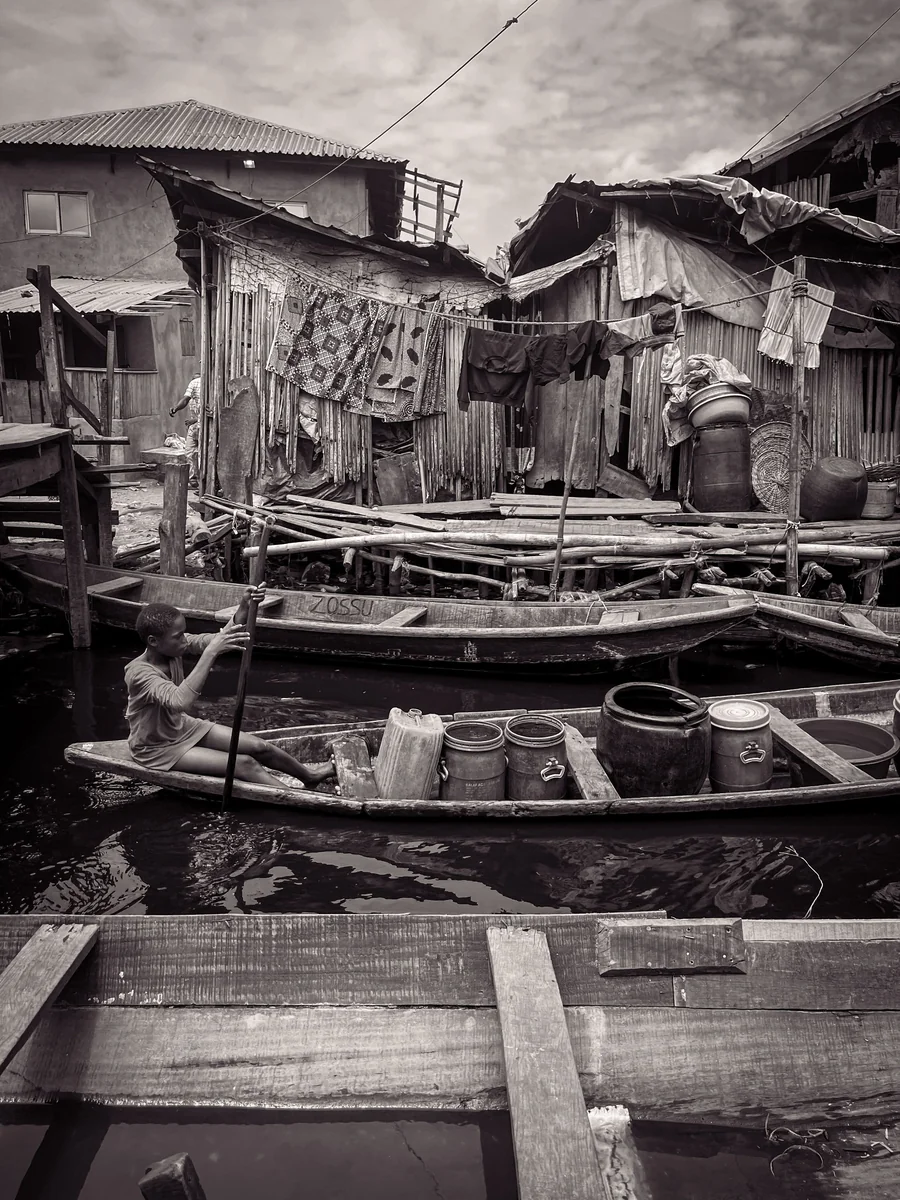
Pirogue (feminine noun) -- Traditional canoe, the universal means of transport in Ganvie. There are dugout pirogues hollowed from a single tree trunk, plank-built pirogues, and motorised pirogues equipped with an outboard engine. A resident's pirogue is their personal vehicle, their storage space and sometimes their workspace. You do not step into someone's pirogue without permission.
Borassus palm (masculine noun) -- A palm tree whose trunk forms the basic stilt for construction on the water in Ganvie. Borassus aethiopum wood is dense, naturally waterproof and resistant to decomposition in an aquatic environment. It can be driven into the lake mud by sheer physical strength, without mechanical tools. Its availability on the shores of Lake Nokoue made it the founding construction material of the stilt city.
Sato (masculine noun) -- Private landing stage in front of a house. Each household has its own sato -- a small wooden platform where the family pirogue is moored, where children embark and disembark for school, where women load their market baskets. The sato is the equivalent of the front porch of an ordinary house.
Fishing and lake economy
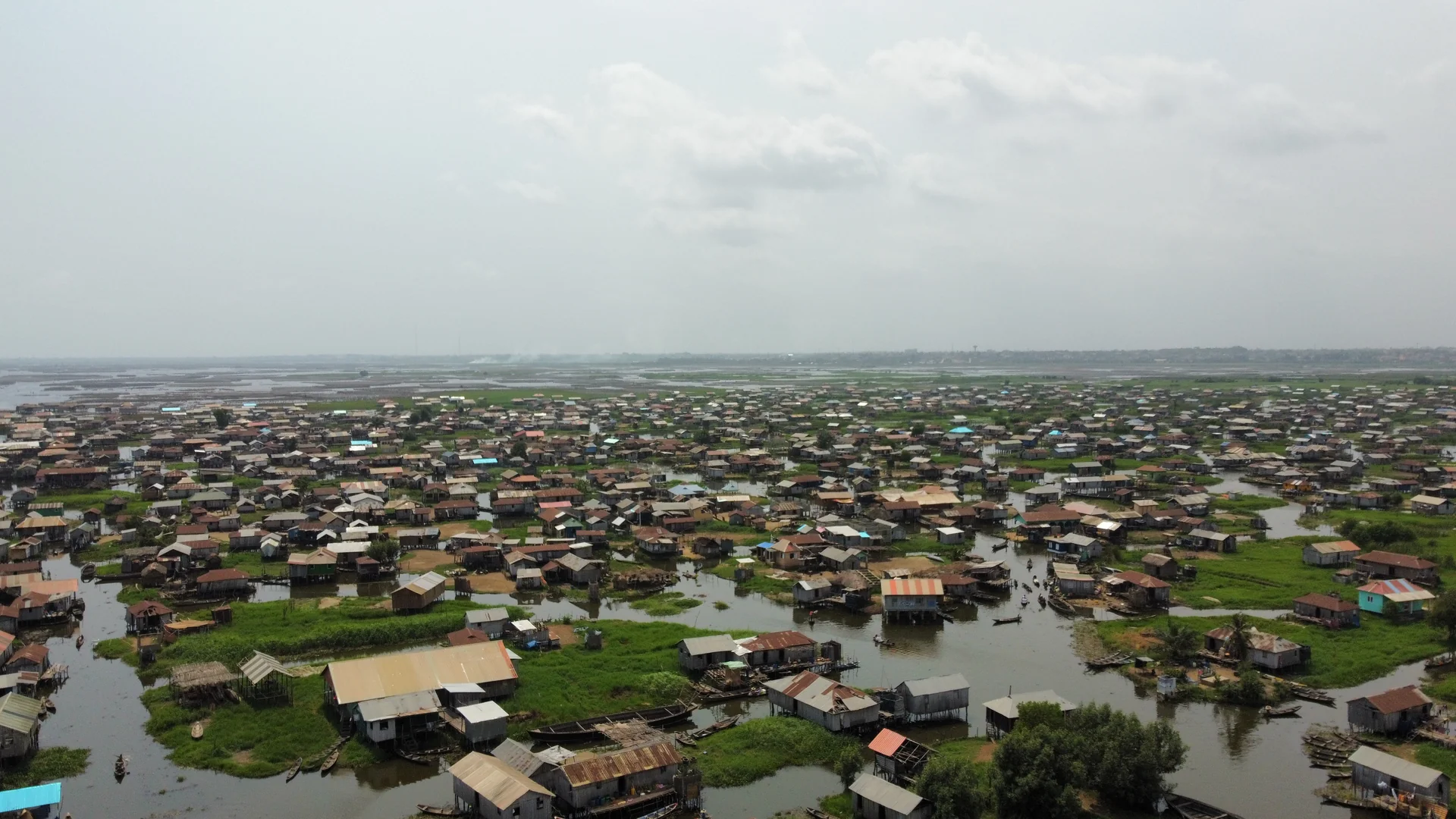
Acadja-farming (masculine noun) -- Modern variant of the traditional Acadja, in which fishermen introduce farmed fingerlings into the enclosure rather than waiting for natural colonisation. This adaptation speeds up productivity and provides better control over the species caught. It is still marginal but is developing in areas where natural stocks have declined.
Azowlisse (proper noun) -- Local name for the floating market of Ganvie. Each morning, hundreds of pirogues loaded with vegetables, dried and fresh fish, spices and fabrics gather at the same spot on the water. The market has two phases: a wholesale market from 4:00 to 5:30 AM, where fishermen sell their catch to resellers, and a retail market from 6:30 AM onward, open to everyone. The Azowlisse is the economic backbone of Ganvie.
Captain fish (masculine noun) -- Local name for Lates niloticus (Nile perch), the predator of Lake Nokoue. Its flesh is firm, with few bones and a more pronounced flavour than tilapia. It is often the choice of floating restaurants for evening meals, grilled whole with a marinade of ginger and palm oil.
Cast net (masculine noun) -- Circular fishing net thrown by hand from a pirogue. The throwing technique requires years of practice. The cast net is opened by lead weights sewn around its perimeter and closes when it hits the bottom. It is used for open-water fishing, outside the Acadja.
Tilapia (masculine noun) -- The most common fish in Lake Nokoue, belonging to the genus Sarotherodon. Its white, slightly sweet flesh forms the dietary staple of Ganvie. Grilled tilapia, served whole with rice or attieke, is the signature dish of the floating restaurants. Fishermen distinguish several local species based on size and colour.
Whedji (masculine noun) -- Basket trap, a cone-shaped or cylinder-shaped woven fishing trap. It is placed in the shallow areas of the lake, often near the Acadja, and lifted each morning. The whedji is the most accessible fishing tool for young fishermen learning the trade.
Society, history and politics
Abomey (proper noun) -- City and former kingdom of southern Benin. The kings of Abomey (Dahomey) led systematic military campaigns in the 18th century to capture slaves, driving the Tofinu people to flee towards Lake Nokoue. The Slave Route that leaves Ouidah towards the Atlantic is the geographical testimony of this period. Today, Abomey houses the royal palaces listed as a UNESCO World Heritage site.
Agbodogbe (proper noun) -- Founding king of Ganvie, according to Tofinu oral tradition. Arriving at the shores of Lake Nokoue around 1717, he is said to have taken the form of a falcon to spot habitable land, then that of a crocodile to carry his people to the island of safety. His name has several spellings (Agbodogbe, Agbogdobe) depending on the source, due to oral transmission of the story over several centuries.
Ako (masculine noun) -- Lineage or clan in Tofinu society. The ako is the basic social unit of the water people, beyond the nuclear family. Membership in an ako determines spatial organisation in Ganvie -- members of the same ako often live in the same sector of the lake -- and each person's social obligations towards their relatives.
Doto (masculine noun) -- Head of the lineage, representative of the ako before other lineages and the customary authority of the village. The doto serves as mediator, guardian of traditional rules, and interlocutor during collective decisions. His authority is moral rather than legal.
Sakete (proper noun) -- Royal lineage directly descended from Agbodogbe, the founder of Ganvie. The Sakete perpetuates the customary authority of the village and participates in important ceremonies. Its legitimacy rests on direct filiation with the founding crocodile king, transmitted by oral tradition for over three centuries.
Tofinu (proper noun) -- "People of the water" in the Goun language. Founding people of Ganvie. The Tofinu are a subgroup of the Goun, specialised in lake life for several generations before the village was founded. The spelling Toffinou is also found. They spoke a variant of Goun enriched with terms specific to the aquatic world.
Navigation and geography
Aguegues (proper noun) -- Lake village neighbouring Ganvie, also built on stilts but less tourist-oriented. Its inhabitants have close family and commercial ties with Ganvie. The atmosphere is quieter, the population density lower. Access is by pirogue from the Abomey-Calavi landing stage.
Landing stage (masculine noun) -- Departure point for pirogues to Ganvie, located at Abomey-Calavi. This is where visitors board a motorised canoe to cross Lake Nokoue (20 to 30 minutes). The landing stage is also a place for negotiating crossing fares and organising guided tours. Arrive early in the morning for the most reasonable prices.
Lake Nokoue (proper noun) -- The body of water that hosts Ganvie and several other lake villages. Covering approximately 150 km², it is connected to the Atlantic Ocean by a channel that runs through Cotonou. Its brackish waters (neither fresh nor fully salty) host a particularly rich fauna: tilapia, captain fish, mullets, shrimp, and over 300 species of birds. The average depth is shallow, between 1 and 3 metres.
Nokoue (proper noun) -- The word alone designates the lake. In the Goun language, it is said to refer to the idea of water that spreads or a deep lagoon. The lake is the cradle of Tofinu culture and the stage for daily life in Ganvie for over three centuries.
So (proper noun) -- River that connects Lake Nokoue to the Atlantic Ocean, passing through Cotonou. Before their exile on the lake, the Tofinu lived on the banks of the So and mastered its course and seasons. It remains a transport and fishing route for riverside villages.
So-Ava (proper noun) -- Lake village located on the So River, between Lake Nokoue and Cotonou. Its stilt houses are less well-known than Ganvie but equally authentic. It is a possible stop for visitors who cross via the river rather than the lake.
Spirituality and culture
Gbe (masculine noun) -- Word from the Fon and Tofinu languages meaning "day", "world" or "destiny". It is heard in common expressions. The notion of gbe refers to a cyclical conception of time typical of the cultures of the Gulf of Benin -- the idea that each day carries its own destiny, to be read in the signs of the lake and the spirits.
Mami Wata (proper noun) -- Water deity venerated on the shores of Lake Nokoue and in many cultures of the Gulf of Guinea. Mami Wata is depicted as a woman with a fish tail or holding snakes. She is both protective and dangerous -- she attracts fishermen and can keep them beneath the waters if she is not appeased. Her presence in Tofinu cosmology reveals something essential about the ambivalent relationship of the lake's inhabitants with the water that sustains them.
Vodoun (masculine noun) -- System of ancestral spiritual beliefs originating from southern Benin and Togo. Vodoun is deeply rooted in Tofinu culture. Ceremonies, dances and altars are elements of ordinary life in Ganvie, not tourist curiosities. January 10 is the national Vodoun holiday in Benin, celebrated in Ouidah with public processions.
Transport and daily life
Agan (masculine noun) -- Lake griot, keeper of the oral memory of the Tofinu people. The agan is the specialist in genealogies, foundation stories, lake legends. His role is to transmit this knowledge from one generation to the next without alteration. He intervenes during important ceremonies and rites of passage.
Zemidjan (masculine noun) -- Motorbike taxi, the main means of land transport in Benin. The word derives from Fon and means "take me quickly". To reach the Abomey-Calavi landing stage from central Cotonou, the zemidjan is often how people travel (20 to 30 minutes depending on traffic, 500-1,000 FCFA).
Useful phrases at Ganvie
A few expressions that your guides will hear you pronounce with gratitude:
- "Kudo" (in Goun) -- Hello, morning greeting. A smile plus "kudo" opens more doors than any business card.
- "Mi kudo" -- Thank you. Simple, effective, universally appreciated.
- "Azowlisse e do ?" -- "Where is the floating market?" A directional question your guides will find amusing since it is everywhere in the morning.
- "Tilapia e jlo ?" -- "Tilapia available?" The ultimate test of your lake lexicon at the floating restaurant.
This Tofinu glossary will accompany you during your visit to Ganvie. By recognising these words on site, you will no longer be a simple tourist: you will become a visitor who understands, at least a little, the language of the lake.
To learn more about the culture and history of the Tofinu people, read our article on the origins of the Tofinu people and our complete guide to the founding of Ganvie.
Book your visit
Guided tour with native Tofinu guide, private pirogue, fixed prices.
Questions fréquentes
What language is spoken in Ganvie?
Can I learn a few words of Tofinu before my visit?
Are there resources for learning Tofinu or Goun?
Does the word 'Ganvie' really mean 'we are saved'?
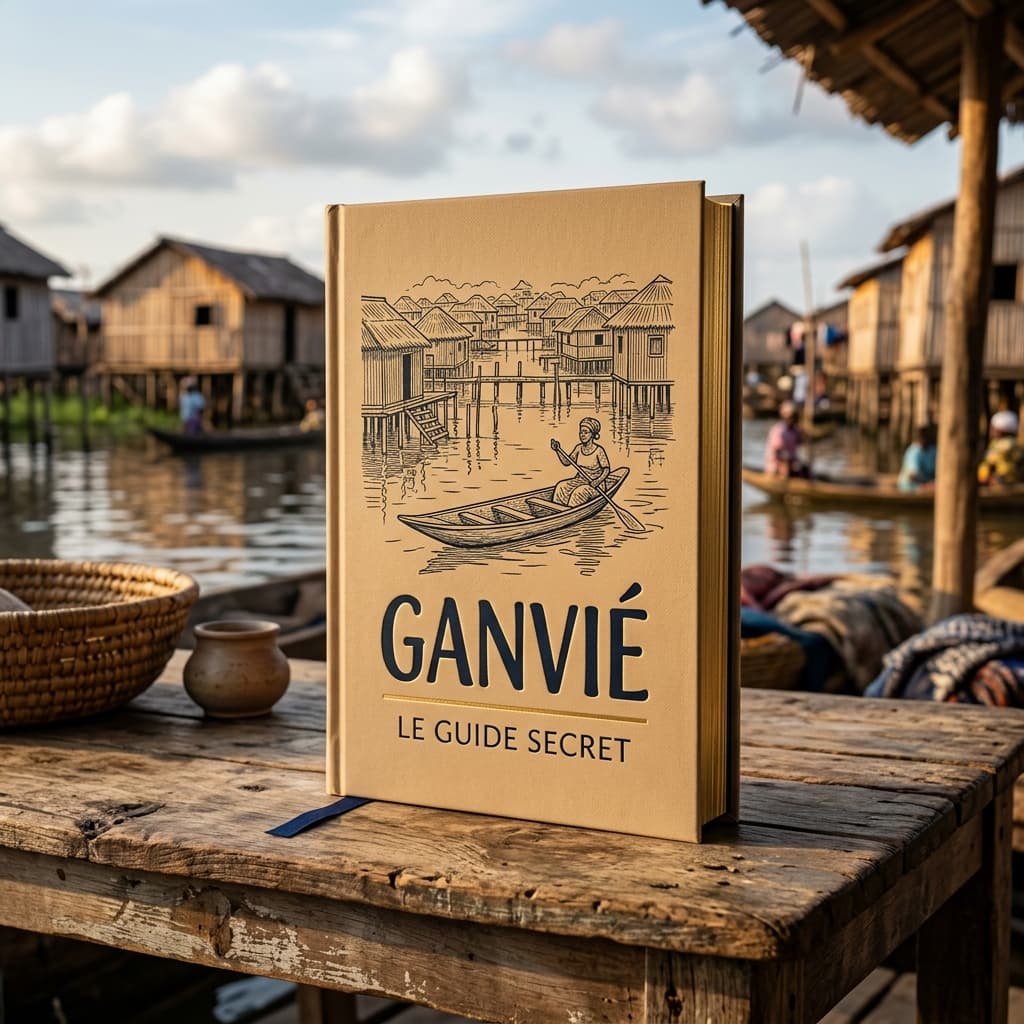
The Secret Guide to Ganvié: Hidden Gems & Etiquette
Discover the authentic Ganvié far from the tourist crowds. Download our exclusive PDF to prepare a respectful and unforgettable visit.
We respect your inbox. No spam.
The Visit Ganvié Team
Written by native Tofinu guides. We have navigated Lake Nokoué since childhood to share the true history of our city, far from tourist traps.
Related articles
Lake Nokoue before Ganvie: geography, origins and ecosystem
Before becoming the cradle of Ganvie, Lake Nokoue was a vast lagoon system teeming with fish. A look at the geographical origins and unique ecosystem of this exceptional lake.
discoveryGanvié vs other stilt villages around the world
Ganvié, Inle Lake, Nzulezu, Kampong Ayer: four stilt villages from around the world compared. Size, tourism, architecture, access and sustainability.