
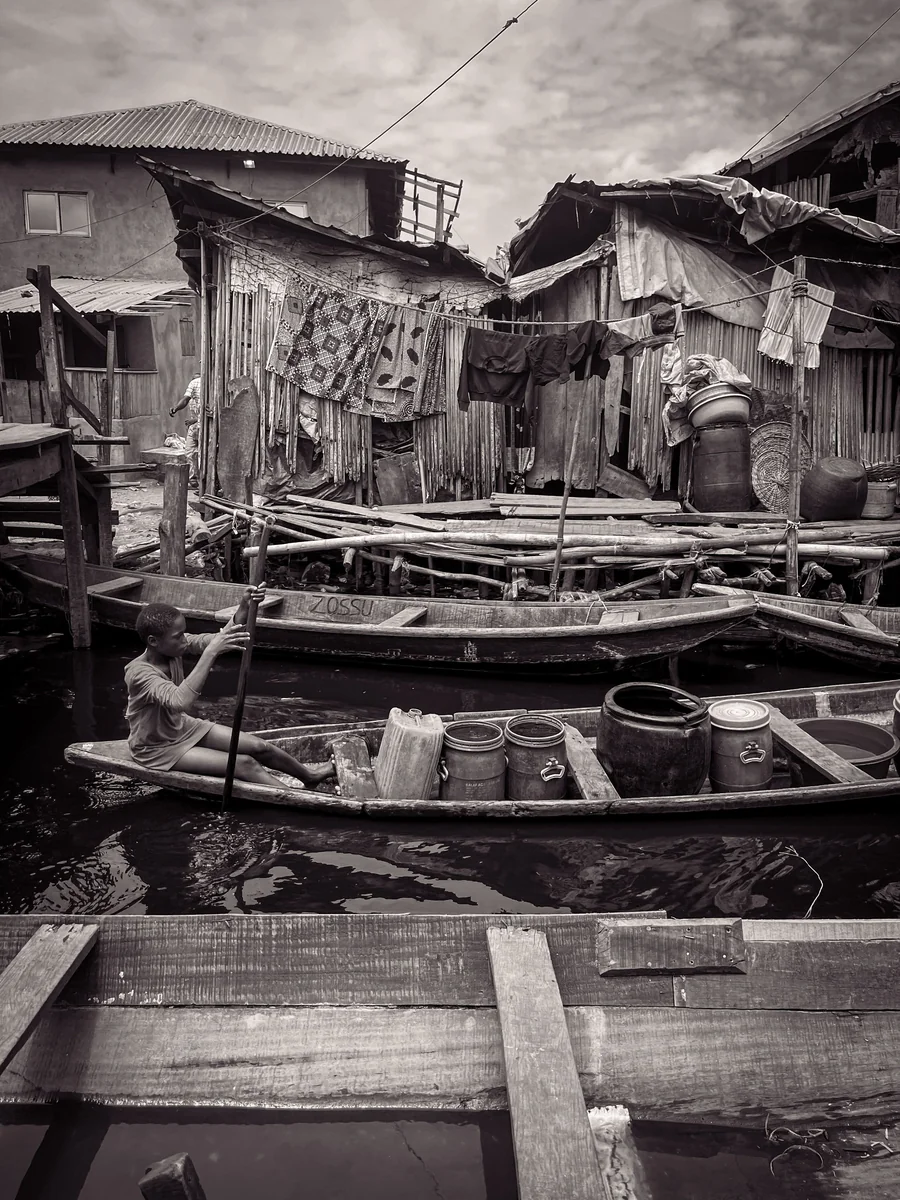
The Tofinu, water people of Benin, have built a unique society on Lake Nokoué over three centuries. Clan organization, fluvial economy, living traditions.
The Tofinu people are not merely the inhabitants of Ganvié. They are the people who chose the water when the land became unlivable — who transformed a survival decision into a culture, and a culture into a civilization. To understand Ganvié beyond the photographs of stilt houses, you need to understand the Tofinu: their social organization, their economy, their language, their spirituality, their specific relationship with Lake Nokoué.
What strikes in Tofinu history is how thoroughly constraint became identity. The flight to the lake in the seventeenth and eighteenth centuries was a survival act. Three centuries later, the Tofinu do not live on the lake despite the water — they live there because the water has become their natural territory. A place of choice, not accident.
Who are the Tofinu: origins and the name
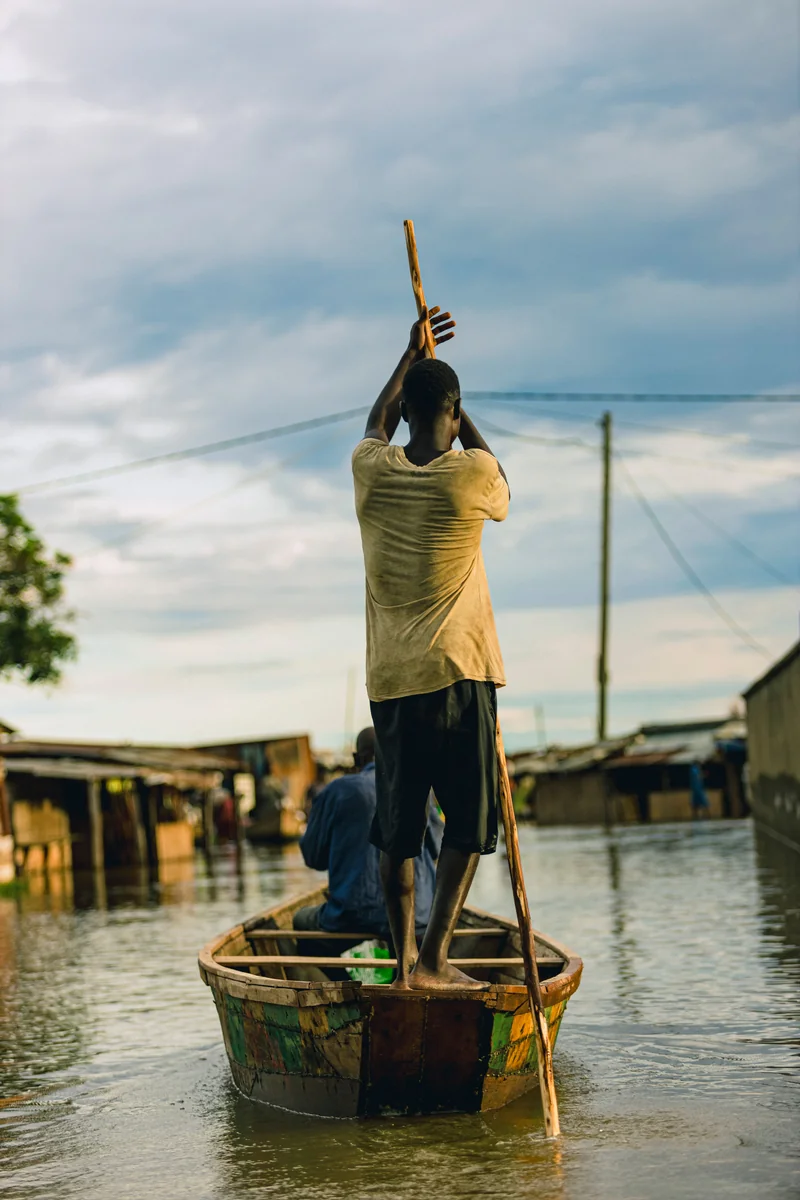 The name Tofinu means "people of the water" or "people of the lake" in the Goun language. The designation is not poetic — it is a material description. A people whose identity is inseparable from an aquatic environment.
Before the founding of Ganvié, the Tofinu lived along the banks of the Sô River and the shores of Lake Nokoué, in the coastal plain that stretches between present-day Cotonou and the villages north of the lake. Their economy was mixed: lacustrine fishing, agriculture along the riverbanks, commerce with merchants on the interior trade routes. Their knowledge of waterways, fish cycles and navigation techniques was already developed before necessity pushed them to settle permanently on the water.
The lake did not create the Tofinu — it revealed them. The lacustrine knowledge that existed in families before the eighteenth-century flight is precisely what made the founding of Ganvié viable. Without this prior mastery of the environment, settling permanently on stilts above a lake would not have been possible.
The Tofinu do not constitute a rigidly homogeneous ethnic group. They define themselves more by their relationship with the lake and their shared history than by a common genetic origin. Families from different groups — Fon, Aïzo, Popo — joined the lake community over the decades following the founding, attracted by the protection the water offered. These successive additions enriched Tofinu culture without dissolving its fundamental traits.
The language: Goun on the lake
The primary language of the Tofinu is Goun (or Gun), a Volta-Congo language belonging to the Gbe family, closely related to Fon. Goun as spoken in Ganvié has developed lexical specificities tied to lacustrine life: technical terms for types of current, water depths, fish species, Acadja structures, pirogue types — words that have no exact equivalent in the varieties of Goun spoken on the mainland.
This lacustrine specialization is a linguistic trace of the Tofinu's cultural adaptation. The language followed the environment — new words emerged to describe new realities, transmitted orally across generations. The Acadja fishing system, for instance, has an entire technical vocabulary in Tofinu Goun that is not present in mainland dialects, because the technique developed specifically on the lake.
French is the language of school instruction and external communication. Younger generations are generally bilingual, sometimes trilingual — Goun, Fon, French. But in Ganvié households, between neighbours, at the floating market, it is Goun that dominates.
Clan-based society: the ako as the basic unit
Tofinu society is organized into patrilineal clans. Each clan, called an "ako," descends from a common ancestor and occupies a geographically defined quarter of Ganvié. The main canals function as boundaries between these clan spaces — water streets that are also cultural frontiers.
The clan chief, the "doto," is responsible for managing internal conflicts, organizing collective work (walkway repair, shared structure maintenance), and representing the clan to customary authorities. His function is not automatically hereditary — it is conferred on the person judged most qualified by the clan's elders. This can be a son, but equally a brother, cousin or son-in-law.
Above the clan chiefs, Ganvié's traditional king, the Sakété, holds spiritual and symbolic authority over the entire community. His position traces back to the lineage of the founding king Agbodogbé and he is regarded as the guardian of tradition and Tofinu unity. The Sakété holds no administrative power in the modern sense — he coexists with the municipal authorities of the Beninese state — but his moral authority in customary matters remains recognized across the community.
The relationship with the lake: territory, not resource
For the Tofinu, Lake Nokoué is not a resource to be exploited. It is a territory to be inhabited. This distinction is fundamental to understanding their relationship with the water.
The lake is the living space in every dimension. You build your house on it. You travel by pirogue on it. You wash in it, do your laundry in it. You fish for food in it. You trade on it. Children learn to paddle before they learn to read. Women hold their market on it. Elders read meteorological signs in the colour of the water and the behaviour of the birds that nest along its shores.
This familiarity is not romantic. It is precise, practical and transmitted. An experienced Tofinu fisherman can read the lake surface — the swirls that signal a shallow bottom, the slight iridescence indicating a concentration of fish near the surface, the direction of wind from the orientation of diving birds. These are forms of knowledge that no one writes down, that everyone acquires progressively by spending hours on the water.
The lake is also inhabited by what cannot be seen. Spiritual forces, ancestral presences, prohibitions that protect the balance between humans and the lake — every fisherman knows that you do not leave without greeting the water first.
Vodun spirituality and its lacustrine dimension
Tofinu spiritual life is organized around vodun — the system of belief that structures the relationships between the living, the dead, natural forces and divine entities in the Fon and Goun cultures of Benin.
Tofinu vodun has developed characteristics specific to life on the water. The vodun associated with aquatic forces occupy a central place that they do not hold in the vodun practices of mainland communities. Mami Wata, the aquatic deity, is among the most honoured entities at Ganvié. Her shrine, discreet to visitors who do not know how to read it, is present in several quarters of the lake city.
The crocodile is sacred in Tofinu tradition, directly linked to the founding legend of King Agbodogbé, who is said to have transformed into a crocodile to carry his people to safety. This sacredness is not purely symbolic: crocodiles in Lake Nokoué are not hunted by the Tofinu. When a crocodile is spotted in the waters near Ganvié, it is approached with caution and respect rather than fear or hostility. The animal that saved the ancestors does not become prey.
Vodun ceremonies punctuate the Tofinu calendar: seasonal rituals linked to fishing (offerings to the lake's vodun before opening a new Acadja), funeral rites adapted to stilt life (bodies are generally brought to dry land for burial, but mourning rites are partly held on the water), and communal celebrations that bring clans together.
These practices are not accessible to passing visitors. Some moments are reserved for initiates and community members. Your guide, if a native of Ganvié, will be able to tell you what is observable and what is not.
The lake economy: fishing and trade
The Tofinu economy rests on a division of roles that crystallized across several generations.
Men fish, build, maintain the Acadja structures and repair the stilt houses. Women trade, distribute, supply the community. This is not a rigid inequality — it is a functional specialization that has proven durable, with room for individual variation.
The Acadja fishing technique is the central pillar of the Tofinu lake economy. These artificial fish reefs — built from branches planted in the lake bed, which attract fish that come to breed and feed among them — are managed by the men of each family. Building an Acadja mobilizes several people for several days; its maintenance is regular and precise work. A well-managed Acadja can yield dozens of kilograms of fish per harvest.
The floating market is the heart of the commercial Tofinu economy, and it is a female economy. Women buy fish wholesale at the 4 AM market, distribute it retail to Ganvié households, smoke or dry it for resale in Cotonou. They keep their accounts in their heads, manage their working capital, reinvest in their stock. The financial and commercial mastery of the floating market women is substantial and real.
Women who trade successfully earn a status and an autonomy that their economic activity directly confers on them. This is a matriarchal economic current running through a broadly patrilineal social structure — both coexist in the Tofinu community without apparent contradiction.
Oral tradition: the agan and living memory
The Tofinu are an oral culture. The history of the people, the genealogies of the clans, fishing techniques, ceremonial songs, the narratives of the ancestors — everything is transmitted by word of mouth, without a written text of reference.
This oral tradition gives the words of elders particular weight. The founding stories of Ganvié, the exploits of King Agbodogbé, the origins of the clans, the rules of the Acadja: knowledge that would disappear if it were not regularly recounted in families and at ceremonies.
Tofinu griots, called agan, are the institutional guardians of this memory. They know genealogies spanning several generations, the ceremonial songs linked to the lake's vodun, the historical narratives connected to the community's major crises. Their presence at important ceremonies is essential — their role is simultaneously commemorative and foundational.
Oral transmission is fragile in the face of modernity. Schooling in French, television, social media — these vectors of a globalized culture compete with the evening when a grandfather recounts the clan's origins to his grandchildren. Some families have begun recording elders' narratives as audio or video, an adaptation of the oral principle to contemporary tools. It is an imperfect solution but a practical one.
The Tofinu today: adaptation and tensions
Tofinu culture is not frozen behind glass. It evolves, adapts and crosses real tensions.
Young people from Ganvié have access to national education, social networks, and the cultural currents that mobile phones distribute everywhere. Some leave for studies in Cotonou, find work there and return only for celebrations. This internal migration is a demographic reality that modifies the composition of Ganvié's quarters.
Those who stay, or who return, carry a hybrid identity. They speak Goun at home and French with the administration. They fish with ancestral techniques and order supplies online. They participate in vodun ceremonies and watch football on a phone charged by a solar panel.
This hybridity is not a betrayal of Tofinu culture. It may be its contemporary form — the continuation, by different means, of the adaptive capacity that allowed this people to survive on a lake for three centuries.
What remains constant is the attachment to the lake. Tofinu people who live in Cotonou during the week often return to Ganvié for the weekend. Not out of obligation — by choice. The lake is home in a way that no mainland city can replicate.
For the history of this people in its founding context, see our article on the Abomey razzias and the flight to Lake Nokoué. To understand how their material knowledge is expressed in craft, see our guide on Ganvié artisanal traditions.
The Secret Guide to Ganvié: Hidden Gems & Etiquette
Discover the authentic Ganvié far from the tourist crowds. Download our exclusive PDF to prepare a respectful and unforgettable visit.
We respect your inbox. No spam.
The Visit Ganvié Team
Written by native Tofinu guides. We have navigated Lake Nokoué since childhood to share the true history of our city, far from tourist traps.
Related articles
Tofinu glossary: essential lexicon of lake life
Complete lexicon of Tofinu, Goun and Fon words to understand lake life at Ganvie. Housing, fishing, navigation, spirituality, cuisine: essential vocabulary before your visit.
edgeLake Nokoue before Ganvie: geography, origins and ecosystem
Before becoming the cradle of Ganvie, Lake Nokoue was a vast lagoon system teeming with fish. A look at the geographical origins and unique ecosystem of this exceptional lake.