
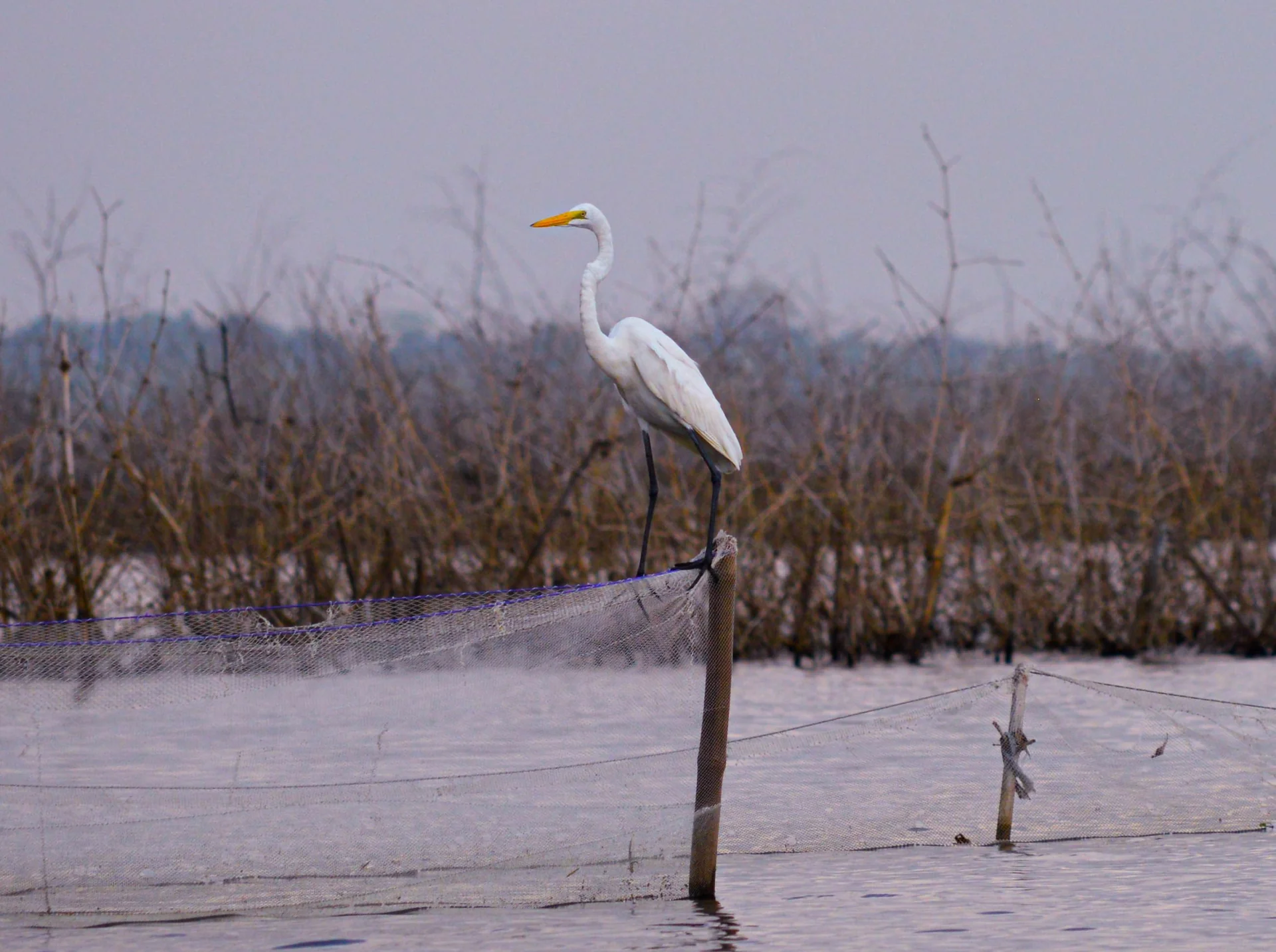
Rising water levels on Lake Nokoué, accelerated by climate change, directly threaten Ganvié and its stilt dwellings. Assessment of the impacts and the solutions being implemented.
Ganvié, the largest lake city in Africa, has been built on stilts planted in the waters of Lake Nokoué for more than three centuries. This settlement on water, decided in the 17th century to escape the raids of the Kingdom of Abomey, allowed a community to survive and then prosper in an environment that no one else had chosen to inhabit. But today, this ancestral relationship between people and water is tested by a phenomenon the founders of Ganvié could not have anticipated. The progressive and accelerated rise of the lake level.
Climate change is not an abstract notion for the inhabitants of Ganvié. It is measured in centimetres of water that climb each year, in stilts that need to be raised more often, in walkways that end up submerged every rainy season, in family homes that had to be abandoned. What the village elders call "the rising water" corresponds to what climatologists measure at their stations. A long, slow and certain underlying trend.
This article examines what climate change is actually doing to Ganvié, to its houses, its economy and its culture, and what inhabitants, associations and governments are trying to put in place to respond to this pressure.
Lake Nokoué: a lagoon at the intersection of multiple pressures
To understand why Ganvié is particularly vulnerable, you need to understand Lake Nokoué itself.
Lake Nokoué is a coastal lagoon of about 150 square kilometres, connected to the Atlantic Ocean by a channel that crosses Cotonou. This connection is a double-edged sword. It gives the lake its fishery wealth, marine species join freshwater species there, but it also exposes its waters to variations in sea level. When the Atlantic rises due to thermal expansion and melting polar ice, seawater pushes further back into the lagoon.
Land-based pressures add to this maritime pressure. The rapid urbanisation of Cotonou, a city of over two million inhabitants bordering the lake to the south, has waterproofed vast surfaces that would previously have absorbed rainwater. This water now runs directly into the lake, increasing seasonal flood episodes. Deforestation of the lake's northern watershed, the forests that regulated the flow of the Sô River and its tributaries, amplifies the phenomenon.
The lake is also subject to accelerated sedimentation. Sediments carried by rivers in flood settle on the bottom, reducing the lake's useful depth and mechanically increasing the water level during intense rainfall.
The result of all these combined pressures is a measurable rise in the average level of Lake Nokoué, estimated between 2 and 4 millimetres per year depending on the monitoring station, with increasingly intense and prolonged flood episodes.
A rising lake, changing lives
For the inhabitants of Ganvié, the consequences of rising water are not theoretical. They are experienced daily.
Wooden stilts, the basic technology of Tofinu architecture, are designed to be driven into the mud to a stable depth. When the lake level rises, the contact zone between the wood and the water expands. Decomposer bacteria and wood-eating fungi, whose activity is highest in the water-level fluctuation zone, neither constantly submerged nor constantly dry, attack the wood over a greater length of the stilt. The result is accelerated degradation. A stilt that lasted ten to twelve years must now be replaced after five to seven years in the most affected areas.
The cost of replacing stilts directly impacts family budgets. A ronier pole, the most resistant wood available locally, costs between 5,000 and 15,000 FCFA depending on size and availability. An average house requires several dozen stilts. For families whose annual income depends on fishing and small trade at the floating market, the maintenance burden has become structurally unsustainable without outside help.
The wooden walkways connecting neighbours' houses are the first infrastructure to suffer. Built at a height considered safe twenty years ago, they end up partially submerged during the most significant seasonal floods. Movement within the village becomes dangerous, especially for the elderly and children.
Impact on stilt architecture
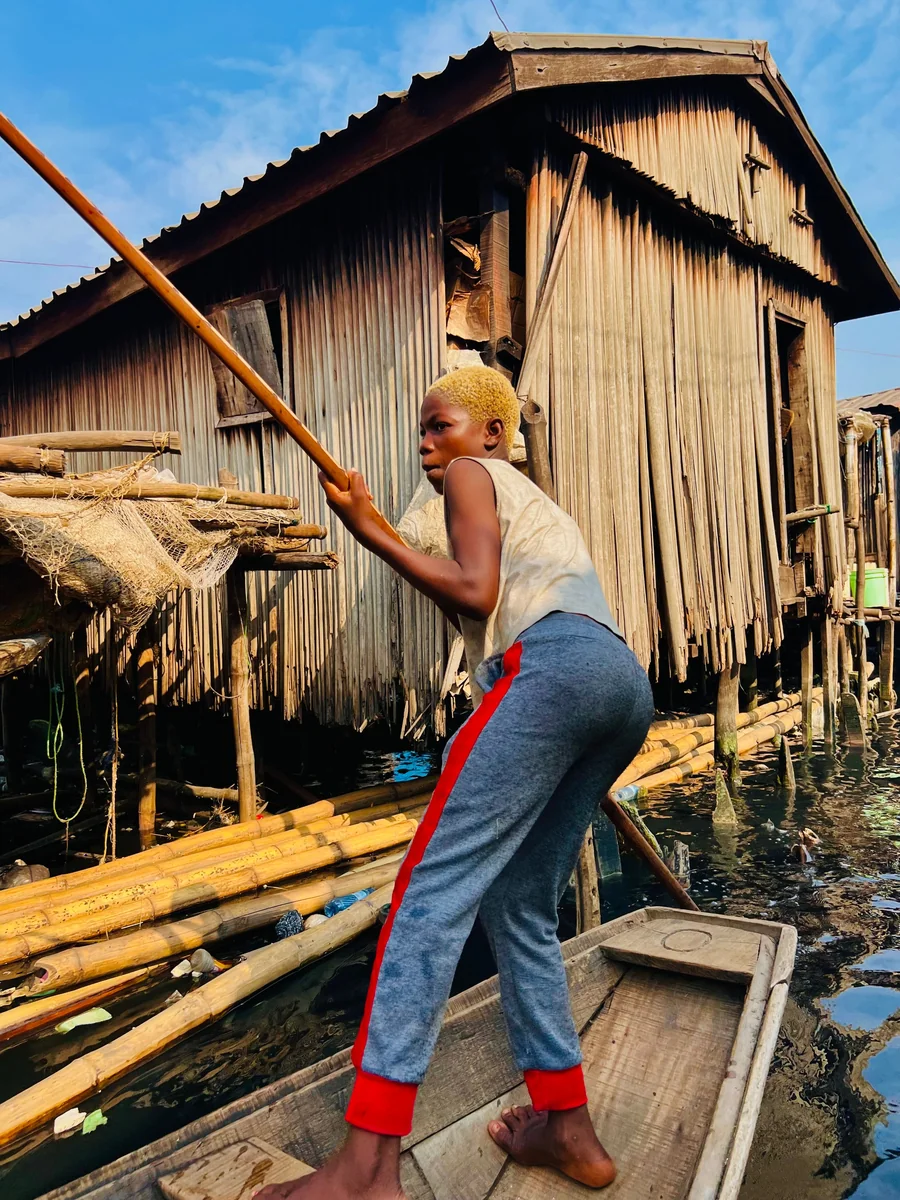
The stilt architecture of Ganvié is both intangible and tangible heritage. Construction techniques, the choice of woods, driving stilts into the mud, building horizontal structures, are knowledge transmitted orally over several generations of Tofinu carpenters, the gandjito. This heritage is valuable precisely because it is adapted to the specific conditions of Lake Nokoué.
Rising water calls some of this knowledge into question. The stilt depths that worked for decades become insufficient. Wood species suited to partial immersion are no longer necessarily suited to prolonged immersion. The most experienced carpenters of Ganvié must recalibrate knowledge transmitted on the assumption of a constant lake level. This recalibration happens without manuals, without scientific experimentation, through observation and pragmatic adjustment.
Several dozen houses in Ganvié have already been abandoned. Their wooden structures still emerge from the water in places, ghosts of an architecture that has yielded under the cumulative pressure of structural degradation and economic impossibility of rebuilding. These lake ruins are not simply visible from tourist pirogues. They are geographical markers of retreat, landmarks of a crisis advancing.
Bank erosion and loss of solid ground
Beyond the rise of the lake's average level, bank erosion literally eats away at the margins of Ganvié.
The patches of dry land that exist within and around the lake city, those hosting cemeteries, some vegetable gardens and a few collective infrastructures like the school, recede year after year. Hundred-year-old trees that served as reference points for fishermen navigating the lake have disappeared underwater in the last two decades. Banks that defined neighbourhood boundaries thirty years ago no longer exist.
This erosion creates demographic pressure on still-stable areas. Families whose houses have been abandoned or destroyed by rising water seek to resettle in already dense sectors. The densification of remaining neighbourhoods worsens sanitation problems and pirogue traffic.
Consequences on fishing and the lake economy
Fishing is the economic pillar of Ganvié. But climate change is modifying Lake Nokoué's ecosystem in ways that directly affect fishing yields.
Rising water temperature, combined with progressive salinisation of the lake due to ocean water intrusion, shifts the balance between species. Freshwater fish, tilapia from the Sô River and certain types of carp, decline in the saltiest sectors. Marine species push further in than in the past, but their presence does not compensate for the decline of locally caught species in the Acadja.
The Acadja fishing structures themselves are affected. These branch constructions, built in shallow areas, end up partially submerged at depths different from those intended during installation. Fish behaviour in more deeply submerged Acadja changes. Yields per harvest decrease, something the most experienced fishermen of Ganvié observe directly without needing scientific data to confirm it.
Fishermen must paddle further to find productive zones. This extra travel time reduces effective fishing time and increases fatigue for men whose economy depends on daily physical strength.
What is being done to protect Ganvié
Faced with these threats, several types of responses are developing at different scales.
Community reforestation initiatives are the most visible. Local associations plant mangroves and other species adapted to wet soils to stabilise receding banks. The intertwined roots of mangroves form natural barriers against erosion, and restored mangrove zones create nurseries for fish fry. These projects progress slowly, a mangrove takes several years to reach an effective size, but they represent long-term investments in ecosystem resilience.
Experimentation with construction materials is less visible but potentially more transformative. Some households experiment with reinforced concrete or composite material stilts, more resistant to prolonged immersion than traditional wood. NGOs and tropical architecture research teams test stilt house models capable of adapting to level variations, structures whose height can be increased without total reconstruction. These approaches are costly and not yet accessible to most families.
Awareness and community mobilisation form the third pillar. Local authorities and Ganvié associations organise campaigns to reduce behaviours that worsen lake erosion and pollution. Not throwing plastic waste into the water, preserving bank vegetation, avoiding construction too close to fragile zones. These individual actions will not alone compensate for systemic climate pressure, but they slow the local degradation processes.
An uncertain but not hopeless future
Climate change is a reality that Ganvié faces every day, carried by the same resilience that allowed its founders to build a city on water three centuries ago in the face of a threat of an entirely different nature.
Rising water does not spell the end of Ganvié. But it demands profound adaptation, deeper and faster than previous generations ever needed. The Tofinu have proven over three hundred years that they know how to transform constraint into invention. The question is whether the resources, financial, technical and institutional, will be available to match the scale of the challenge, and at the speed that climate change demands.
Solutions exist. They cost money, time and political will. They also demand international attention that recognises Ganvié not only as a unique tourist destination but as a living laboratory of human adaptation to an aquatic environment. Its partial disappearance would be a loss for all humanity.
To deepen understanding of the threatened architectural heritage, read our article on Ganvié stilt architecture. To understand the international recognition issues, see our article on Ganvié and the UNESCO World Heritage candidacy.
The Secret Guide to Ganvié: Hidden Gems & Etiquette
Discover the authentic Ganvié far from the tourist crowds. Download our exclusive PDF to prepare a respectful and unforgettable visit.
We respect your inbox. No spam.
The Visit Ganvié Team
Written by native Tofinu guides. We have navigated Lake Nokoué since childhood to share the true history of our city, far from tourist traps.
Related articles
Voodoo & Lake Spirituality in Ganvié: Water Shrines, Tofinu Deities & January 10th Rituals
Ganvié is not only an architectural marvel — it is a sacred territory rooted in Voodoo spirituality. Discover the intimate bond between the Tofinu people and the guardian spirits of Lake Nokoué.
edgeGanvié stilt architecture: techniques, heritage and preservation challenges
Ganvié's stilt architecture is a living heritage built on ancestral techniques transmitted orally since the 18th century. Analysis of materials, construction methods, the spatial organization of this lake city, and the contemporary challenges threatening this unique building knowledge.