
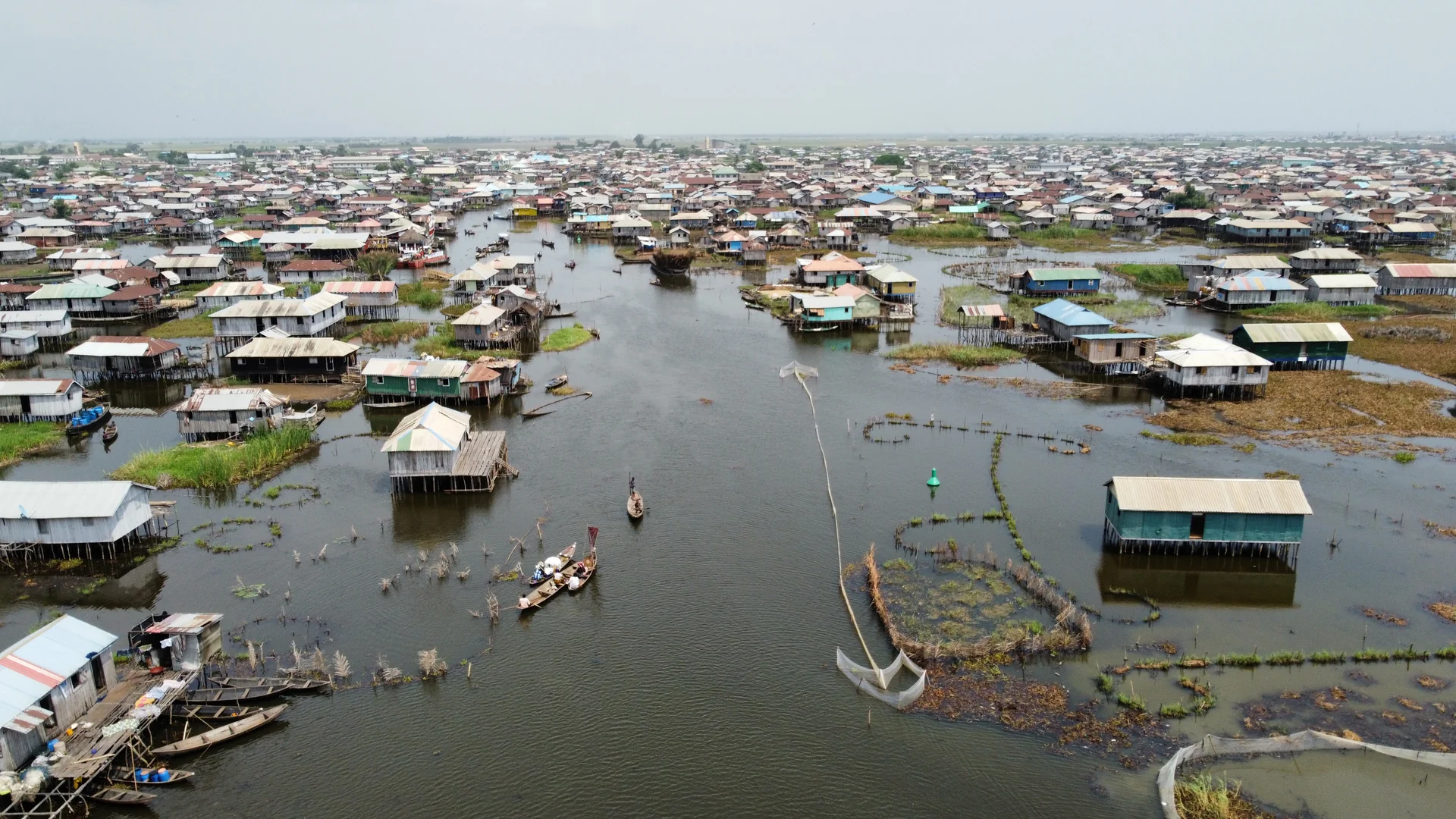
Ganvié's stilt architecture is a living heritage built on ancestral techniques transmitted orally since the 18th century. Analysis of materials, construction methods, the spatial organization of this lake city, and the contemporary challenges threatening this unique building knowledge.
Ganvié is often compared to Venice, and this popular comparison creates a fundamental architectural confusion. Venice is built on islets in a lagoon. Ganvié is built on stilts planted in the water of a lake. They are not the same thing. Ganvié stilt architecture did not seek dry land. It decided to do without it entirely.
This decision, born of necessity in the 18th century, gave rise to a body of architectural knowledge unique on the African continent. Lake stilt construction relies on locally developed techniques, transmitted orally over three centuries, adapted to physical constraints that no construction manual anticipates.
The founding constraint: building without land foundations
An ordinary house rests on solid ground. Concrete foundations, stones, compacted earth, something solid. A stilt house in Ganvié rests on poles driven into the mud of a lake.
The mud of Lake Nokoué has its own physical characteristics. Its depth varies between one and three metres depending on the area. Its composition is a mix of clay, silt and decomposing organic matter, neither completely fluid nor solid. Driving a stilt into this mud and keeping it standing for decades requires precise knowledge of the material's resistance and the forces that will act on the structure.
Tofinu builders solved this problem through observation and experimentation over generations. They identified the areas of the lake where the mud offered the best anchorage. They determined the necessary driving depth based on the height of the planned house. They understood that poles planted in pairs or threes, slightly spread at the base and joined at the top, offered better resistance to currents than a single pole. These solutions are written nowhere. They exist in the hands and eyes of the builders.
The woods for stilts: ronier palm and its equivalents
Choosing the wood is the first decision in any stilt construction project. Not all woods are suitable for permanent immersion in brackish water mixed with decomposing organisms.
Ronier palm (Borassus aethiopum), a palm tree found throughout the lake zones of West Africa, is the traditional base material for Ganvié's stilts. Its wood is exceptional for this purpose. High density makes it naturally rot-resistant. Long, regular fibres resist deformation under stress. Natural impermeability slows moisture penetration. A properly planted ronier stilt can last twenty to thirty years before needing replacement.
Bamboo is used for lightweight structures, walkways, interior partitions and window frames. Its lightness, flexibility and moisture resistance make it a natural complement to ronier for elements that do not bear the full weight of the house.
Iroko wood (Milicia excelsa), transported by pirogue from mainland forests, is used for horizontal beams and floors, the structural elements that bear the weight of occupants and furniture. Iroko is dense, hard and resists ambient humidity well, though it is more sensitive to standing water than ronier.
Mangrove wood, when available from nearby mangrove zones, has been traditionally used for the most exposed stilts, those that remain permanently submerged. Their adventitious roots intertwined in the mud create a natural anchor that few woods can match. But mangroves are becoming scarce due to deforestation of coastal areas.
The step-by-step construction process
Building a stilt house in Ganvié follows a precise sequence led by the "gandjito" (lake carpenter) with help from family members or neighbours.
First step: marking the platform. The future owner and the carpenter agree on the dimensions of the planned house. The size depends on available means and family size. A standard house measures between 15 and 30 square metres. The space is marked in the water by temporary stakes that serve as reference points.
Second step: driving the stilts. This is the most physically demanding stage. The gandjito and his helpers lift each pole above the lake surface, then let it fall under its own weight into the mud. Repeating this action progressively drives the stilt to the desired depth. There is no pile driver or mechanical system, only gravity and human strength. An average project mobilises three to five people for two to three days for this phase alone.
The verticality of the stilts is checked by eye, through experience. A slightly tilted stilt will be compensated by the horizontal structure connecting the tops. The imprecision of one is corrected by the whole.
Third step: the horizontal structure. Iroko beams are placed horizontally on top of the stilts and secured with traditional liana bindings or wire, depending on available means. These beams form the load-bearing skeleton of the platform. A first layer of wooden planks, nailed perpendicular to the beams, forms the house floor.
Fourth step: walls and roofing. Walls are traditionally built from woven bamboo. Bamboos are split into strips, woven into panels of the desired height, and fixed onto a wooden frame. This technique produces light, breathable walls that let air through but protect from rain. Some newer houses have concrete block walls laid on a concrete slab supported by the stilts.
Roofing today is almost universally corrugated metal. This imported material has replaced the woven raffia palm roofs that were standard until the mid-20th century. Metal lasts longer and does not need yearly replacement, but it is noisy during rain and heats the interior more.
Fifth step: the landing stage. Every house has a wooden staircase descending from the terrace to the water surface, sometimes to the lake bed at low tide in shallow areas. This staircase is the interface between the house and the pirogue, between private space and public lake space. Its construction is careful, because this is where goods, visitors and family members pass at all hours of the day and night.
The spatial organization of the lake city
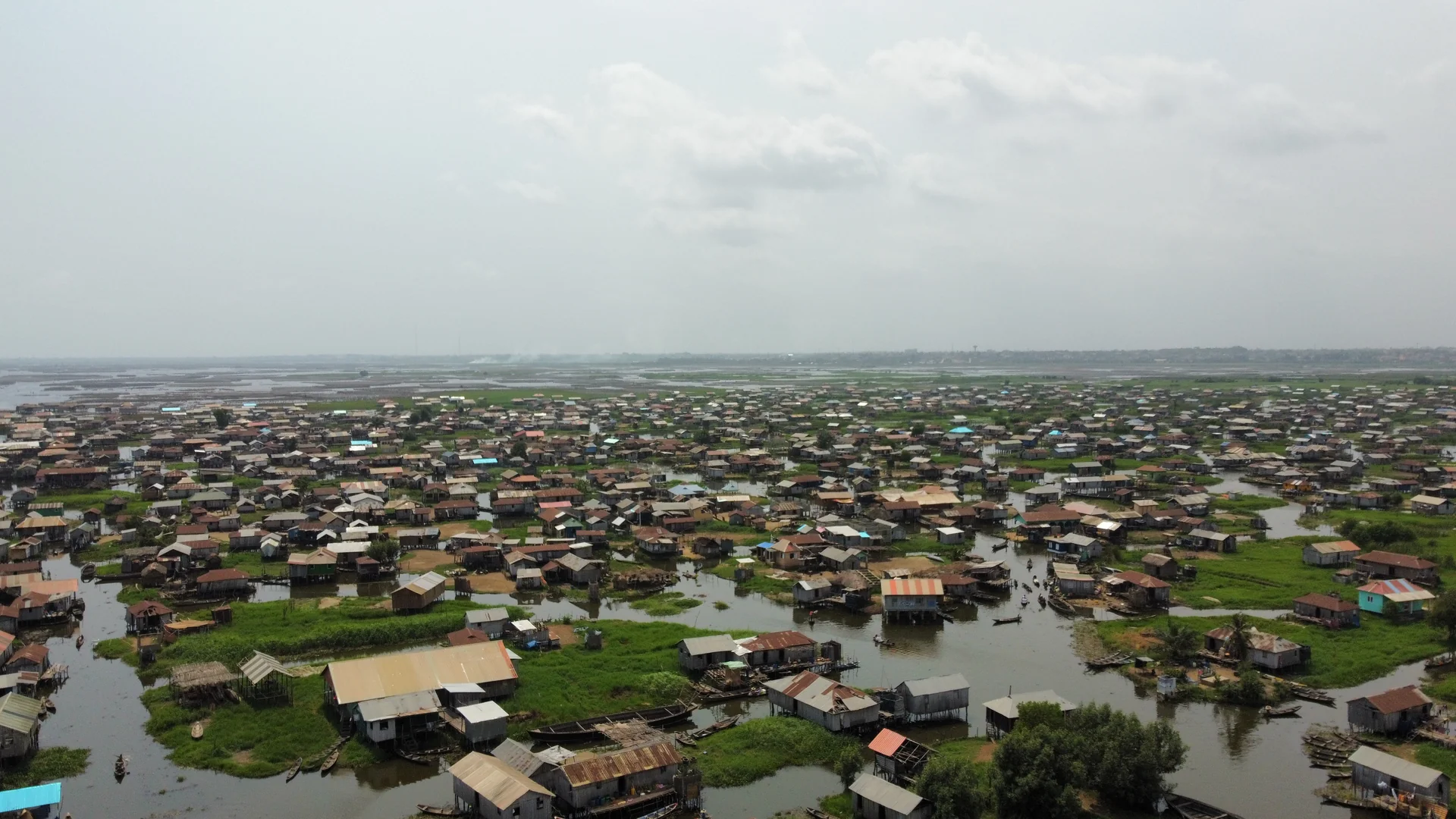
Ganvié's architecture is not read house by house. It is read at the scale of the neighbourhood and the city.
Houses are grouped by clan in areas delimited by the main canals. These canals, two to five metres wide depending on the sector, function as streets and as boundaries between neighbourhoods. The pirogue moves through these canals like a car moves through alleyways.
The main canals, the widest, connect neighbourhoods to each other and lead to the fishing zones and to the Abomey-Calavi landing stage on the mainland. Secondary canals, narrower, penetrate into the heart of neighbourhoods and allow access to the most remote houses. Some canals are so narrow that only one pirogue can pass. Meetings in opposite directions require tacit coordination between piroguers.
Shared spaces, the market, meeting areas and vodun sites, are located at canal intersections, accessible from multiple directions. This organisation reproduces the spatial logic of land villages, the central square as a point of convergence, transposed onto water.
The wooden walkways connecting houses between neighbours are an intermediate element of Tofinu urban architecture. They are not quite streets, you can step over them from a pirogue, and not quite private annexes, they are shared. Their maintenance is a collective responsibility of the families they connect.
Contemporary changes in architecture
Ganvié's architecture is not frozen. It evolves under multiple pressures that are gradually transforming the face of the lake city.
The introduction of concrete. Reinforced concrete stilts and columns appear in newer constructions. Presented as more durable than wood, which is debatable in a brackish environment that corrodes rebar, they also signal higher economic status and an aspiration to modernity. The visual result is growing heterogeneity, bamboo houses on ronier alongside concrete structures with coloured metal roofs.
Increasing house sizes. New constructions are generally larger than traditional houses. Improved living standards for some families, particularly those who have developed tourism or commercial activities, result in two-room houses, wider terraces and additional storage space.
Scarcity of traditional materials. Ronier palm is becoming rarer near Ganvié. Palms accessible by pirogue have been massively harvested over past generations. Builders must go further to find them, increasing costs. Iroko faces the same pressures. This scarcity pushes builders toward lower-quality wood or substitute materials.
The challenges of passing on building knowledge
Tofinu architectural knowledge is intangible heritage in the truest sense. It exists only in the hands and minds of those who practice it. No manuals, no plans, no specialised schools.
The most skilled gandjito are elderly men. The next generation is smaller and less trained. Young men of Ganvié are attracted to the tourism sector, guiding and piroguing, to trade, or to Cotonou, activities perceived as less physically demanding and better paid than lake carpentry.
This disaffection is not irreversible, but it demands active attention. Transmission initiatives exist, workshops with elder carpenters, photographic and video documentation programmes of techniques, but they remain insufficient given the scale of the heritage to transmit.
The tourism value of Ganvié's traditional architecture is an argument for preservation. Visitors who come for the stilt houses would be far fewer if these houses were replaced by standardised concrete buildings. The architecture is a tourist attraction, and the tourist attraction can fund its own preservation if the link between architectural quality and visitor numbers is sufficiently understood in construction decisions.
Visiting Ganvié with a native guide who explains how to read a house, identifying the age of a stilt by its colour and texture, recognising the different weaving qualities of the walls, understanding the logic of the landing stage, is a concrete way to give value to this heritage.
Experience the architecture from the inside
Looking at houses from the outside on a boat is like looking at a museum display window without going inside. Standard tours can't get you inside homes because they lack local ties. Thanks to our guides' family connections, the Premium Tour allows you to step inside an actual stilt house and meet its inhabitants (please note, out of respect for our hosts' privacy, taking photos inside is strictly prohibited).
Step inside a traditional home
Discover Ganvié's architecture from the inside out with our Premium Tours.
To explore the broader heritage dimension, read our article on Ganvié and the UNESCO World Heritage candidacy.
The Secret Guide to Ganvié: Hidden Gems & Etiquette
Discover the authentic Ganvié far from the tourist crowds. Download our exclusive PDF to prepare a respectful and unforgettable visit.
We respect your inbox. No spam.
The Visit Ganvié Team
Written by native Tofinu guides. We have navigated Lake Nokoué since childhood to share the true history of our city, far from tourist traps.
Related articles
Voodoo & Lake Spirituality in Ganvié: Water Shrines, Tofinu Deities & January 10th Rituals
Ganvié is not only an architectural marvel — it is a sacred territory rooted in Voodoo spirituality. Discover the intimate bond between the Tofinu people and the guardian spirits of Lake Nokoué.
edgeGanvié and climate change: rising waters of Lake Nokoué
Rising water levels on Lake Nokoué, accelerated by climate change, directly threaten Ganvié and its stilt dwellings. Assessment of the impacts and the solutions being implemented.