
Ganvié crafts are the material reflection of a lake civilisation: pirogue building in iroko, ronier fibre basketry, animal sculpture, mat weaving. Guide to techniques, the history of Tofinu know-how and responsible purchasing practices.
Ganvié is not only a spectacle of stilt houses and canals. It is a place of creation, where Tofinu know-how has been passed down through generations in forms that passing tourism never truly sees. Ganvié crafts were not invented for souvenir shops. They were developed out of necessity. A community settled on a lake, without daily access to dry land, had to produce for itself what it needed.
This guide covers the techniques, materials, artisans and good practices for buying with discernment in the lake city.
A material civilisation born of constraint
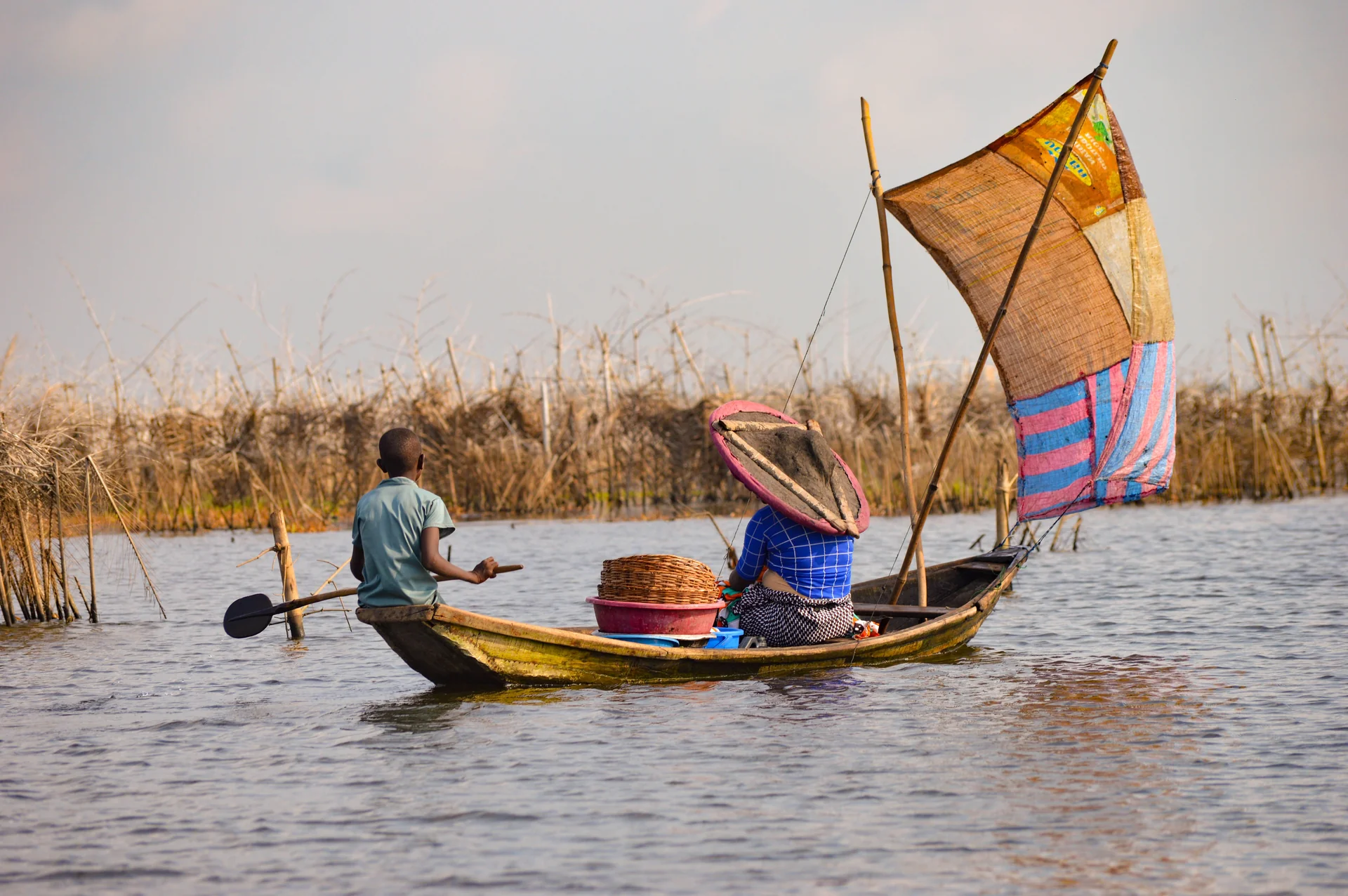
When the Tofinu chose Lake Nokoué as their refuge in the 18th century, they brought their knowledge with them, but not their tools or land-based raw materials. They had to relearn how to build, to make, to equip themselves with what the lake and its surroundings offered.
The ronier palm (Borassus aethiopum), the dominant palm of lake zones, became Ganvié's central craft resource. Its dense, immersion-resistant wood serves for house stilts. Its leaf fibres provide the material for mats and baskets. Its dried ribs go into broom and tool making. One tree, multiple uses.
Iroko (Milicia excelsa) and kapok, brought from dry land by pirogue, provided the logs for pirogue construction. Reeds from the lake margins, bamboo transported from the mainland, shells from the lake bed, every available material found its place in the lake city's craft system.
What distinguishes Ganvié crafts from the generic handicrafts found in Cotonou tourist markets is this coherence between environment and production. The objects made here respond to real, local, ancient needs.
Pirogue building: the most vital craft
The pirogue is to Ganvié what the car is to a mainland city. Without it, nothing circulates, nothing is exchanged, nobody moves. Its construction is therefore the most vital craft skill of the lake city.
A pirogue builder typically spends two to four weeks on a standard-sized vessel, working in time available between fishing and Acadja maintenance. The process begins with choosing the trunk, ideally iroko, whose wood is dense, resistant to immersion and flexible enough not to split under impact. A good trunk of four to five metres diameter can yield a pirogue usable for ten to fifteen years.
Hollowing is the most physically demanding work. The artisan uses an adze (a curved-blade tool), a wide-blade wood chisel and, depending on technique, fire to soften and bend the inner walls. The outer hull is left thick for impact resistance. The interior is progressively hollowed out until the balance between lightness and rigidity is found.
No written plans exist. Measurements are taken by eye and hand: palm widths for the bottom width, forearm length for wall thickness. These are proprioceptive knowledge transmitted by doing, not by explaining.
Visitors who arrive at the right time can observe this work in progress in certain open-air workshops on the outskirts of Ganvié. Approaching a working artisan with quiet curiosity, and asking your guide to present the situation, usually opens the door.
Basketry: ronier fibres in every shape
Basketry is perhaps the most widespread craft in Ganvié. Women weave mats, baskets, hats and decorative objects from dried ronier fibres. This is work done in groups, in conversation, often in the morning under a house awning.
Mats (gbaka in the Fon language) are the most utilitarian craft. They serve as flooring in stilt houses, no house lays parquet or tiles, as sleeping surfaces, as carpets during ceremonies. A well-woven mat lasts several years. The simplest models are single-colour or in two natural tones. More elaborate models incorporate geometric patterns, diagonals, chevrons, grids, that vary by family and neighbourhood tradition.
Baskets come in several sizes and functions. Large transport baskets with a central handle are used for carrying goods on the head. Lighter market baskets are carried on the arm. Decorative baskets intended for visitors are finished with coloured ribs forming patterns. The geometries integrated into these baskets are not purely decorative. They often encode references to lake life, wave forms, net patterns, stylised representations of the Acadja.
Wide-brimmed hats are essential on the lake. Sun reflecting off the water strikes twice. Fishermen, guides, floating market vendors, almost everyone wears a hat in Ganvié. Local models, tightly woven from dried palm, are both functional and beautiful.
Wood carving: from utility to decoration
Wood carving exists in Ganvié in two distinct registers that do not overlap: utility work, building pirogues, making paddles and utensils, and decorative work destined largely for the tourist market.
Miniature pirogues are the most representative carved souvenirs of Ganvié. A good carver reproduces the exact shape of the lake vessels, with their specific proportions different from pirogues found elsewhere in West Africa. Reduced-scale paddles, miniature jute nets tied to scale, these details identify pieces actually made in Ganvié, as opposed to generic productions bought in Cotonou and resold.
Animal carving holds a particular place. Lake fish, tilapia, captain fish, catfish, are represented with an anatomical precision that betrays the carvers' daily familiarity with these species. Lake birds, grey herons, kingfishers, cormorants, are treated with more stylistic freedom but remain immediately identifiable. Crocodiles, sacred animals in Tofinu tradition, are the most elaborate pieces and the most symbolically charged.
Masks form a more recent craft in Ganvié, influenced by traditions of northern Benin communities but reinterpreted with a lake sensibility. Forms are generally rounder, features softer than the geometric masks of the north.
Pottery: a declining tradition
Pottery is the craft knowledge declining fastest in Ganvié. Once practised by many women in the lake city, it is now concentrated in the hands of a few elderly artisans and in the neighbouring village of So-Ava, specialised in lake ceramics.
The Tofinu technique uses clay taken from the shores, mixed with crushed shells that serve as tempering. Shaping is done without a wheel, by hand, through successive modelling. Open-air firing produces a grey-black ceramic with a granular texture, recognisable among all others.
The forms produced are utilitarian. Round-bottomed cooking pots adapted to three-stone hearths, storage jars for water and grains, bowls and serving dishes. Decorative ceramics exist but are a minority in local production.
If you have the chance to meet a still-active potter in Ganvié or So-Ava, it is a window onto knowledge condemned to disappear in the short term without significant transmission to younger generations.
Where to buy crafts in Ganvié
There is no central craft shop in Ganvié. Purchases are made directly from artisans, in their workshops or along the floating market.
At the floating market: small items, miniature baskets, hats, lightweight sculptures, shell jewellery, are offered from pirogues. Transactions happen quickly, standing in the boat. This is the most accessible place for a quick purchase, but not always where prices are lowest.
In the workshops: if you express interest in an object at the market, you will often be invited to see the artisan who made it. These workshop visits are the most instructive. You see the work in progress, you understand the steps, you buy a piece whose exact origin you know.
Through your accommodation: a host family will generally put you in touch with artisans in their network if you ask. This is the most direct path to quality pieces.
Prices and negotiation
Craft prices in Ganvié are generally lower than in Cotonou, as items do not pass through intermediaries. Some reference prices for 2026:
- Small woven basket (decorative): 1,000 to 3,000 FCFA
- Fisherman's palm hat: 1,500 to 3,000 FCFA
- Miniature carved pirogue (20-30 cm): 3,000 to 8,000 FCFA
- Woven mat (60x90 cm): 2,000 to 5,000 FCFA
- Medium-sized animal carving: 5,000 to 15,000 FCFA
- Carved mask: 10,000 to 30,000 FCFA depending on complexity
Negotiation is accepted, but with a different register from the markets of Cotonou. Ganvié artisans set already tight prices. Their margin is not that of a commercial reseller. Gentle bargaining, asking for the best price for several pieces bought together, is appropriate. Aggressive pursuit of savings on 500 FCFA is not.
Bring small denomination notes. Artisans do not have card terminals, and large notes are difficult to change on the lake.
Buying with discernment
Some objects sold at the Abomey-Calavi landing stage and sometimes even at the Ganvié floating market are not made locally. Reproductions of masks and cheap wooden statuettes arrive from Cotonou, sometimes imported from neighbouring countries, and end up in tourist circuits.
A few indicators of authenticity:
An object made locally bears the traces of manual work, slight irregularities in the weave, slight variations in carved proportions, natural patina of the material. Industrial or semi-industrial pieces have a regularity that betrays their origin.
Very low prices, under 500 FCFA for a carving, under 1,000 FCFA for a basket, are a warning signal about the product's origin.
Asking to see the artisan, or visiting the workshop, even briefly, is the best guarantee of authenticity.
Buying crafts in Ganvié is much more than a tourist act. It is direct support for know-how, some of which is disappearing, and for a lake economy facing real pressures, lake pollution, youth migration to Cotonou, competition from industrial products. The money from a basket bought directly from a weaver goes into her economy, not that of a middleman on the mainland.
Book your visit
Guided tour with native Tofinu guide, private pirogue, fixed prices.
The Secret Guide to Ganvié: Hidden Gems & Etiquette
Discover the authentic Ganvié far from the tourist crowds. Download our exclusive PDF to prepare a respectful and unforgettable visit.
We respect your inbox. No spam.
The Visit Ganvié Team
Written by native Tofinu guides. We have navigated Lake Nokoué since childhood to share the true history of our city, far from tourist traps.
Related articles
Lake Nokoué: ecosystem, birds and aquatic life
Lake Nokoué is a rich ecosystem hosting hundreds of bird species, fish and aquatic plants. An ornithological and ecological guide around the lake city of Ganvié.
supportGanvié's floating schools: education on Lake Nokoué
Discover Ganvié's floating schools: how Tofinu children cross the lake by pirogue every morning to reach their stilt classroom, and the unique challenges of education in a lake city.