
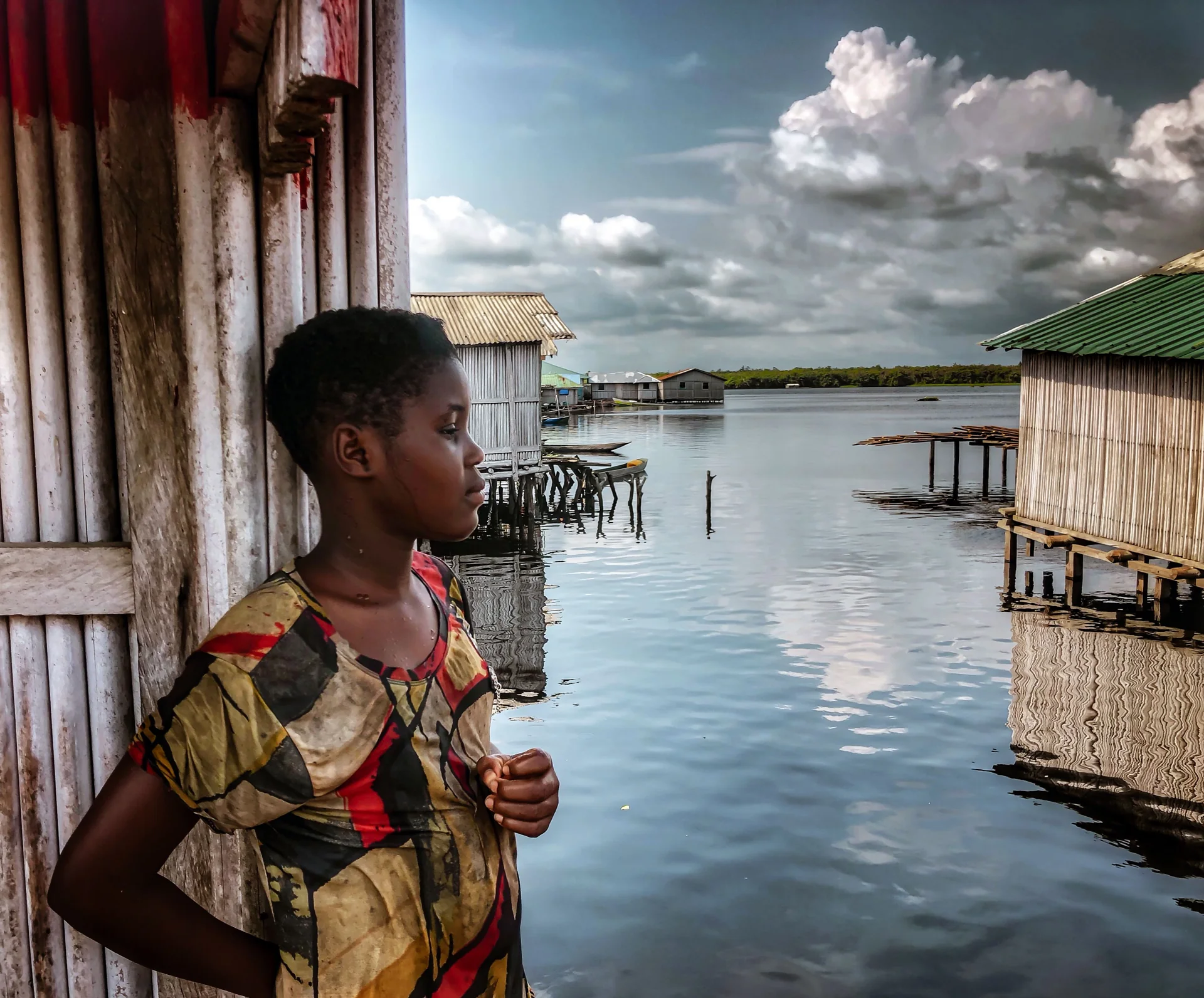
Discover Ganvié's floating schools: how Tofinu children cross the lake by pirogue every morning to reach their stilt classroom, and the unique challenges of education in a lake city.
Every morning, well before the first visitors arrive on Lake Nokoué, a silent flotilla sets in motion. Pirogues loaded with children leave the neighbourhoods of Ganvié and glide between the stilt houses in the still-golden morning light. Backpacks wedged between their feet, notebooks protected in plastic bags, ironed school uniforms. They all head toward the same point: the school. The floating school of Ganvié is not an abstract concept or a tourist slogan. It is a daily reality for hundreds of Tofinu children who live on the water and learn on the water.
What this morning pirogue represents deserves to be said. In one of the most geographically isolated communities in Benin, families of fishermen and floating market traders organise themselves every day so that their children can access a national education. This pirogue crosses a physical, economic and cultural distance every morning that the words "school commute" cannot contain.
Over 300 enrolled students. 6 levels from CP to CM2. 8 to 10 teachers. Average pirogue commute: 10 minutes. Classes from 8am to 12pm, then from 3pm to 5pm. Public school under the authority of Benin's Ministry of Education.
A school accessible only by water
Contrary to what its name suggests, the Ganvié school is not a floating structure in the literal sense. It is built on a tongue of dry land at the eastern end of the lake city, a solid patch that emerges enough from the lake to allow standard concrete block construction. But its access is entirely lacustrine. You reach it by pirogue or along wooden walkways crossing the final canals. The school is floating in its relationship to the water, not in its foundations.
Ganvié's public primary school welcomes several hundred students spread across six levels. The buildings are concrete block, with walls pierced by wide windows to let the lake breeze circulate. There is no electricity in most classrooms, except in the principal's office which is equipped with a solar panel. Lessons take place by natural light.
For children from distant Ganvié neighbourhoods, the pirogue is the only way to arrive. The youngest, aged five or six, leave with their mother or an older sister, seated at the front of the boat, backpack between their feet. Older children paddle alone or in small groups of two to four. The crossing takes between five and twenty minutes depending on distance and wind. When the wind blows against them from the lake, the crossing can take twice the usual time.
This morning crossing has become the most iconic image of education in Ganvié. It illustrates a paradox worth naming. These children live in one of Benin's most isolated cities, yet they go to school every day with an autonomy and responsibility that few children their age experience on dry land. An eight-year-old who manages his pirogue alone through the channels of Ganvié develops navigation skills, weather-reading abilities and risk management that the school curriculum will never directly teach him.
How a school on the water works
The Ganvié school follows the national Beninese curriculum. The subjects taught are the same as in any primary school in the country: French, mathematics, life and earth sciences, history-geography, civics. But adaptation to the lake context is constant, informal and creative.
A teacher explaining fractions might use fish distribution at the market as an example. A lesson about the seasons can incorporate variations in lake level and their impact on fishing. Geography taught here is not abstract. The children already know the canals, the fishing zones and the neighbouring lake villages better than any textbook can describe them.
Classrooms are equipped with wooden bench-desks. Drinking water arrives in containers delivered by pirogue from Abomey-Calavi, a logistical supply that illustrates how much the lake city still depends on the mainland for its basic needs. Latrines are located on a raised platform away from the classrooms. During the rainy season, when the lake level rises, the playground can be partially flooded. Children then play on the highest parts or stay under the shelter.
Break times are particularly interesting to observe. The children of Ganvié play like children everywhere in Benin, improvised football, skipping games, running, but as soon as the end-of-break bell rings, they return to their pirogues moored along the bank with an efficiency and navigational discipline that their teachers did not teach them.
The daily life of Ganvié schoolchildren
A Ganvié schoolchild's day begins before dawn. They wake up, have a quick breakfast, often corn porridge with sweetened condensed milk, or akara (fried bean fritters) bought from a vendor pirogue that passes early through the canals. They grab their backpack and descend into the family pirogue.
Classes start at 8am, but arrival is staggered depending on distance. The first arrive at 7.30am, others until 8.15am. Pirogues accumulate along the school bank, moored to each other in compact rows. Children jump from pirogue to pirogue to reach the shore, with the lightness of someone who has made this gesture thousands of times.
The morning session runs until noon. Then children return to their neighbourhood for lunch. In the afternoon, classes resume from 3pm to 5pm. The pirogues make the trip in reverse, twice a day.
For many students, the journey to school is also a time for play and socialising. They paddle in groups, splash each other, laugh at clumsy manoeuvres. Sometimes a pirogue tips slightly in the wider canals. But here, every child knows how to swim before they know how to read. Falling into the lake is an inconvenience, not a catastrophe. This early learning of the physical relationship with water, understanding currents, depths, real risks distinct from imagined ones, is one of the foundations of Tofinu competence.
The challenges of education in a lake environment
The Ganvié school faces structural difficulties that land-based schools do not encounter and that cannot be resolved through pedagogical goodwill alone.
Seasonal absenteeism is the most documented problem. During the rainy season, the number of present students drops significantly. Crossings are more dangerous when seasonal winds blow and waves on open parts of the lake become unpredictable. Families keep children at home on bad weather days, with a caution that is justified but accumulates missed days. Afternoon storms regularly interrupt the 3pm session. Teachers have learned to watch the sky as much as the board.
School supplies do not cope well with the lake's chronic humidity. Notebooks warp, book covers peel off, ink pens clog. Families must replace supplies several times during the school year, an additional cost in budgets that are not already flexible. The plastic bags children use to protect their belongings are a pragmatic solution and an additional source of pollution in the lake.
Teacher recruitment remains one of the most persistent problems. Few trained teachers voluntarily accept postings to Ganvié. Geographic isolation, the absence of official housing on the lake, daily transport conditions (obligatory pirogue crossing) and identical pay to more accessible posts reduce applications. Teachers who accept often come from the region and have a pre-existing relationship with life on the water. Those who arrive without this familiarity generally go through a difficult adjustment period.
Access to secondary education is the most structurally defining educational challenge. After CM2, Ganvié students who want to continue their studies have no choice but to leave the lake city for Abomey-Calavi or Cotonou. This means living with a relative in the city, paying for board or making long, costly daily trips. This constraint is a real economic filter. Less wealthy families often choose to stop schooling after primary, not from lack of interest in education, but from financial impossibility.
Remarkable resilience in context
Despite these obstacles, the school enrolment rate in Ganvié progresses every year. Tofinu families measure the value of education with a precision that national statistics do not capture. Parents who never set foot in a school insist that their children attend. The morning pirogue is the daily proof of this determination.
Initiatives for lake education
In recent years, several initiatives have improved learning conditions in Ganvié.
National and international NGOs have funded the construction of new classrooms, roof renovations and the installation of solar panels on some buildings. These investments have allowed the introduction of a few computers in a dedicated room, giving CM1 and CM2 students a first contact with digital technology, even though internet access remains non-existent in Ganvié.
School meal programmes, supported by international partners, provide a hot meal to students several days a week. This initiative has a direct and measurable effect on attendance regularity. Families who know their children eat at school send them more consistently, even in bad weather.
The Beninese government has integrated Ganvié into its priority education programmes for difficult environments. Isolation bonuses are officially planned for teachers posted to lake positions. Their application remains uneven, but institutional recognition of the problem is progress.
The most ambitious discussion concerns the creation of a stilt secondary school, a middle school infrastructure that would allow Ganvié's adolescents to continue their studies without leaving the lake. This project, still at the planning and fundraising stage in 2026, represents the most important educational challenge for the Tofinu community in the years ahead.
School and tourism: how to behave
The pirogue of Ganvié schoolchildren has become one of the most photographed images of the lake city. Visitors are regularly struck by the calm discipline of these uniformed children crossing the lake at dawn or returning to their neighbourhoods in paddling groups in the afternoon.
This image is real and deserves to be seen. But it also deserves to be seen with respectful eyes.
Children are going to school. They are not a tourist attraction. Photographing them without their parents' permission, blocking their pirogue path for a better frame, or calling out to them to pose are not appropriate behaviours. A smile and a small wave, on the other hand, are often rewarded with genuine enthusiasm.
If you wish to concretely support education in Ganvié, ask your guide or local associations about appropriate forms of help. Buying school supplies directly from Ganvié shops, sponsoring a child through a verified local association, or donating to the school through transparent channels are gestures whose impact is direct and measurable.
Going further
To better understand the lives of Ganvié children beyond school, read our article on a day in the life of a Ganvié inhabitant. You will discover how the school pirogue fits into the broader rhythm of the lake city.
To learn about the history of Ganvié and the Tofinu people, our article on the history of Ganvié explores the origins of this unique city.
Support education in Ganvié
Your visit contributes to the local economy. Ask your guide about educational initiatives.
Book your visit
Guided tour with native Tofinu guide, private pirogue, fixed prices.
Questions fréquentes
Where exactly is the Ganvié school located?
Do all Ganvié children attend school?
How do teachers get to Ganvié?
Is there a middle or high school in Ganvié?
Can tourists visit the school?
How can I concretely support education in Ganvié?
The Secret Guide to Ganvié: Hidden Gems & Etiquette
Discover the authentic Ganvié far from the tourist crowds. Download our exclusive PDF to prepare a respectful and unforgettable visit.
We respect your inbox. No spam.
The Visit Ganvié Team
Written by native Tofinu guides. We have navigated Lake Nokoué since childhood to share the true history of our city, far from tourist traps.
Related articles
Lake Nokoué: ecosystem, birds and aquatic life
Lake Nokoué is a rich ecosystem hosting hundreds of bird species, fish and aquatic plants. An ornithological and ecological guide around the lake city of Ganvié.
edgeGanvié crafts: carving, weaving and Lake Nokoué know-how
Ganvié crafts are the material reflection of a lake civilisation: pirogue building in iroko, ronier fibre basketry, animal sculpture, mat weaving. Guide to techniques, the history of Tofinu know-how and responsible purchasing practices.