
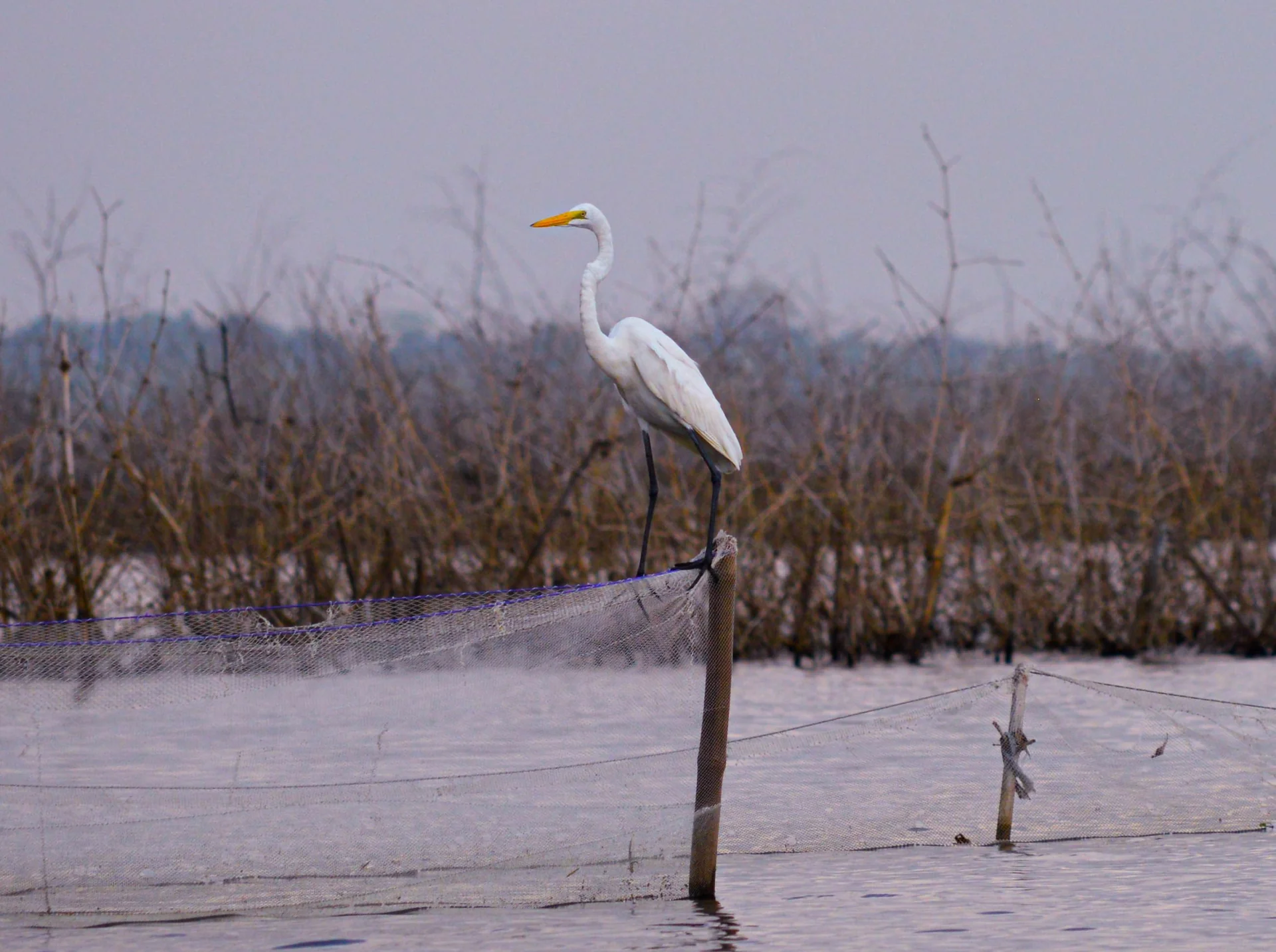
Lake Nokoué is a rich ecosystem hosting hundreds of bird species, fish and aquatic plants. An ornithological and ecological guide around the lake city of Ganvié.
Lake Nokoué is much more than the liquid foundation on which Ganvié rests. It is a complex and dynamic ecosystem, a brackish coastal lagoon that functions as a crossroads between the freshwater of inland rivers and the saltwater of the Atlantic, between coastal wetlands and the urban agglomerations bordering it to the south.
For the visitor crossing the lake by pirogue toward Ganvié, attention naturally goes to the stilt houses, the market pirogues, the human silhouettes. But those who lift their eyes to the sky or lower them to the water discover another spectacle. The birds fishing from abandoned posts, the fish tracing wakes at the surface, the aquatic plants forming green islands in the calm sectors of the lake.
This guide is for those who want to see both: the lake city and the ecosystem that supports it.
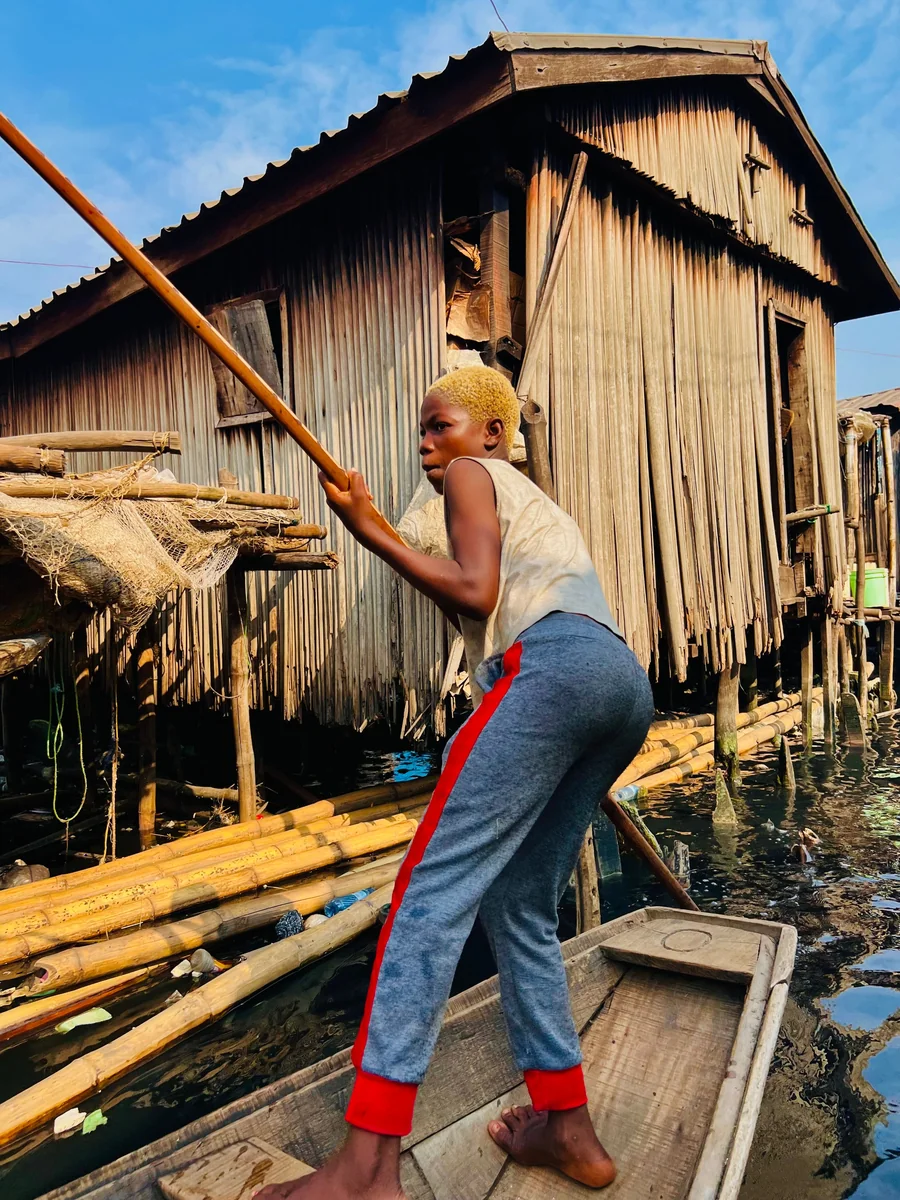
Geography and characteristics of Lake Nokoué
Lake Nokoué covers about 150 square kilometres and is the largest lake in Benin. It is located between the Cotonou urban area to the south, the commune of Abomey-Calavi to the north-west and Porto-Novo to the east, connected to the latter by Lake Nokoué-East and the Sô River.
The lake is classified as a lagoon, a coastal body of water separated from the sea by a sand barrier and maintaining a partial connection with the Atlantic via the Cotonou channel. This configuration creates brackish water whose salinity varies according to season, geographic position within the lake and rainfall. The southern part and the Cotonou channel are the saltiest. The northern and eastern zones, fed by inland rivers, remain fresher.
Average depth is shallow, between 1 and 2 metres, with deeper areas in the main channels. This shallowness makes the lake highly sensitive to seasonal variations and explains why the Acadja, the Tofinu fish traps, work so well. Fish have nowhere to flee in depth.
Birds of Lake Nokoué
Lake Nokoué hosts significant ornithological diversity. Over 150 bird species have been recorded on its shores and waters, making this coastal lagoon a site of interest for both amateur and experienced birdwatchers.
Grey herons and cattle egrets are the most visible residents of the lake. They are observed motionless on stilts of abandoned houses, on dead branches emerging from the water, or at the edge of Acadja, watching for fish with a patience that photographers envy. The grey heron (Ardea cinerea) can remain in the same position for entire minutes before striking the water with its beak with absolute precision. Tofinu fishermen know this behaviour well and respect it. A heron stationed near an Acadja signals that the sector is fish-rich.
Kingfishers are the jewels of the lake. The pied kingfisher (Ceryle rudis), with its black and white plumage and imposing beak, is a regular on the Ganvié canals. It dives arrow-like from a perch, a post, a branch, sometimes the edge of a moored pirogue, and regains its position in seconds with a silver fish in its beak. Its diving speed exceeds 90 km/h. Its presence in a canal indicates relatively clear and fish-rich water.
Egrets patrol the shallow waters constantly. The little egret (Egretta garzetta), small and entirely white, is the most common. The intermediate egret (Mesophoyx intermedia) is slightly larger and frequents the same areas. In the dry season, when the lake level drops and fish concentrate in shallow areas, dozens of egrets gather in the same sectors, creating visually striking collective hunting scenes.
Greater flamingos visit Lake Nokoué seasonally, mainly between November and February. They stay in the least frequented parts of the lake, where salinity is highest, particularly near the Cotonou channel. Their presence in numbers, which can reach several hundred individuals in some years, is an indicator of water quality and ecosystem balance. Years when flamingos are absent or few trouble the most observant fishermen.
The osprey (Pandion haliaetus) soars over the lake looking for surface fish. A migratory raptor wintering on the coastal lagoons of West Africa, it plunges feet-first into the water at impressive speed and flies off with its catch. The black kite (Milvus migrans), more opportunistic, circles above the floating market at day's end, scavenging for fish waste.
Waders and gulls use Lake Nokoué as a migratory stopover. In October-November and March-April, sandpipers, stints and gulls in transit between Europe and sub-Saharan Africa pause on the lake's shores. These species are present for only a few days, but their passage marks moments of intense ornithological activity.
Fish of Lake Nokoué: the food chain
The Lake Nokoué ecosystem rests on a food chain in which fish are the central link. Several species coexist in the brackish waters, creating a fishery wealth that directly feeds the inhabitants of Ganvié and supplies the markets of Cotonou.
Tilapia (several species of the genus Sarotherodon) is the most caught and most consumed fish. Omnivorous and hardy, it reproduces quickly and resists well the salinity variations that characterise the lagoon. Tofinu Acadja are specifically designed to attract and concentrate tilapia. The branches create a habitat that reproduces the conditions of natural spawning grounds.
Captain fish (Lates niloticus in its lake variant, or Chrysichthys nigrodigitatus) is the lake's large predator. Carnivorous, it hunts tilapia and mullet in the deep channels. Its firm flesh and size, up to several kilograms, make it the most prized fish at the floating market, sold at significantly higher prices than tilapia.
Mullet (Mugil sp.) regularly migrate up the communication channel between the lake and the Atlantic Ocean. These migratory fish arrive in large schools at certain seasons, creating intensive fishing opportunities that mobilise many families. Their arrival is awaited and anticipated by fishermen who know the lake's cycles.
Shrimp and crabs complete the list of exploited species. Brackish water shrimp (Penaeus sp.) are caught by women and children in shallow areas using small gill nets. Mangrove crabs occupy areas where mangroves still survive. These secondary species represent a significant food and commercial supplement for Ganvié households.
Aquatic flora and lake landscapes
Lake Nokoué is not a simple uniform body of water. It consists of several distinct ecological zones that vary according to depth, salinity and proximity to the shores.
Water lilies and water hyacinths form floating mats in the calm areas of the lake, sheltered from currents. The purple flowers of the water hyacinth (Eichhornia crassipes) are visually attractive. They are also one of the most serious environmental problems on the lake. An introduced invasive species, hyacinth proliferates in response to nutrient enrichment of the waters, agricultural fertilisers, wastewater, and can obstruct entire channels in a few weeks. Its floating roots capture dissolved oxygen and create dead zones for fish.
Mangroves border certain shores of the lake, particularly in the southern sector where water is saltiest. These plant formations play a major ecological role: bank stabilisation against erosion, filtration of pollutants from the watershed, provision of nursery habitats for tilapia and mullet fry. Deforestation of mangrove zones around the lake for agriculture and urbanisation has significantly reduced these protective areas since the 1980s.
Submerged aquatic plants, invisible from the surface, constitute the main habitat for aquatic insect larvae, small shrimp and fry. They are the primary producers of the lake ecosystem, converting solar energy into plant biomass that enters the food chain. Their density and health directly condition the lake's fishery productivity.
Seasonal variations in the ecosystem
The Lake Nokoué ecosystem is not observed the same way from one month to the next. The seasons profoundly structure the life of the lake.
In the rainy season (April to October), the lake level rises by 30 to 60 centimetres depending on rainfall intensity. Freshwater from inland rivers dilutes the lagoon's salinity. Fish disperse into flooded areas, making fishing less concentrated but more extensive. This is the breeding period for many tilapia species. Females brood eggs in their mouths to protect them. Nesting birds take advantage of abundant vegetation to build nests in reeds and mangroves.
In the dry season (November to March), the lake level drops, salinity increases in sectors near the Cotonou channel and fish concentrate in deeper channels. This is the best season for bird observation. Herons and egrets gather around the most productive fishing areas. Flamingos appear when salinity reaches their comfort threshold. African cormorants dive in groups in the channels.
The harmattan (December to February) brings a veiled sky of Saharan dust carried by north-easterly winds. The light is diffuse, filtered, of particular photographic quality. Temperatures drop at night and mornings are cool on the lake. Migratory birds from Europe, barn swallows, yellow wagtails, chiffchaffs, stop on the shores during their journey toward southern Africa.
Birdwatching on Lake Nokoué from Ganvié
Ganvié is an excellent starting point for birdwatching. Most Lake Nokoué species are visible from a pirogue during a crossing between the city's canals and the wilder areas of the lake.
The best observation sectors are in the south-eastern part of the lake, where remaining mangroves host nesting birds, and near the mouth of the Cotonou channel, where marine and lake species meet. Abandoned Acadja, with their protruding posts, are prized perches for herons and cormorants.
The ideal time is early morning, between 6am and 8am, when birds are most active, the light is at its best and tourists are still absent. Late afternoons, just before sunset, constitute the second ideal window. Between these two peaks, the hottest hours of the day are generally less productive for observations.
For birdwatchers equipped with binoculars or a telephoto lens camera, a pirogue excursion off the main tourist circuits, into mangrove sectors or little-frequented fishing areas, allows observation of the more discreet species without disturbing them. A native guide who knows the lake will be more useful than any published site list.
An ecosystem under pressure
Lake Nokoué is an ecosystem under multiple pressures. Urban pollution from Cotonou, plastic waste, untreated industrial and domestic wastewater, fuel residues from motorised boats, has been degrading water quality continuously since the 1970s.
Sedimentation linked to deforestation of watersheds progressively fills the lake's shallow areas and reduces the useful surface for fish reproduction. The Acadja themselves contribute locally to sedimentation by slowing currents.
Overfishing in some sectors, particularly illegal trawling on the lake's periphery, depletes adult fish stocks and disturbs balances between species. Nets with mesh size too small, used to maximise short-term yield, catch fry before they can reproduce.
Water hyacinth proliferation, amplified by water eutrophication, creates oxygen-depleted zones where fish cannot survive. In some sectors, these hyacinth mats cover several hectares and require regular manual removal to maintain pirogue circulation in the channels.
Becoming aware of this fragility means learning to visit Ganvié and Lake Nokoué with appropriate behaviours. Throw nothing into the water. Do not disturb nesting birds. Prefer operators who use electric motors or paddle pirogues in sensitive areas.
Want to explore Lake Nokoué and observe its birds? Book a pirogue excursion with a nature guide who knows the best spots for combining discovery of Ganvié with lake biodiversity observation.
Book your visit
Guided tour with native Tofinu guide, private pirogue, fixed prices.
The Secret Guide to Ganvié: Hidden Gems & Etiquette
Discover the authentic Ganvié far from the tourist crowds. Download our exclusive PDF to prepare a respectful and unforgettable visit.
We respect your inbox. No spam.
The Visit Ganvié Team
Written by native Tofinu guides. We have navigated Lake Nokoué since childhood to share the true history of our city, far from tourist traps.
Related articles
Ganvié's floating schools: education on Lake Nokoué
Discover Ganvié's floating schools: how Tofinu children cross the lake by pirogue every morning to reach their stilt classroom, and the unique challenges of education in a lake city.
edgeGanvié crafts: carving, weaving and Lake Nokoué know-how
Ganvié crafts are the material reflection of a lake civilisation: pirogue building in iroko, ronier fibre basketry, animal sculpture, mat weaving. Guide to techniques, the history of Tofinu know-how and responsible purchasing practices.