
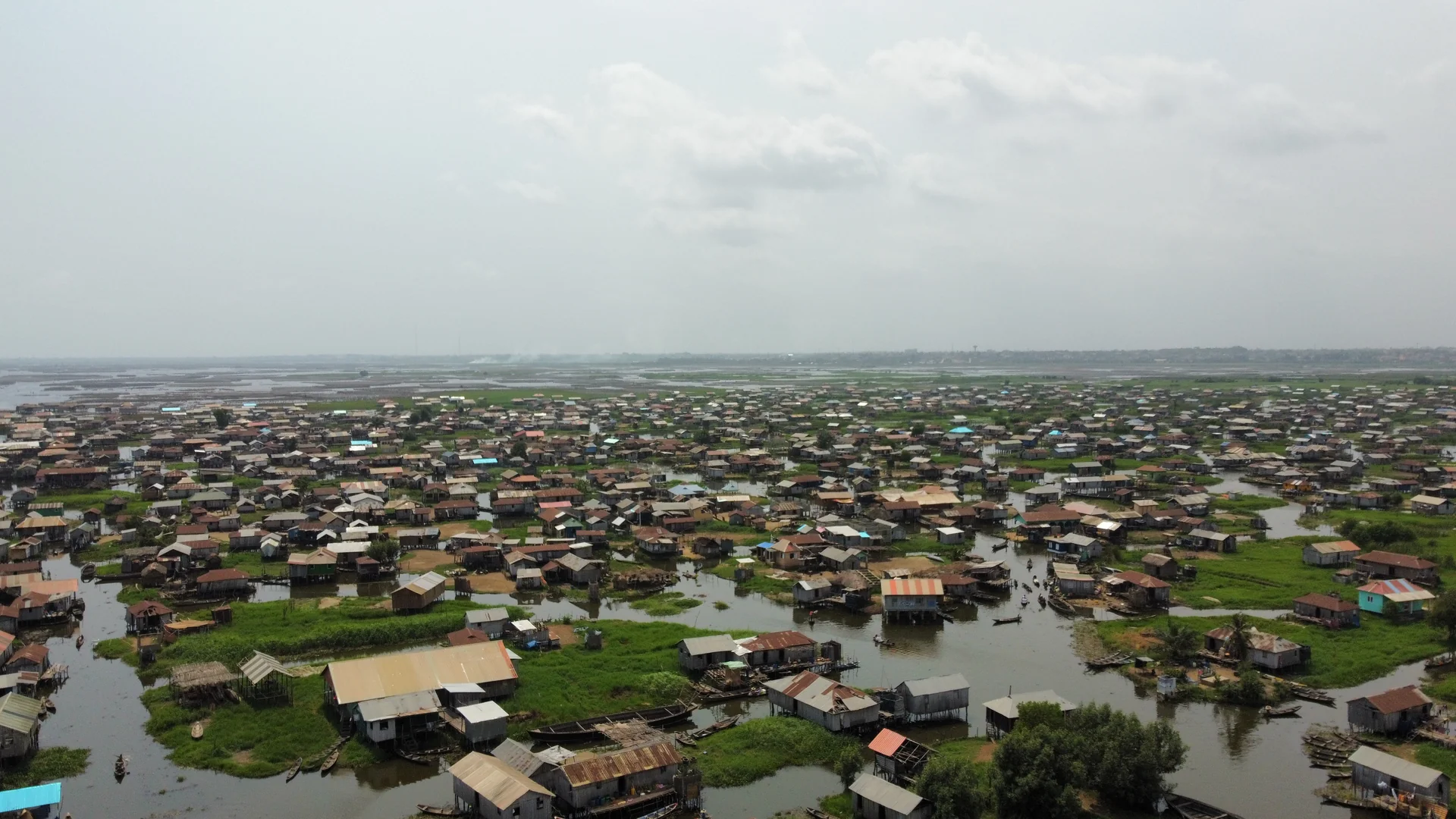
Complete guide to what to see in Ganvié: floating market, canal tour through stilt-house neighbourhoods, Acadja fishing, artisan quarter, neighbouring villages and what day-trippers never reach. Half-day and full-day itineraries with timing.
Every visitor who steps into a pirogue at Abomey-Calavi asks the same question before the motor starts: what to see in Ganvié that makes the crossing worth it? The floating market, obviously. The stilt houses. The canals. But Ganvié is not a museum of a few set pieces — it is a living city of 30,000 people where the most interesting things to see are distributed across time, not just space.
This guide organises those things by duration: what you can cover in a half-day, what becomes accessible with a full day, and what day-trippers never reach.
The pirogue crossing as the first thing to see
 Before you arrive in Ganvié, you will cross Lake Nokoué. That twenty-minute journey by motorized pirogue from the Abomey-Calavi embarcadère is not a transfer — it is the opening act.
From the water, you start to understand Ganvié's scale. The lake is large enough that the city is invisible until you're five minutes into the crossing. Then the silhouettes of stilt houses appear on the horizon and multiply as you approach. The structures emerge from the water — some clustered tightly, others set apart, surrounded by rings of branches that your guide will explain as Acadja fishing installations.
By the time you dock at Ganvié's main landing, you have already understood something about the place that no photograph on a travel website communicates: this community is genuinely on the water. Not a village near a lake. On the lake.
The floating market: the best reason to arrive early
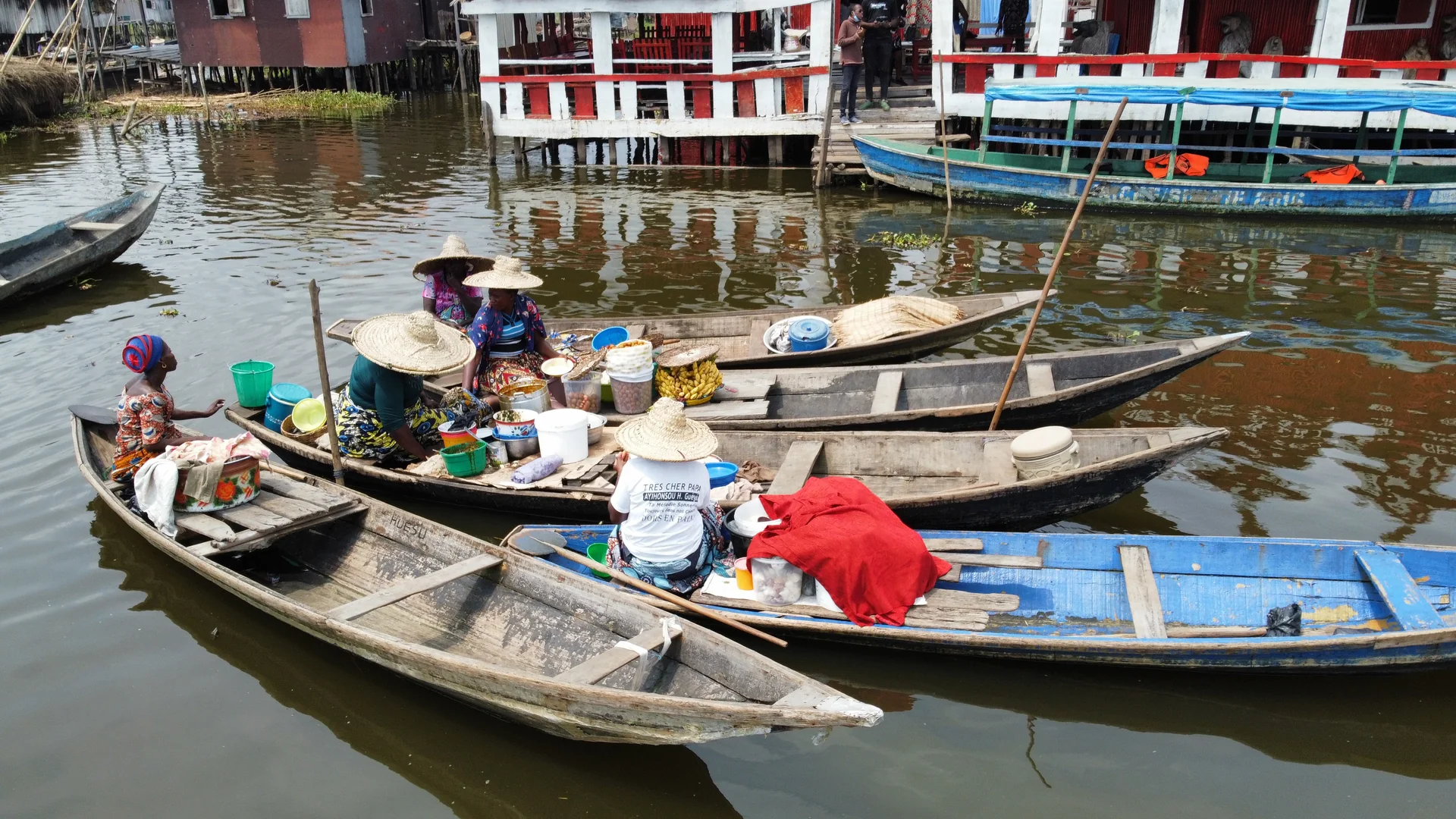
The floating market is the logical first stop whatever the length of your visit. It begins before dawn, but the peak activity for visitors happens between 6 and 8 am. Hundreds of pirogues converge on the central market zone, loaded with fish, fruit, vegetables, fabrics and household goods. Tofinu women negotiate, call out to each other, sort products and make change with the ease of people who have done this work every morning since childhood.
This market has two distinct phases, and most visitors only see the second.
The wholesale phase (4 am to 6:30 am) is where the night's fishing catch changes hands. Fishermen who have worked all night on their Acadja structures arrive with their haul. Specialist vendors buy in bulk while it is still dark, then resell retail as the sun rises. This phase is invisible to day-trippers from Cotonou — accessing it requires sleeping on the lake.
The retail phase (6:30 am to noon) is what arriving visitors see. This is the Ganvié that appears in travel magazines: colorful pirogues loaded with red tomatoes, green plantains, smoked fish, fabric bolts; the calls of vendors; the light on the water. It is a genuine and spectacular spectacle, not a staged one for tourists.
To experience the market fully, arrive between 6 and 7 am. By 9:30 am, the main activity has already peaked.
For more on market economics and timing, read our complete guide to the Ganvié floating market.
Leave Cotonou at 5:30 am. Arrive Ganvié 7:00 am. Floating market (7:00–8:00). Canal tour through stilt-house neighbourhoods (8:00–9:30). Artisan quarter (9:30–10:15). Lunch at stilt restaurant (10:15–11:00). Return crossing to embarcadère, back in Cotonou around 12:30 pm.
The canal tour: what is inside the market photo
Visitors who see Ganvié from their pirogue as a sequence of market photos and stilt-house silhouettes are seeing a small fraction of what there is. The canals that run between the residential neighbourhoods reveal the actual city.
These channels function as streets. The pirogue is the bicycle, the car, and the delivery truck all at once. Your guide navigates between rows of stilt houses where daily life is visible from the water: a woman washing clothes at the stairway that dips into the lake, children playing on a wooden terrace, a fisherman repairing a net in the shade of his house, smoke rising from a cooking fire on a covered platform.
The architecture is worth close attention. Stilt houses in Ganvié are built on rônier palm poles — a wood dense enough to resist years of immersion. The main structure is typically bamboo woven into panels, with a corrugated iron roof. Some older houses have walls of fired clay brick, which requires a reinforced platform below and signals a family of greater means. Walking-width footbridges connect neighbours who would otherwise be separated by water.
The canal tour also shows you the Acadja fields. These rings and rectangles of branches protruding from the water surface surround much of Ganvié. From above, the lake around the city looks like a patchwork of geometric shapes. From water level, they are simply clusters of branches — their significance is ecological and economic, not visual. A good guide will stop the pirogue near an Acadja and explain what is happening underneath: the miniature ecosystem that concentrates fish for harvest.
The artisan quarter: craftsmanship on the water
On the outer edge of Ganvié, craftspeople maintain techniques that have not changed materially in generations. These are not curio sellers running a tourist stall — they are the people whose work supplies the rest of the community.
Pirogue builders are perhaps the most striking to watch. The construction of a pirogue from an iroko trunk is weeks of work: felling, rough shaping, hollowing, smoothing, treating with fire. A finished pirogue can last a decade with regular maintenance. The builder's tools are simple — adze, chisel, fire — and entirely manual.
Mat weavers work with fibres from the rônier palm, the same tree whose wood holds up the stilt houses. Strips of dried palm leaf are woven into floor mats, wall panels, and ceiling covers. The technique is identical to what the first Ganvié residents used when they built the original stilt houses in the eighteenth century.
Basket makers work with bamboo strips, producing carrying baskets, fishing traps, and market goods. The bamboo arrives from the mainland by pirogue.
Potters maintain a tradition that connects Ganvié to the neighboring village of So-Ava, known throughout the region for its ceramic production. Some Ganvié families have pottery skills transmitted across generations.
Buying directly from these artisans keeps money in the community. The prices are typically lower than what you would pay for the same items at the Abomey-Calavi embarcadère from intermediary vendors.
The Acadja zones: an ecological marvel worth a stop
Most visitors see the Acadja structures from a distance during the canal tour. A guide who is genuinely from Ganvié can take you closer — to the edge of an active installation where you can see the branches, understand the system, and perhaps observe a fisherman at work if your timing is right.
Acadja fishing is one of the most ecologically intelligent low-tech aquaculture systems in the world. Branches planted in the lake create artificial habitat that attracts algae, microorganisms, invertebrates, and finally fish. After several weeks, the fish concentration is high enough for a net harvest. The technique uses only biodegradable materials and actively increases the lake's biodiversity in the zones where it is installed.
Observing this from a pirogue — the branches in the water, the fisherman tending his structure, the lake ecology made visible — is one of the most instructive stops on a Ganvié visit, and one of the most frequently skipped in favour of the floating market alone.
The best time to see Acadja in active use is the morning, between 5:30 and 8 am. For more detail on the technique and its history, read our guide on Acadja fishing in Ganvié.
Full-day visits: what you access with more time
What a full day unlocks
A half-day shows you Ganvié. A full day lets you understand it. The difference lies in the unhurried pace and the stops that require time rather than just access: a family visit, an Acadja harvest, the quiet of the afternoon, the light of late afternoon on the lake.
A visit with a Tofinu family
A guide from the community can take you into a Tofinu home — not a demonstration house set up for tourism, but a family that agrees to receive visitors for an hour. You step inside a stilt house: the single room with bamboo walls, the rolled sleeping mats, the cooking stove, the solar lamp on the windowsill. The family often shares tea or bissap juice. Conversation, through your guide, might cover how they built the house, how they access water, where the children go to school.
This is the stop that separates a Ganvié visit from a Ganvié photograph. Day-trippers on fast circuits never experience it.
The neighbouring villages: So-Ava and Sô-Tchanhoué
Lake Nokoué supports several communities beyond Ganvié. So-Ava, half an hour by pirogue to the northeast, is the lake community known for its pottery. Sô-Tchanhoué, closer to Ganvié, is associated with weaving. A three-village pirogue circuit covers all three in a full day and shows how different lake communities have developed different economic specializations around the same basic water-living conditions.
The dual market: gros and détail
Visitors who arrive at 7 am see the retail market at its peak. Those who have slept on the lake can see the transition between the wholesale phase and the retail phase at 6 am — when the dynamics shift, the wholesale vendors disperse, and the daylight sellers take their places. This double market visible only to those on the lake before dawn is one of the more compelling arguments for staying overnight.
What day-trippers never see
The most interesting things in Ganvié happen at the edges of the standard visit window.
The dawn market (4 am to 6 am): only accessible to overnight guests. The wholesale fish market, the pre-dawn light on the water, the silence of the lake except for paddles and voices.
The afternoon quiet (noon to 4 pm): after the morning's tourist wave, Ganvié returns to its own rhythm. The canal becomes a neighbourhood — conversations between terraces, children's games, the slow work of afternoon repairs. No tourist pirogues. A guide who lives there will be able to take you through this version of the city.
The sunset and evening: the last light on Lake Nokoué colours the stilt houses copper and violet. After 5 pm, the returning fishing pirogues, the smoke of cooking fires, the sounds of evening settling over the water. Day-trip boats are long gone by then.
Conversations with guides after dark: the most candid exchanges with Tofinu community members happen in the evening, on a terrace, when the day's work is over and there is no hurry. These conversations about the lake's future, about what tourism has changed and what it hasn't, about the pressure on young people to migrate to Cotonou — they don't happen in the three-hour window of a morning circuit.
What to bring
Whatever duration you choose:
- High-SPF sunscreen and a hat — lake reflection is intense
- At least 1.5 litres of water per person
- Camera in a waterproof bag or case
- Cash in small denominations (500, 1,000, 2,000 FCFA) — no ATMs on the lake
- Insect repellent — mosquitoes are active at dawn and dusk
- Light clothing that covers shoulders and knees — sun protection and respect in sacred spaces
Book your Ganvié visit
Half-day or full-day tour with a native guide, private pirogue, and everything covered.
Questions fréquentes
Can you visit Ganvié without a guide?
What is better — half-day or full-day in Ganvié?
What is the best time of day to visit Ganvié?
Is the floating market accessible every day?
Can you see Acadja fishing during a Ganvié visit?
Is it worth spending the night in Ganvié rather than doing a day trip?
The Secret Guide to Ganvié: Hidden Gems & Etiquette
Discover the authentic Ganvié far from the tourist crowds. Download our exclusive PDF to prepare a respectful and unforgettable visit.
We respect your inbox. No spam.
The Visit Ganvié Team
Written by native Tofinu guides. We have navigated Lake Nokoué since childhood to share the true history of our city, far from tourist traps.
Related articles
From Cotonou Airport (COO) to Ganvié Pier: Transfers, Taxis & Transport Guide
Landing at Cotonou International Airport (COO) and heading directly to the lake stilt village of Ganvié? Discover our comprehensive transport guide, drive times, and taxi fares.
supportGanvié: tourism and visit on Lake Nokoué
Ganvié is Africa's largest stilt village. Between pirogues, floating market, Acadja fishing, and life on stilts, it offers an unforgettable tourism experience on Lake Nokoué. Everything you need to know before your visit.