
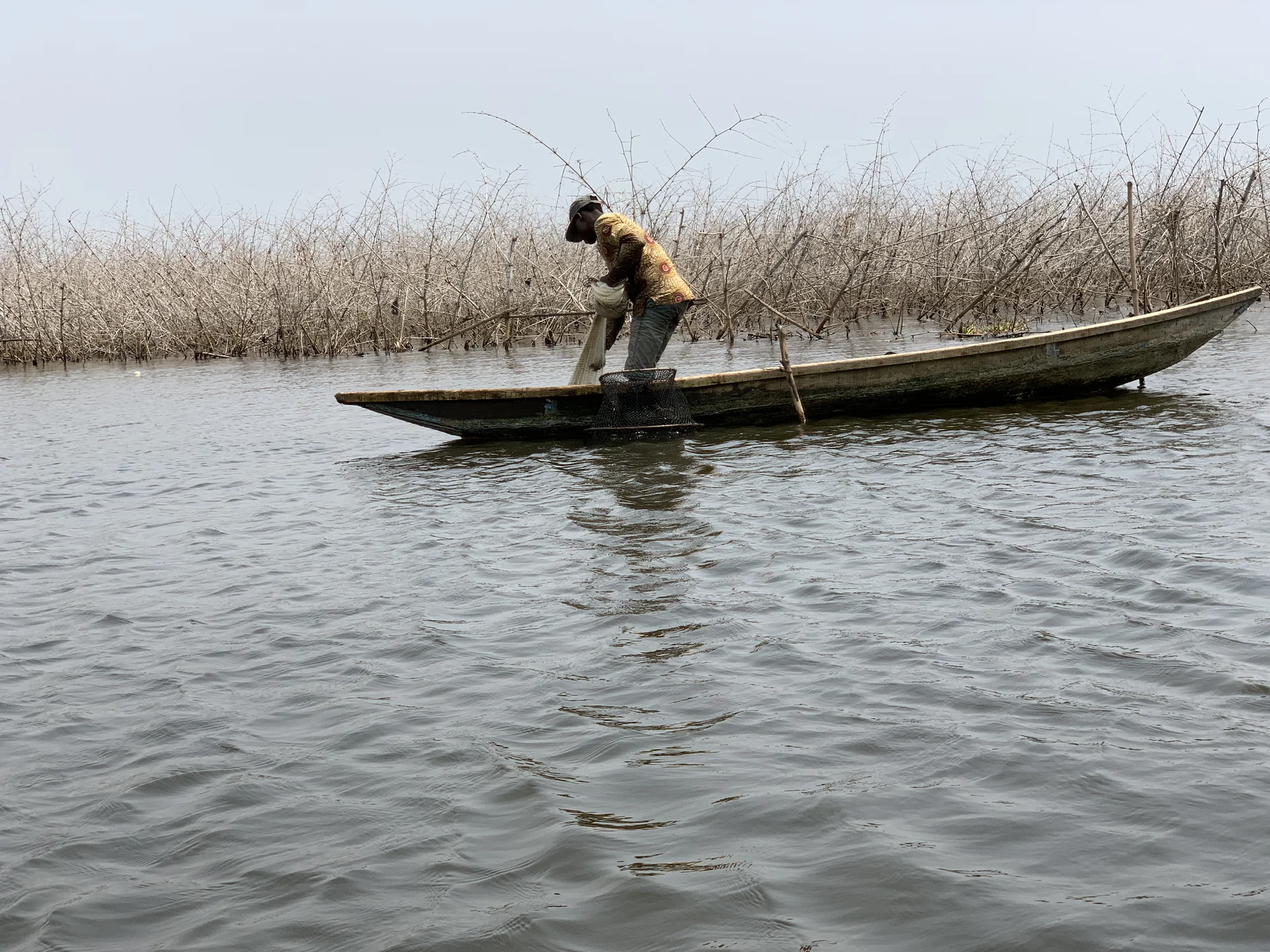
Acadja fishing is one of the world's most elegant low-tech aquaculture systems: branches planted in Lake Nokoué create artificial habitats where fish concentrate naturally. A Tofinu technique centuries old, now studied by international researchers as a model for sustainable fishing.
On Lake Nokoué, a fishing technique without equivalent anywhere in the world has been passed down through generations for centuries. It is called Acadja. It looks like nothing recognizable from conventional fishing: branches planted in the water to create artificial reefs where fish come to reproduce, feed, and concentrate naturally — before a single net sweep collects much of what has gathered.
This is not fishing in the usual sense. It is farming without enclosures, aquaculture without tanks, ecological intelligence encoded in gestures transmitted orally for three hundred years. And it is what Tofinu fishermen of Ganvié practice each morning on the waters of Lake Nokoué.
What Acadja is, exactly
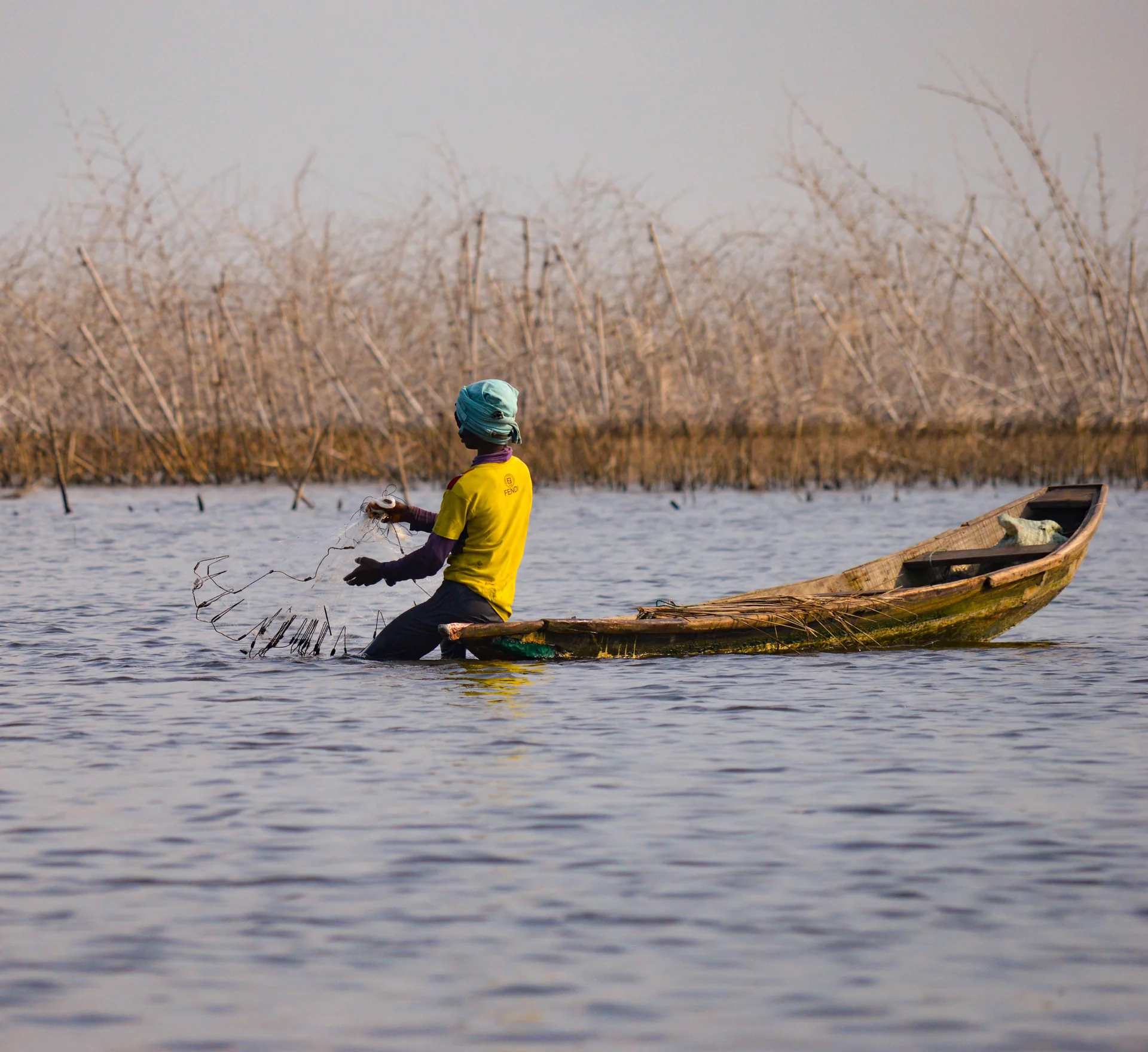 The word Acadja refers both to the technique and to the physical structure itself. Concretely: tree and shrub branches planted in the lake bed, arranged in circles or rectangles, forming a submerged vegetal barrier. An Acadja can measure anywhere from 10 to over 50 meters in diameter, depending on the fisherman's resources and the depth of the chosen site.
These branches create a miniature ecosystem in a lake that, in its natural state, offers fish very few structures to organize around. Algae colonize the submerged wood quickly. Microorganisms settle on the branch surfaces. Aquatic invertebrates — insect larvae, small crustaceans, worms — come to feed on those first residents. Fish follow the food chain.
After a few weeks, the concentration of fish inside and around the Acadja is high enough that the fisherman simply casts his nets around the structure and harvests what has gathered. The logic is reversed compared to conventional fishing: instead of chasing fish that scatter, you create the conditions that bring them together.
It is agronomic intelligence applied to water.
Where the technique comes from
 Acadja did not originate with Ganvié. The technique predates the lake city's founding and belongs to a broader Tofinu aquatic knowledge system developed probably well before the eighteenth century on the shores of Lake Nokoué.
Tofinu oral traditions associate the first Acadja with a simple observation: fish concentrate naturally around fallen trees in the water, around submerged roots, around thick stands of aquatic vegetation. The ancestors noticed the link between wood in the water and fish abundance, and they decided to reproduce that condition deliberately rather than wait for a tree to fall in the right place.
This observation — that the environment structures fish behavior — led to a system of growing sophistication. Over centuries, Tofinu fishermen refined the choice of wood species, the optimal geometries of the structures, the ideal depths, the best times to harvest. Every detail of the current technique encodes decades of practical experimentation transmitted without writing.
When the Tofinu settled on the lake to escape the slave raids of the Kingdom of Dahomey in the early eighteenth century, they brought this knowledge with them and adapted it to the specific conditions of Lake Nokoué. Acadja became the economic foundation of Ganvié — what allowed 30,000 people to live on water without depending entirely on dry land for their food.
How an Acadja is built
Constructing an Acadja is collective work that mobilizes several fishermen for two to five days, depending on the size of the planned structure. This is not improvisation — it is a project with its own sequence, materials, and rules.
Site selection is the first and most important decision. The ideal depth is between one and two meters — deep enough to submerge the branches without them breaking the surface, shallow enough for the lake bed to be reachable. Moderate current zones are preferred: the current renews oxygenated water without pulling the branches loose. Experienced fishermen know the "good zones" of Lake Nokoué through multigenerational observation.
Wood selection is a technical skill in itself. Not all wood works. You need species that resist several weeks or months in the water without decomposing too quickly, while remaining supple enough to bend with the current without breaking. Dead branches recovered from the shoreline, pruning residues from riverside trees, certain specific shrubs — these are the materials of the Acadja. What a linear economy would consider waste becomes here the foundation of a food production system.
Planting is physical work. Branches are transported by pirogue to the chosen site, then planted one by one into the lake bed by fishermen standing in the water. The structure takes shape progressively: the large perimeter branches first, defining the boundary, then the interior branches that reinforce the structure and increase the colonizable surface area for algae and microorganisms.
Maintenance is continuous. Branches rot over time and must be replaced. The fisherman visits his Acadja regularly — often every two or three days — to check the structure's condition, evaluate fish concentration, and replace degraded sections. A well-maintained Acadja can remain productive for two to four years.
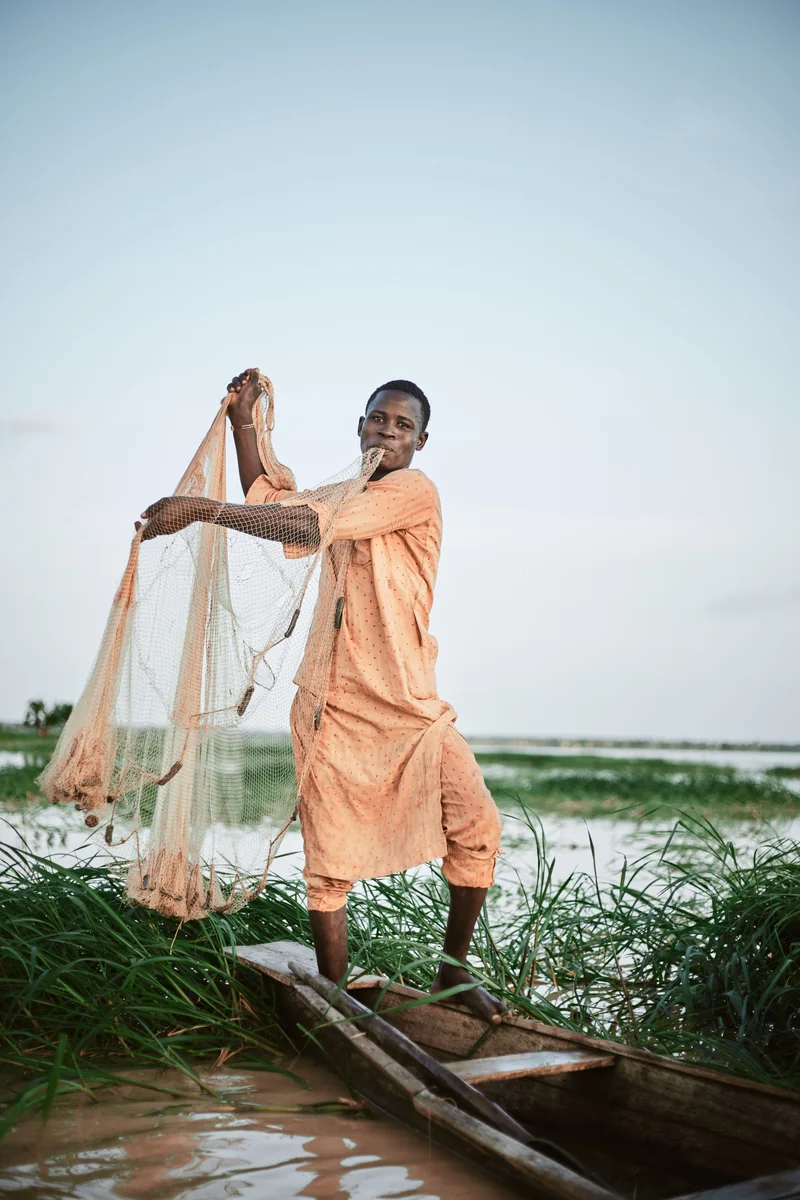
Harvest is the culmination. The fisherman casts his nets around the Acadja in a circle that progressively closes the space. Then he beats the water with a paddle to frighten fish toward the nets. A good Acadja's harvest can represent several dozen kilograms in a single pull.
Why Acadja is ecologically remarkable
Most modern fishing techniques operate on an extractive logic: you take from the natural environment and hope that reproduction compensates for what you take. Acadja operates differently.
By creating artificial habitat, Acadja actively increases the lake's carrying capacity for fish. It doesn't harvest from an existing stock; it creates the conditions for a new stock to form. The branches serve as spawning grounds for fish — adults lay their eggs there, which hatch in a protected environment. Juvenile fish find shelter from larger predators inside the Acadja structure. Species reproduce in place.
Scientific studies by the French Research Institute for Development (IRD) and the University of Abomey-Calavi have measured the biodiversity difference between Acadja zones and open lake areas. The results are clear: Acadja zones concentrate up to three times more species and biomass than the surrounding open water. This is not accelerated extraction — it is production.
The technique uses only biodegradable materials, without chemical inputs, without artificial feeding, without genetic modification. It operates within the lake's natural cycle rather than short-circuiting it.
Organizations including the FAO and the United Nations Environment Programme have documented Acadja as a model of low-impact artisanal aquaculture. International development researchers studying what they call "nature-based solutions" — technologies that amplify existing ecological processes rather than replacing them — cite Acadja regularly.
The fish species of the Acadja system
Lake Nokoué supports significant aquatic biodiversity, and Acadja preferentially attracts certain species more than others.
Tilapia is the dominant species in Acadja catches. This herbivorous and omnivorous fish feeds directly on the algae that colonize the submerged branches. Its rapid reproduction and adaptation to the lake's salinity variations make it the most abundant and sought-after species.
Nile perch (Lates niloticus, called "capitaine" locally) is a larger predator attracted by the abundance of small fish in the Acadja. Its white, firm flesh commands higher prices at Cotonou markets than tilapia.
Shrimp and crabs complement the catch, particularly during seasons when the lake's salinity increases with marine inputs. These crustaceans colonize the spaces between branches and are harvested with fine-mesh nets.
Catfish (Clarias species) are also present in Acadja structures. Their ability to breathe oxygen-depleted air lets them survive in the less well-ventilated zones of the structure where other species don't venture.
The diversity of species makes Acadja a versatile fishing system that secures the fisherman's income: if one species is less abundant in a given season, the others compensate.
The economics: who fishes and who sells
The economic chain around Acadja is a clearly gendered one. Men build, maintain, and harvest the Acadja structures. Women process and sell the catch.
After the morning harvest, women take charge of distribution. Part of the catch is sold fresh directly at the floating market. Another part is smoked or dried for multi-day preservation. Smoked fish is packaged in newspaper or leaves, transported by pirogue to Cotonou markets, and resold with a commercial margin that constitutes one of the main sources of female income in the community.
Women do not traditionally own Acadja structures in the Tofinu system, but they control the commercialization of the catch. This division of labor is balanced in a way outside observers often underestimate: without the female commercial network, the Acadja harvest could not be efficiently distributed. The fisherman and the trader are economically interdependent.
What threatens Acadja today
The Acadja technique faces several pressures that undermine its future.
Lake Nokoué's pollution is the most direct threat. Wastewater and industrial waste from Cotonou flows into the lake, reducing water quality and disrupting fish reproduction. The zones closest to the agglomeration have already recorded significant biodiversity declines.
Acadja overcrowding is a recent phenomenon. Under demographic and economic pressure, some fishermen have multiplied structures to the point where the lake lacks sufficient open space for water circulation. A lake entirely covered in Acadja is no longer a functional lake — open areas are necessary for oxygenation and natural biological cycles.
Destructive fishing competes with Acadja. Some fishermen use very fine-mesh nets that capture juvenile fish and drain natural stocks before they can rebuild. Some use chemical agents that stun fish — effective in the short term, catastrophic in the medium term.
Knowledge transmission is under pressure. Young men in Ganvié, attracted by the tourism economy or by migration to Cotonou, are less likely to learn Acadja construction and maintenance. The technique risks becoming concentrated in the hands of older fishermen without being transmitted to a sufficient new generation to maintain it at the scale necessary for the community.
Observing an Acadja during your visit
Acadja structures are visible across almost the entire surface of Lake Nokoué around Ganvié. Arriving by pirogue from the Abomey-Calavi embarcadère, you will see these circles and rectangles of branches protruding from the water. Some are recent — the branches are still green. Others are in natural decomposition and will be replaced in the coming weeks.
The best time to observe fishermen working their Acadja is in the morning, between 5:30 and 8 AM, when they cast nets or collect the night's harvest. This is also when the floating market is most active and the light on the lake is at its most beautiful.
A native guide can take you to see an Acadja up close, introduce you to a fisherman willing to explain his technique, and show you the visual difference between a fresh structure, a productive one, and one at the end of its life. It is one of the most instructive stops on a Ganvié visit — too often skipped in favor of floating market photos alone.
For more on the floating market and how the catch moves through the economy, read our article on the Ganvié floating market.
Frequently asked questions
What is an Acadja? An Acadja is a structure of branches planted in Lake Nokoué that creates an artificial habitat for fish. Algae and microorganisms colonize the wood, attracting a complete food chain. The fisherman then casts nets around the structure to harvest the concentrated fish.
Is Acadja fishing environmentally sustainable? Yes. Acadja uses biodegradable materials, increases local biodiversity, and creates spawning grounds that increase fish stocks rather than reducing them. Scientific studies show that Acadja zones concentrate up to three times more species than open water areas.
How long does an Acadja last? A well-maintained Acadja can be productive for two to four years. Maintenance is continuous: branches rot and must be replaced regularly during the fisherman's twice-weekly or weekly visits.
What is the difference between Acadja and ordinary net fishing? Ordinary net fishing pursues fish wherever they are. Acadja creates conditions for fish to gather at a specific location. The difference is between hunting and farming: a production logic rather than an extraction logic.
Can you see Acadja structures during a Ganvié visit? Yes. Acadja are visible all around Ganvié from the lake. To observe fishermen actively working their structures, you need to leave early in the morning (before 8 AM) and ideally stay overnight on the lake to access the pre-dawn market when the night's harvest is sorted and sold.
Book your visit
Guided tour with native Tofinu guide, private pirogue, fixed prices.
The Secret Guide to Ganvié: Hidden Gems & Etiquette
Discover the authentic Ganvié far from the tourist crowds. Download our exclusive PDF to prepare a respectful and unforgettable visit.
We respect your inbox. No spam.
The Visit Ganvié Team
Written by native Tofinu guides. We have navigated Lake Nokoué since childhood to share the true history of our city, far from tourist traps.
Related articles
Lake Nokoué: ecosystem, birds and aquatic life
Lake Nokoué is a rich ecosystem hosting hundreds of bird species, fish and aquatic plants. An ornithological and ecological guide around the lake city of Ganvié.
supportGanvié's floating schools: education on Lake Nokoué
Discover Ganvié's floating schools: how Tofinu children cross the lake by pirogue every morning to reach their stilt classroom, and the unique challenges of education in a lake city.