
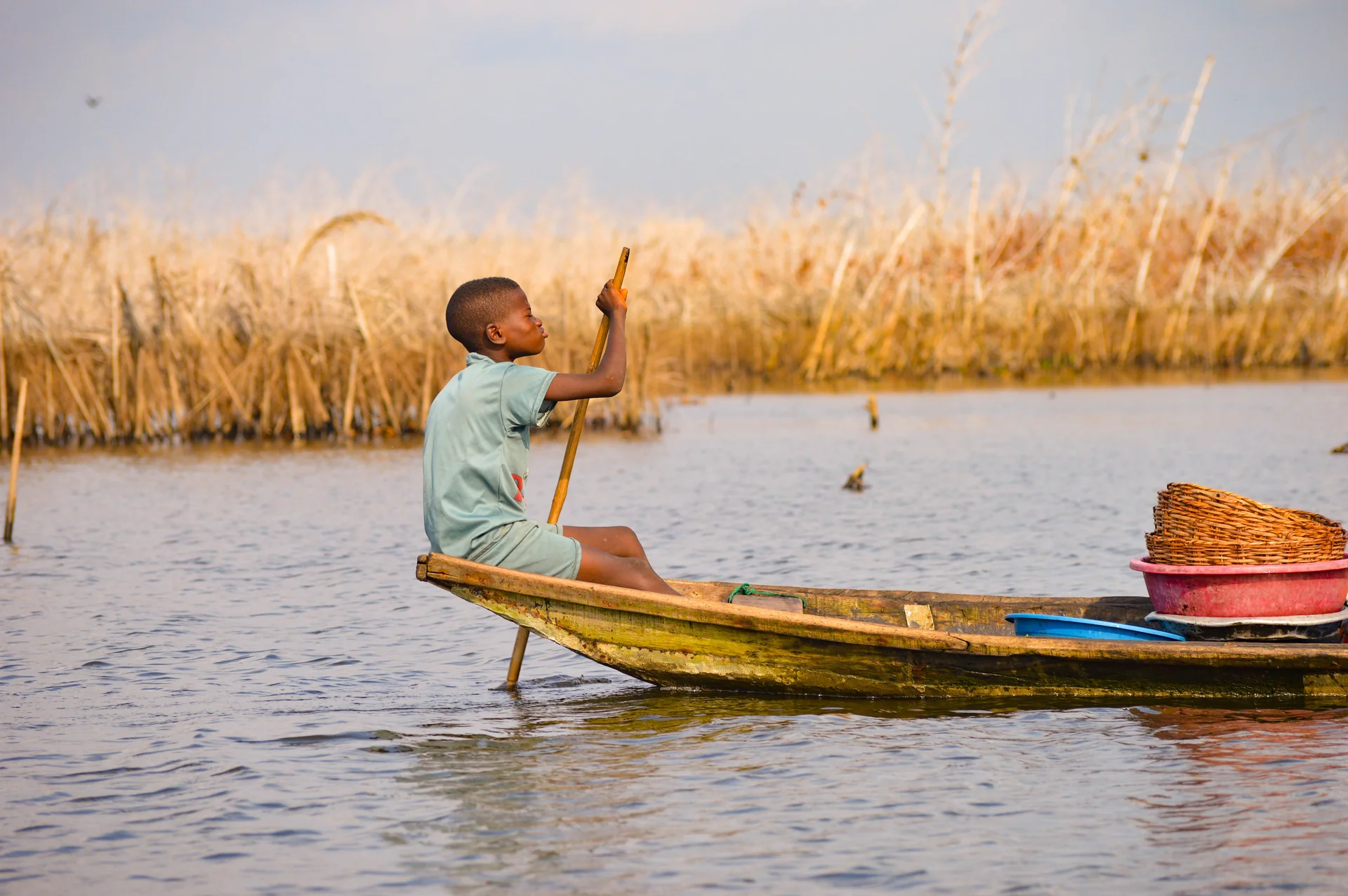
An immersive look at Ganvié daily life: waking before dawn on Lake Nokoué, the floating market, school by pirogue, Acadja fishing, community crafts, family meal and the quiet of the lake at night.
Day has not yet broken over Lake Nokoué when the first sounds announce the awakening of Ganvié. A paddle striking water. A woman's voice calling from a stilt terrace. The dull thud of a pot placed on an iron stove above a charcoal fire. Ganvié daily life begins well before dawn, and it is in full swing by the time the first visitors arrive from Cotonou.
This immersion into the everyday routines of the lake city's residents was built through sustained exchanges with Tofinu families who have lived on the water for generations. It follows the day of a resident we call Kpénanh — a composite figure that puts a face to what thousands of people experience each day on stilts above Lake Nokoué.
4:30 am: the pirogues stir
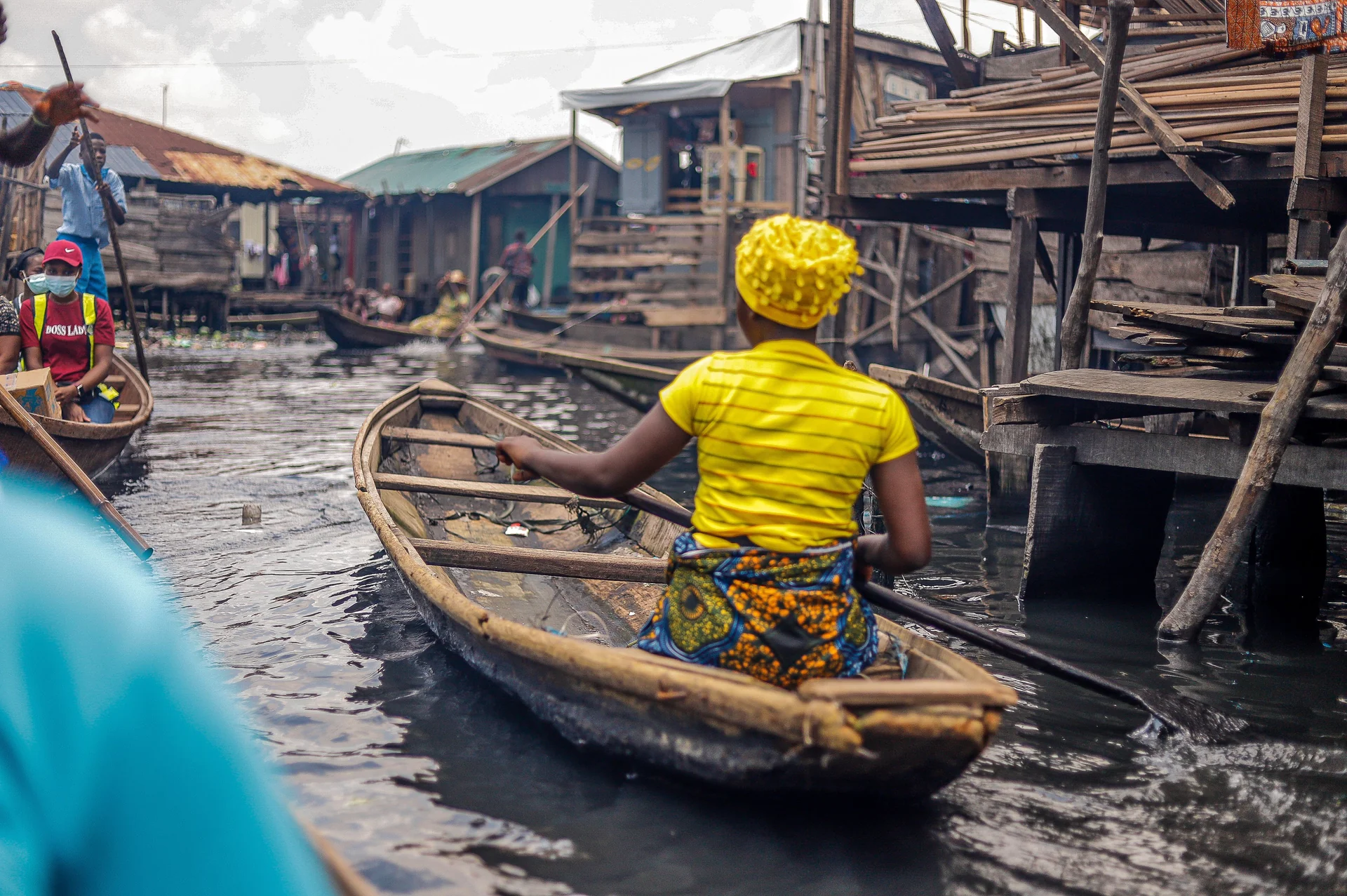 Kpénanh wakes in the dark. Her stilt house is a single room of about fifteen square metres: plank floor that rings hollow over the water below, woven bamboo walls, a corrugated iron roof that amplifies every raindrop in wet season. A charcoal stove in one corner. Three pots in graduated sizes, stacked. Rolled sleeping mats against the back wall.
There is no electricity from the national grid — it does not reach Ganvié. A solar lamp charged during the day sits on the windowsill, giving enough light to move around, not enough to read. The battery was bought two years ago, replacing the kerosene lamp that left everything smelling of fuel.
She descends the rickety wooden stairs that plunge into the lake water at low tide. Her pirogue is moored to a stilt below, tied with a braided rope. It is a working tool, not a leisure craft — four metres of iroko wood, hollowed by hand, with a paddle lying flat at the bottom and a few rags to protect goods from moisture. In the lake city, the pirogue is what the car represents on dry land: the means of doing everything, going everywhere, existing in space.
She paddles toward the main floating market area, ten minutes' rowing from her neighbourhood. Her hands know every stroke. She has been on the water since the age of seven — first with her mother, then alone at nine, then with her own children once she had them.
5:00 am: the floating market before the sun
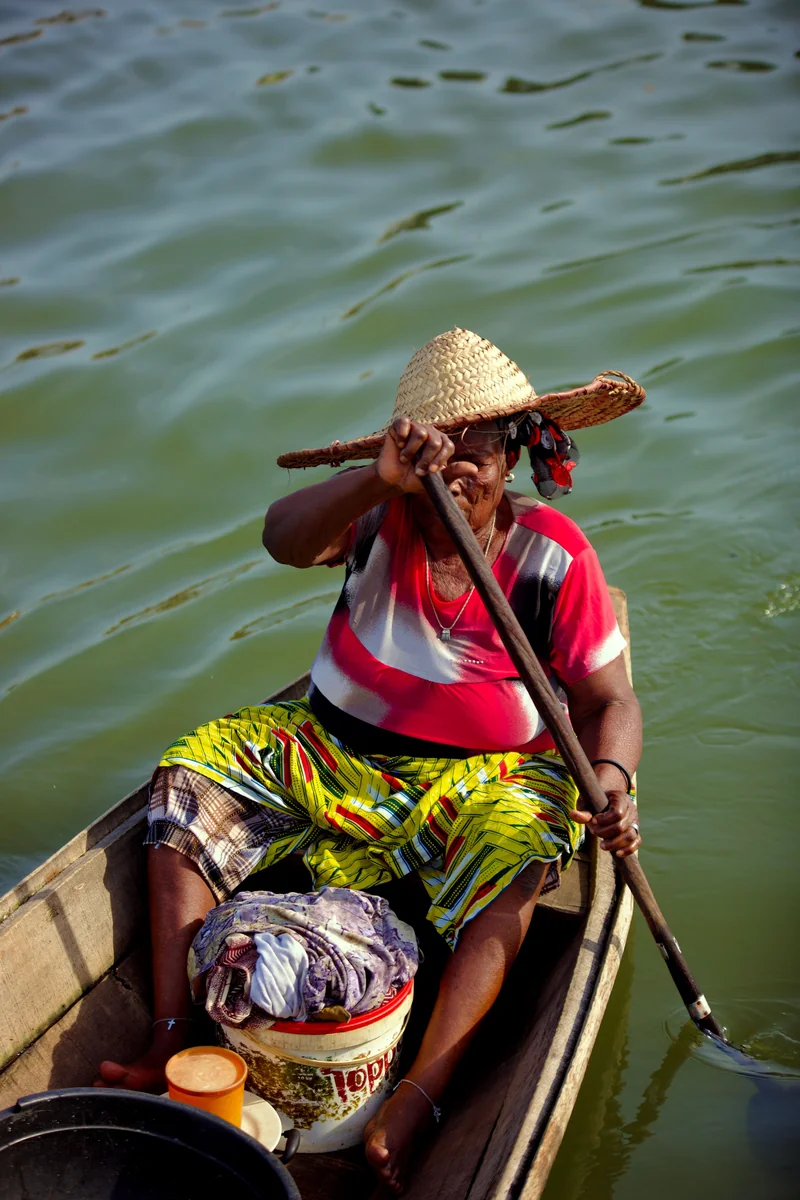 Before the sky begins to glow pink in the east, the floating market is in full swing. Dozens of pirogues converge on the same zone of the lake. The headlamps and solar lanterns of the vendors create a constellation of moving lights on the black water. The noise builds: sellers announcing their goods, paddles lapping, wooden hulls rubbing against each other.
Kpénanh is a fish seller. She buys tilapia and capitaine (Nile perch) from fishermen who have worked through the night on their Acadja — those structures of submerged branches that concentrate fish naturally. She buys wholesale, pays in cash, sorts the catch quickly by size and species. This first wholesale market, which ends before 6:30 am, is reserved for professionals. Fishermen sell fast because fresh fish cannot wait under tropical heat.
Women run the market economy. Men fish, build, and repair. Women trade, distribute, feed. This is not a written rule — it is an organization that has sediment over generations and structures the entire economy of the lake city.
To understand how the market operates and its hours, read our article on the Ganvié floating market.
6:30 am: the retail market and the first visitors
By 6:30 am, the market shifts character. The wholesale fishermen are gone. The retail market begins — the one visitors arriving by pirogue from Cotonou at 7 am will see.
Hundreds of additional pirogues arrive, loaded with goods from the mainland redistributed across the lake. Tomatoes from northern farms. Onions and chillies from Dantokpa market, re-routed by water. Sachets of akara (bean fritters) prepared since before dawn by women who cook for a living. Bunches of plantain, yams, cassava, leafy greens.
Kpénanh now sells retail — the same fish she bought wholesale two hours earlier, sometimes portioned, always fresh, at a price that leaves her a margin after purchase costs and transport. Her nearest competitor is three pirogue-lengths away. They have known each other since childhood.
4:30 am Wake up and prepare. 5:00 am Wholesale fish market. 6:30 am Retail market opens. 7:30 am Return home, children leave for school. 8:00 am Domestic work and house maintenance. 12:00 pm Main meal. 2:00 pm Rest or collective crafts. 4:00 pm Children return from school. 6:00 pm Dinner preparation, last light on the lake. 7:00 pm Family meal. 8:00 pm Evening gathering, sleep.
7:30 am: school by pirogue
The sun has been up for an hour. The children of Ganvié are getting ready for school. Some leave by pirogue, others take the wooden walkways that connect the stilt houses of their neighbourhood.
Ganvié's school is not floating — it sits on a tongue of land at the eastern edge of the city. Every morning, clusters of pirogues loaded with children cross the lake to reach the classroom. The youngest travel with a parent or an older sibling. The older children — from around seven or eight years old — paddle alone, in groups of three or four, following channels they have known since they were old enough to hold a paddle.
Kpénanh, back from the market, sends her eight-year-old son from the family landing. She checks his bag, reminds him to come back before the rain, and watches him disappear with the other children from the neighbourhood. It is a daily scene at Ganvié — the school pirogue, which startles visitors, is for residents simply how you go to class.
The school commute by pirogue is not without risk. Drowning accidents happen, even though lake children learn to swim very early. Families have their own rules: life vests for the youngest, established routes, neighbours who watch the boats passing.
8:00 am: the work of the morning
Back at the house, Kpénanh does what women of Ganvié have done every morning since they became women of Ganvié.
Laundry first. She descends to the stairway that dips into the lake and washes the clothes in lake water. The water is not drinkable, but it serves for everything that doesn't enter the body: laundry, dishes, cleaning the floor. For drinking and cooking, Ganvié residents buy water in 20-litre canisters delivered by pirogue from the mainland — a regular, fixed cost that represents a meaningful share of the budget for the most modest families.
Then the housework. The plank floor is scrubbed with soapy water. The sleeping mat is shaken and aired on the terrace. The charcoal stove is cleared of yesterday's ash, fresh charcoal arranged for the midday meal. The bamboo walls are checked — a loose plank, a widening gap, repaired with whatever is on hand.
In a stilt house, maintenance is constant and no service team will come. Wood rots fast under permanent humidity. The iron sheets rust and let rain through if not replaced in time. The stilts themselves need periodic inspection — a rônier palm stilt holds for several decades, but not forever.
10:00 am: crafts and the social life of the lake
Some mornings, Kpénanh joins other women from the neighbourhood under the awning of a neighbour's house. They weave mats from rônier palm fibres together, or plait bamboo baskets. Hands stay busy while conversations move in all directions — fish prices this week, family news, weather forecasts, a husband's plans.
This moment of collective work is not purely economic. It is the social network of the lake city. Important neighbourhood decisions are often made in these informal groups, transmitted through the women whose knowledge of the community's fabric is finer than any administration's.
Elsewhere in Ganvié, the men work to their own rhythm. A pirogue builder can spend three weeks hollowing an iroko trunk to extract a functional hull. The axe, the wood chisel, the fire to scorch the walls — gestures passed from father to son, without a written plan or measurement, for generations.
12:00 pm: the midday meal
Lunch is the main meal of the day. Not for abstract cultural reasons — simply because the women have been up since 4:30 am and the afternoon heat is coming, and now is when a substantial pause is needed.
Kpénanh prepares a tomato sauce with smoked fish. The tomatoes and chillies came from the morning market. The smoked fish comes from her own catch of the previous week, dried and preserved. The dish is served with attiéké — a pleasantly acidic fermented cassava couscous — or with pounded yam depending on what remains in the larder.
The family eats seated on a mat, around the single dish placed in the centre. Right hands serve as utensils. The fish is shared, each person taking their portion according to the family's tacit hierarchy. The conversation is quiet, sometimes silent.
2:00 pm: the afternoon lull
The afternoon heat slows everything on the lake as on the land. Ganvié has its quiet hours like every tropical city. Some nap. Others repair a fishing net in the shade of a terrace, sort dried fish, mend a torn cloth.
This is the hour of repairs and preparations. The fisherman who pulled his catch this morning is fixing his Acadja structure this afternoon so it is operational tomorrow. Women prepare the next morning's goods — fish to smoke, vegetables to sort, water canisters to order.
A pirogue drifts sometimes from one house to the next in this calm. Neighbours call out softly from terrace to terrace. The lake surface mirrors the sky.
4:00 pm: the children return
The school pirogues come back. The neighbourhood wakes again. Children return, drop their bags, tell their day. Kpénanh gives her son practical tasks: carry a water canister from the delivery point, put away the sleeping mats, feed the chickens.
Chickens. This is one of the things visitors don't expect to see in Ganvié: livestock on raised platforms above the water. Hens in bamboo cages under the staircases. Goats sometimes, on wider platforms. Some families even keep pigs on specially built structures. Dry land is twenty minutes away by pirogue, but life with animals is organized on the water too.
This return of the children is the noisiest hour of the day. Play shouts mix with mothers' calls. Children dive from staircases and terraces — into water that represents for them the street, the yard, and the swimming pool all at once. They know how to swim before they know how to read.
6:00 pm: the last light on the lake
When the sun drops over Lake Nokoué, Ganvié transforms. The colours shift from the white of afternoon to gold, then copper, then a deep violet before night takes over. This is the hour photographers have tried to capture from their tourist pirogues for decades.
But the residents of Ganvié do not watch this sunset as a spectacle. They are inside it. Kpénanh prepares dinner against this backdrop without particularly watching it. It is the sky of every evening. It is home.
Cooking smoke rises from the tin roofs. Pirogues come back one by one — fishermen returning from their Acadja, vendors who spent the afternoon in Cotonou restocking. The channels fill briefly, then empty.
7:00 pm: evening gathering
Night falls fast under the tropics. Solar lamps light up one by one inside the houses. Conversations carry from one house to the next across calm water — the lake surface transmits sound in a way that dry land does not. You can hear neighbours two houses away as clearly as if they were in the same room.
The evening meal is lighter. A fish soup with rice. Akara (fried bean fritters) bought from the neighbourhood food pirogue. Fruit. Kpénanh's son does his homework under the solar lamp balanced on the window ledge. Her husband talks with a neighbour seated on the adjacent terrace, in low voices, about something that has concerned them both for a week: the state of one of their Acadja structures that has been deteriorating for the past month and will need to be replaced soon.
The children go to bed early. The adults stay up a little longer — not long, because 4:30 am comes fast, and the day in Ganvié restarts before the rest of the world is even awake.
4:30 am: and the cycle restarts
Kpénanh falls asleep to the sound of the lake. The stilts creak softly under the house's weight and the movements of the water. A pirogue passes in the distance, its motor barely audible. The water laps at the wood.
In a few hours, everything will start again. The solar lamp in the dark. The wooden staircase. The pirogue moored below. The journey to the market before dawn. Ganvié daily life is made of repeated cycles, gestures transmitted across generations, a social organization built over centuries on the water of Lake Nokoué.
What you see when you visit Ganvié — the market, the canals, the pirogues, the stilt houses — is the backdrop to this life. The life itself is less visible. It happens in the hours that tourist circuits don't cover.
Living Ganvié, not just seeing it
This immersion in Tofinu daily life is an invitation to look at Ganvié differently. Behind the photos of stilt houses are real lives with their concerns, joys, routines, and fragilities. To get close to this reality, spend a night on the lake. The conversations that open in the evening, with residents who have finished their working day, have no equivalent in a three-hour excursion.
Experience Ganvié in full immersion
Circuit with a native guide to go beyond the standard tourist loop and understand daily life in the lake city.
Questions fréquentes
How do Ganvié residents get drinking water?
Do stilt houses have electricity?
How do children get to school in Ganvié?
What jobs do Ganvié residents do?
How does waste management work in Ganvié?
Book your visit
Guided tour with native Tofinu guide, private pirogue, fixed prices.
The Secret Guide to Ganvié: Hidden Gems & Etiquette
Discover the authentic Ganvié far from the tourist crowds. Download our exclusive PDF to prepare a respectful and unforgettable visit.
We respect your inbox. No spam.
The Visit Ganvié Team
Written by native Tofinu guides. We have navigated Lake Nokoué since childhood to share the true history of our city, far from tourist traps.
Related articles
Lake Nokoué: ecosystem, birds and aquatic life
Lake Nokoué is a rich ecosystem hosting hundreds of bird species, fish and aquatic plants. An ornithological and ecological guide around the lake city of Ganvié.
supportGanvié's floating schools: education on Lake Nokoué
Discover Ganvié's floating schools: how Tofinu children cross the lake by pirogue every morning to reach their stilt classroom, and the unique challenges of education in a lake city.