
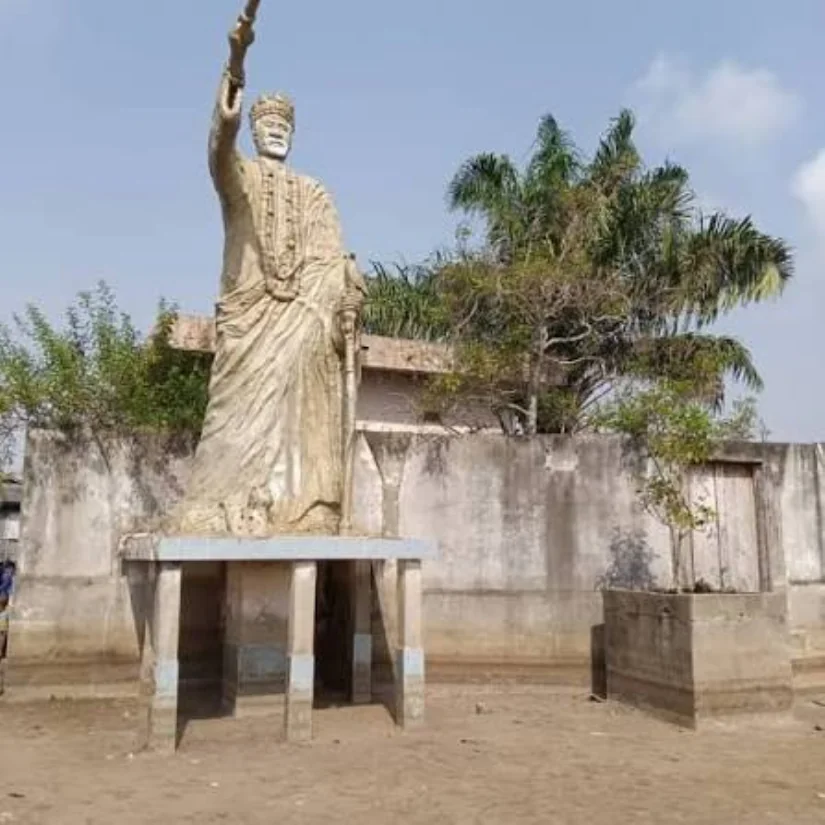
The statue of King Agbodogbé stands on Ganvié's royal square. It embodies the legend of the founder who transformed into a hawk then a crocodile to save his people from Dahomey's slave raids in 1717.
On Ganvié's royal square, at the heart of the stilt village, a statue stands watch. It depicts King Agbodogbé, founder of Ganvié in 1717. His gaze is fixed on Lake Nokoué — the body of water that saved his people and that no enemy army ever managed to cross. This statue is not a tourist monument erected for passing visitors. It is an act of collective memory, maintained by a community that knows precisely what it owes to this man.
To understand why King Agbodogbé occupies such a central place in Tofinu identity, you need to understand the circumstances in which he made his decisions. This is not simply a legend. It is a survival strategy that worked for three centuries.
Who Agbodogbé was before becoming a legend
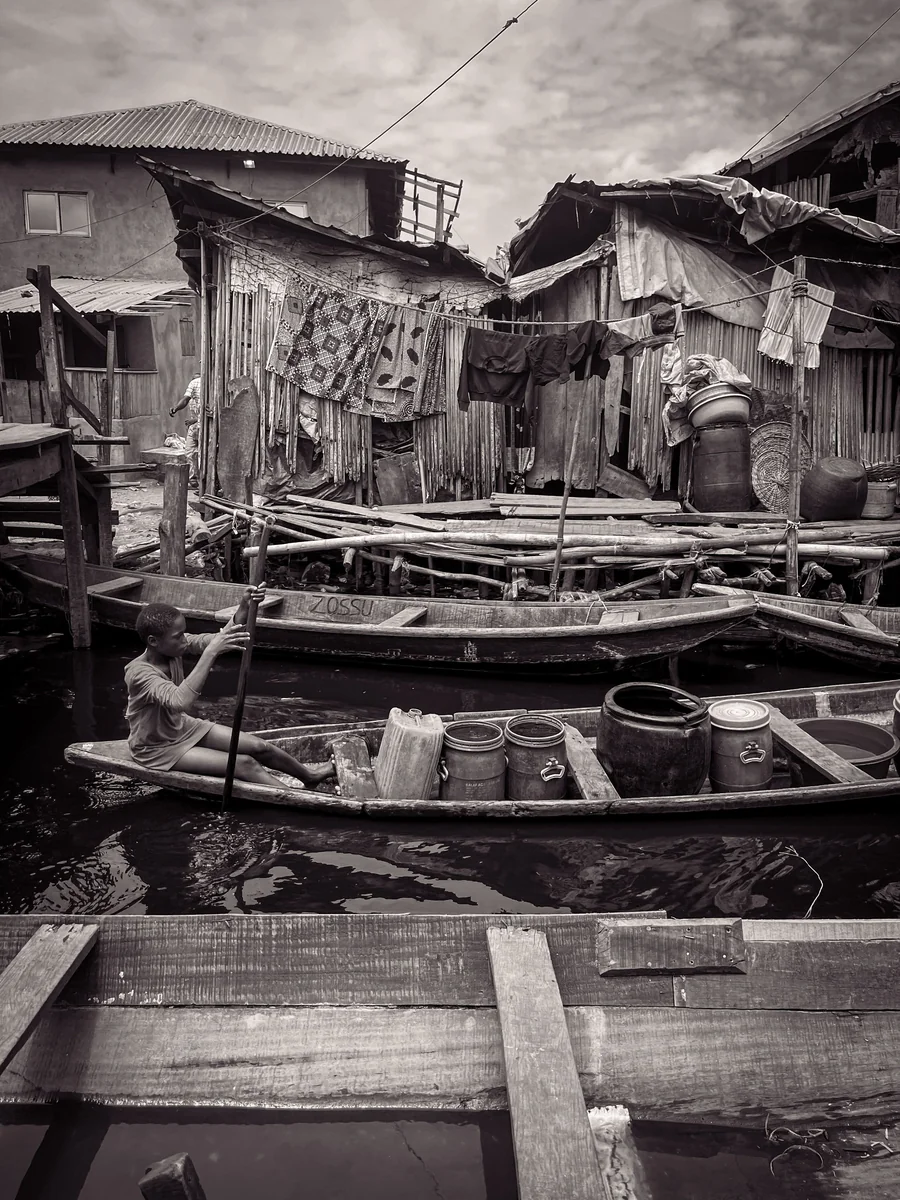 Tofinu oral tradition describes Agbodogbé as a king of considerable power in vodun — a man capable of mobilizing forces his adversaries could not understand or anticipate. Before arriving at the edge of Lake Nokoué, he led a Tofinu community established along the banks of the Sô River, in the inland plateau of what is now southern Benin.
The Tofinu of that period were not rootless refugees. They knew the lake from long experience — they fished in it, navigated it, and had transmitted precise knowledge of its depths, shallow zones, and seasonal currents across generations. This knowledge would prove decisive in the years that followed.
But by the early eighteenth century, the pressure from the Kingdom of Abomey had become unbearable. The Dahomey kings had built an organized war economy around the capture of slaves destined for the European traders stationed at Ouidah. The slave raids were not opportunistic — they were planned, ordered from above, with quotas to fill. For communities across the region, the threat was constant.
Why the lake: the logic behind the legend
The decision to settle on Lake Nokoué was not spontaneous. It was the result of a precise analysis of the military situation.
The Kingdom of Abomey prohibited its soldiers from fighting on water. This was not a tactical weakness but a religious rule embedded in the cosmology of the kingdom. The Fon considered certain aquatic environments to be the domain of deities that must not be disturbed. Dahomey's armies, formidable on land, refused to engage on the lake.
Agbodogbé — or his advisers — had identified this gap. The lake was not only a fishing ground. It was the only boundary that Abomey's armies would not cross. Settling there permanently meant turning an enemy war rule into absolute protection.
This decision is more strategic than mystical. The transformation into a hawk and a crocodile that the legend recounts encodes this reality: the king used aerial reconnaissance to scout terrain, and water transport to move an entire people to safety. The legend names the competencies required, not gratuitous magical powers.
The statue on the royal square
Ganvié's royal square is the political and ceremonial center of the city. It is where clan chiefs meet, where important decisions are made for the community, and where rites of passage and integration ceremonies take place. The statue of Agbodogbé is its focal point.
The statue shows a king standing upright, in a posture that suggests both authority and rootedness. It is visible from the main canals of the village. Local guides consistently include it in their tours because it is the natural convergence point for all the narratives about the founding of the village.
What strikes visitors is the contrast between the location — a city built on water, with no dry ground underfoot — and a statue of a man standing firm on the square's surface. This paradox is deliberate. It says something essential: even on water, the Tofinu have a homeland, a center, an authority. The statue of Agbodogbé is that center.
For visitors, stopping in front of the statue with a local guide changes the quality of the experience. The guide does not read from a plaque. He tells the story. And what he tells is a story he received from another guide, who received it from an elder, who received it from a father. The chain of transmission is alive.
The spelling of the name: Agbodogbé or Agbogdobé?
Anyone who tries to document the founding king of Ganvié seriously will quickly encounter a persistent spelling variation. Sources write Agbodogbé, Agbogdobé, Agbogboé, sometimes Agbod'ogbé.
This variability is not a sign of historical confusion. It is the visible trace of oral transmission over three centuries. The Tofinu language, a variant of Goun, had no standardized orthography at the time of Ganvié's founding. Each researcher, journalist, or guide who transcribed the name made slightly different phonetic choices based on their own native language, their level of familiarity with Goun, and their listening instruments.
The two most common forms — Agbodogbé and Agbogdobé — refer to the same figure, the same legend, the same date of 1717. These are not two distinct kings or two contradictory stories. This is oral tradition's signature in written form.
Tê-Agbanlin: the confusion that should not be perpetuated
A persistent error in online content sometimes attributes the founding of Ganvié to Tê-Agbanlin. This confusion deserves clear correction.
Tê-Agbanlin is the founder of the Kingdom of Xogbonu, which became Porto-Novo, the current capital of Benin. His story is well documented: after a succession dispute within the Kingdom of Allada, he migrated south, passed through several localities — including areas near Ganvié — and eventually established his power over lands then occupied by Yoruba populations. Ganvié was only a geographic stopping point on his journey, not his destination or the seat of his power.
The confusion arises from the temporal and geographic proximity of the two stories. Same century, same region, same dynamic of flight from the dynastic conflicts of Allada and Dahomey. On less rigorous travel websites, these two royal histories were merged.
Agbodogbé founded Ganvié. Tê-Agbanlin founded Porto-Novo. Two kings, two kingdoms, two distinct founding legends.
The sacred crocodile: from legend to living practice
Agbodogbé's transformation into a crocodile is not merely a narrative metaphor. It has practical consequences on life in Ganvié that persist to this day.
In Tofinu and vodun cosmology, the crocodile that carried the ancestors on its back is an allied being, not a predator to be feared. It entered into a relationship of reciprocal debt with the Tofinu people: it carried them across, they honor it. This symbolic contract translates concretely into a prohibition against hunting or killing crocodiles in the waters of Lake Nokoué.
Crocodiles are still present in the lake. When one approaches a residential zone, the Tofinu response is calm observation rather than alarm — a recognition of its presence. Elders may interpret a crocodile sighting as a sign worth reading, a visit from an ancestral presence.
This attitude has measurable ecological effects. Crocodile populations in Lake Nokoué have been less decimated than those in other water bodies in the region, precisely because a cultural rule has functioned as a protection mechanism for three centuries.
What the statue transmits to new generations
For the children of Ganvié who grow up within sight of the statue of Agbodogbé, it is a permanent lesson about identity.
It says: your people nearly ceased to exist. They did not. The decision made by this man at the edge of the lake — the decision to cross — is the reason you are here. Every stilt house, every pirogue, every Acadja in the lake is the continuation of that choice.
This memory is not read in books in Ganvié. It is seen in the statue, heard in the guides' stories, practiced in the respect for the crocodile, and in the way the lake is still managed collectively across lineage lines.
To explore the legend and its historical context in full detail, read our complete article on Agbodogbé, the king who became a crocodile. To understand the Dahomey raids that triggered the founding, read our article on Abomey's raids and the flight to Lake Nokoué.
Questions fréquentes
Where is the statue of King Agbodogbé in Ganvié?
When did Agbodogbé found Ganvié?
Why is Agbodogbé associated with the crocodile?
What is the difference between Agbodogbé and Tê-Agbanlin?
The Secret Guide to Ganvié: Hidden Gems & Etiquette
Discover the authentic Ganvié far from the tourist crowds. Download our exclusive PDF to prepare a respectful and unforgettable visit.
We respect your inbox. No spam.
The Visit Ganvié Team
Written by native Tofinu guides. We have navigated Lake Nokoué since childhood to share the true history of our city, far from tourist traps.
Related articles
Tofinu glossary: essential lexicon of lake life
Complete lexicon of Tofinu, Goun and Fon words to understand lake life at Ganvie. Housing, fishing, navigation, spirituality, cuisine: essential vocabulary before your visit.
edgeLake Nokoue before Ganvie: geography, origins and ecosystem
Before becoming the cradle of Ganvie, Lake Nokoue was a vast lagoon system teeming with fish. A look at the geographical origins and unique ecosystem of this exceptional lake.